
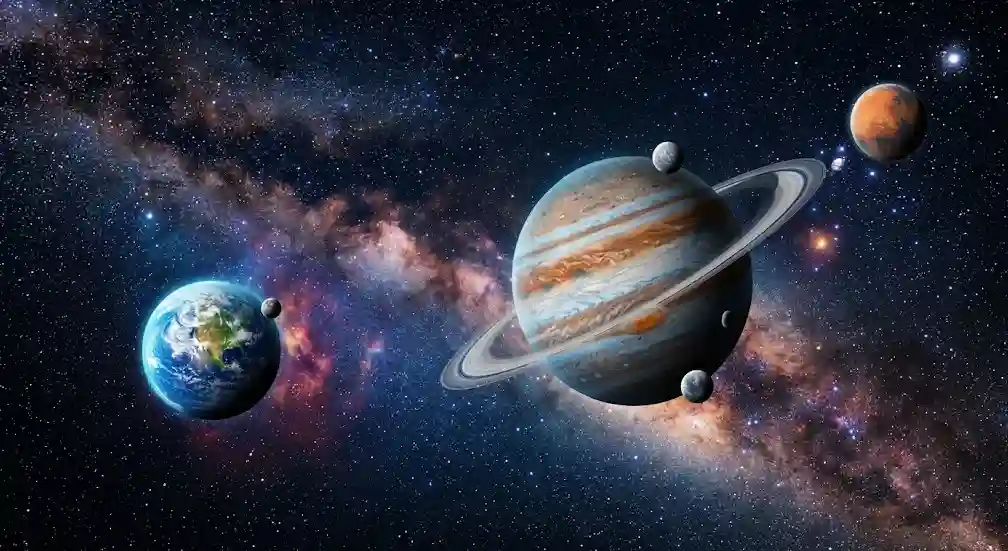
Explore 100 fact-checked facts about space, from planets and black holes to the Milky Way and the ISS, with NASA and ESA sources and live data from our trackers.
Updated: October 13th 2026
Live: The ISS Right Now
Updates every 10 seconds. See the ISS on the live map or find out when it passes over your city.
Solar System Facts
1. The Solar System is about 4.6 billion years old
It formed from a collapsing cloud of gas and dust. The Sun formed first, and the planets formed from the leftover material.
2. The Sun holds 99.86% of all mass in the Solar System
Everything else, including all planets, moons and asteroids, shares the remaining 0.14%.
3. There are eight planets, not nine
Pluto was reclassified as a dwarf planet in 2006 by the International Astronomical Union because it has not cleared its orbit of other objects.
4. Sunlight takes about 8 minutes and 20 seconds to reach Earth
The Sun is roughly 150 million kilometers away. You always see the Sun as it was a little over 8 minutes ago.
5. One astronomical unit (AU) is about 150 million kilometers
That is the average distance between Earth and the Sun, or about 93 million miles. Astronomers use it to measure distances inside the Solar System.
6. Jupiter is more than twice as massive as all other planets combined
It is so large that more than 1,300 Earths would fit inside it.
7. The four inner planets are rocky, the four outer planets are giants
Mercury, Venus, Earth and Mars have solid surfaces. Jupiter and Saturn are gas giants. Uranus and Neptune are ice giants.
8. The asteroid belt weighs less than the Moon
The belt between Mars and Jupiter holds millions of asteroids, but their combined mass is only about 3% of the Moon’s mass.
9. Pluto is smaller than Earth’s Moon
Pluto is about 2,377 km wide. The Moon is about 3,474 km wide.
10. Neptune takes 165 Earth years to orbit the Sun once
Neptune was discovered in 1846. It completed its first full orbit since then in 2011.
11. The Kuiper Belt is a ring of icy bodies beyond Neptune
It stretches from about 30 AU to about 50 AU from the Sun. Pluto is its best-known object.
12. The Oort Cloud is a theorized shell of icy objects at the edge of the Solar System
It may start about 2,000 AU from the Sun and extend up to 100,000 AU. No spacecraft has reached it, and it has never been directly observed.
13. Voyager 1 is the most distant human-made object
Launched in 1977, it entered interstellar space in 2012 and is now more than 25 billion kilometers from Earth.
14. The Solar System orbits the center of the Milky Way every 230 million years
The last time we were in this spot, dinosaurs were just appearing on Earth.
Planets & Moons Facts
15. Mercury and Venus are the only planets with no moons
Every other planet in the Solar System has at least one moon. Mars has two, and Earth has one.
16. Mercury is the smallest planet, only slightly bigger than Earth’s Moon
Mercury is about 4,879 km wide. The Moon is about 3,474 km wide.
17. A day on Venus is longer than its year
Venus takes about 243 Earth days to rotate once, but only about 225 Earth days to orbit the Sun.
18. Venus is the hottest planet, even though Mercury is closer to the Sun
Surface temperature on Venus is about 465 °C. Its thick carbon dioxide atmosphere traps heat.
19. Olympus Mons on Mars is the tallest volcano in the Solar System
It is about 22 km high, roughly 2.5 times the height of Mount Everest above sea level.
20. Mars is red because of rust
The surface dust contains iron oxide, the same compound that makes rust on Earth.
21. Jupiter’s Great Red Spot is a storm that has been observed for more than 150 years
The storm is wider than Earth, but it has been shrinking over time.
22. Saturn is less dense than water
Saturn is made mostly of hydrogen and helium. In theory, it would float in a bathtub large enough to hold it.
23. Uranus rotates on its side
Its axis is tilted about 98 degrees, so it rolls around the Sun instead of spinning upright like most planets.
24. Neptune has the fastest winds in the Solar System
Wind speeds on Neptune can exceed 2,000 km/h, faster than the speed of sound on Earth.
25. Neptune’s moon Triton orbits the planet backwards
Triton is the only large moon in the Solar System with a retrograde orbit. It was probably captured from the Kuiper Belt.
26. Io, a moon of Jupiter, is the most volcanically active body in the Solar System
It has more than 400 active volcanoes, and some eruptions throw lava hundreds of kilometers into the air.
27. Ganymede, a moon of Jupiter, is bigger than the planet Mercury
Ganymede is about 5,268 km wide, making it the largest moon in the Solar System. Mercury is still heavier.
28. Titan is the only moon with a thick atmosphere and liquid on its surface
Saturn’s moon Titan has lakes and rivers of liquid methane and ethane, and its air pressure is higher than on Earth.
29. The Moon is moving away from Earth by about 3.8 cm every year
Measurements from mirrors left on the Moon by Apollo astronauts confirm this.
Facts About the Sun & Stars
30. The Sun is a yellow dwarf star about halfway through its life
It is about 4.6 billion years old and has roughly 5 billion years of fuel left. Astronomers classify it as a G-type main-sequence star.
31. The Sun’s core is about 15 million °C
That heat and pressure fuse hydrogen into helium, which powers the Sun.
32. The Sun’s surface is about 5,500 °C
That is far cooler than its core, but still hot enough to melt every known material.
33. The Sun’s outer atmosphere is much hotter than its surface
The corona reaches over a million degrees Celsius. Scientists are still studying why it is so much hotter than the surface below it.
34. About 1.3 million Earths would fit inside the Sun
The Sun is about 109 times wider than Earth.
35. The Sun does not rotate at the same speed everywhere
It spins once every 25 Earth days at the equator, but takes about 36 days at the poles, because it is not solid.
36. The Sun turns about 4 million tonnes of matter into energy every second
This happens through nuclear fusion in the core.
37. Sunlight takes tens of thousands of years to get out of the Sun
Energy made in the core bounces around inside the Sun for a very long time before it reaches the surface. After that, it takes just over 8 minutes to reach Earth.
38. The Sun will become a red giant in about 5 billion years
It will swell up and swallow Mercury and Venus. Earth may be swallowed too, or become too hot for life.
39. Proxima Centauri is the closest star to the Sun
It is about 4.24 light-years away, which is roughly 40 trillion kilometers.
40. Most stars in the Milky Way are red dwarfs
Red dwarfs are small and dim, and none of them can be seen with the naked eye. They can burn for trillions of years.
41. Betelgeuse is so big it would reach beyond Mars if it replaced the Sun
It is a red supergiant in the constellation Orion, hundreds of times wider than the Sun.
42. A teaspoon of neutron star would weigh about a billion tonnes
Neutron stars are the collapsed cores of massive stars. They pack more mass than the Sun into a ball about 20 km wide.
43. Most elements heavier than helium were made inside stars
The carbon in your body and the iron in your blood were made in stars and stellar explosions billions of years ago.
44. Stars twinkle because of Earth’s atmosphere
Moving air bends the starlight on its way down. Planets twinkle much less because they look like small discs, not points of light.
Milky Way & Galaxy Facts
45. The Milky Way is a barred spiral galaxy
It has a central bar of stars with spiral arms winding out from it. Our Sun sits in a smaller arm called the Orion Spur.
46. The Milky Way holds between 100 and 400 billion stars
Nobody knows the exact number, because dust hides much of the galaxy and many stars are too faint to count.
47. The Milky Way is about 100,000 light-years across
Light takes 100,000 years to travel from one edge of the galaxy to the other.
48. The Sun is about 26,000 light-years from the center of the galaxy
We live roughly halfway out from the center, in the galactic disk.
49. A supermassive black hole sits at the center of the Milky Way
It is called Sagittarius A* and has a mass of about 4 million Suns. The first image of it was released in 2022.
50. Andromeda is the nearest large galaxy to the Milky Way
It is about 2.5 million light-years away and is the farthest object most people can see with the naked eye, from a dark location.
51. Andromeda is moving toward the Milky Way
The two galaxies may collide and merge in several billion years. The exact timing is still uncertain, and stars would almost never hit each other because of the huge distances between them.
52. The observable universe is about 93 billion light-years across
The universe is about 13.8 billion years old, but space has expanded while light has been traveling, so the observable part is larger than 13.8 billion light-years in radius.
53. There are hundreds of billions of galaxies in the observable universe
Estimates range from about 200 billion to 2 trillion, and they keep changing as telescopes improve.
54. Looking at distant galaxies means looking back in time
Light from a galaxy 10 billion light-years away left it 10 billion years ago. The James Webb Space Telescope has seen galaxies as they were only a few hundred million years after the Big Bang.
55. Ordinary matter makes up only about 5% of the universe
About 27% is dark matter and about 68% is dark energy. Scientists can measure their effects, but do not yet know what they are.
56. The universe is expanding, and the expansion is speeding up
Distant galaxies are moving away from us faster over time. Dark energy is the name given to whatever is driving this.
57. The Milky Way has smaller satellite galaxies
The Large and Small Magellanic Clouds are the best known. They are visible to the naked eye from the Southern Hemisphere.
58. The Milky Way has grown by absorbing smaller galaxies
Astronomers have found streams of stars in our galaxy that came from galaxies that were pulled apart long ago.
Black Hole Facts
59. A black hole is a region where gravity is so strong that nothing can escape, not even light
It forms when a huge amount of matter is squeezed into a very small space.
60. The event horizon is the point of no return
Anything that crosses this boundary, including light, cannot get back out. The black hole itself is not a surface, but the edge of the region you cannot leave.
61. Most black holes form when massive stars collapse
When a star much bigger than the Sun runs out of fuel, its core collapses and the outer layers explode in a supernova. What remains can be a black hole.
62. Black holes come in three main sizes
Stellar black holes weigh a few to dozens of Suns. Intermediate ones weigh hundreds to thousands. Supermassive black holes weigh millions to billions of Suns.
63. The first image of a black hole was released in 2019
The Event Horizon Telescope captured the black hole at the center of galaxy M87, about 55 million light-years away.
64. The nearest known black hole is about 1,560 light-years away
It is called Gaia BH1 and was found in 2022 because it makes a Sun-like star next to it wobble.
65. Black holes do not suck up everything around them
If the Sun became a black hole of the same mass, Earth would keep orbiting just as before. It would only get dark and cold.
66. Time runs slower near a black hole
Strong gravity slows time. To a distant observer, a clock near a black hole ticks more slowly than a clock far away.
67. Falling into a black hole would stretch you out
Gravity pulls harder on your feet than on your head if you fall in feet first. Scientists call this effect spaghettification.
68. Black holes can slowly lose energy
Stephen Hawking showed in 1974 that black holes should give off tiny amounts of radiation and could eventually evaporate. This has never been observed, and for large black holes it would take far longer than the age of the universe.
69. Supermassive black holes can power the brightest objects in the universe
When a black hole pulls in lots of gas, the gas heats up and glows. The result is a quasar, which can outshine an entire galaxy.
70. One of the biggest known black holes weighs tens of billions of Suns
TON 618 is often listed at around 40 billion solar masses, though estimates vary. It is billions of light-years away.
71. We first detected colliding black holes in 2015
The LIGO detectors picked up gravitational waves from two black holes merging about 1.3 billion light-years away. It was the first direct detection of gravitational waves.
72. A black hole can tear a star apart
When a star passes too close, the black hole’s gravity stretches it and rips it into a stream of gas. Astronomers call this a tidal disruption event.
ISS & Astronaut Facts
73. The ISS has been continuously crewed since November 2, 2000
People have lived and worked on board without a break for more than 25 years.
74. The ISS travels at about 27,600 km/h
That is roughly 7.7 km every second. It orbits Earth about once every 90 minutes.
75. The ISS orbits about 400 km above Earth
Its exact altitude changes, because thin air at that height slowly drags it down and engines have to boost it back up.
76. Astronauts on the ISS see about 16 sunrises and 16 sunsets every day
With one orbit every 90 minutes, the crew passes from daylight to darkness and back again many times a day.
77. The ISS is about the size of a football field
It measures about 109 meters from end to end and weighs around 420 tonnes. It is the largest structure ever built in space.
78. You can see the ISS with your own eyes
It looks like a very bright, fast-moving star that crosses the sky in a few minutes. At its best, it outshines every star and can even be brighter than Venus.
79. The ISS recycles most of its water, including urine and sweat
The water recovery system turns about 98% of the crew’s waste water back into drinking water.
80. Astronauts can grow up to 3% taller in space
Without gravity pressing on the spine, the vertebrae spread apart. They return to normal height after coming back to Earth.
81. Astronauts lose bone and muscle mass in space
Without gravity, bones and muscles do less work. That is why ISS crews exercise about two hours every day.
82. The longest single spaceflight lasted 437 days
Russian cosmonaut Valeri Polyakov spent 437 days on the Mir space station between 1994 and 1995.
83. Yuri Gagarin was the first human in space
He flew once around Earth on April 12, 1961. His flight lasted 108 minutes.
84. Twelve people have walked on the Moon
All of them were American astronauts, and all landed between 1969 and 1972 during the Apollo program. The last person to leave the Moon was Eugene Cernan in December 1972.
85. Neil Armstrong was the first person to walk on the Moon
He stepped onto the surface on July 20, 1969, during Apollo 11. Buzz Aldrin followed him about 19 minutes later.
86. The ISS will be brought down on purpose around 2031
The station is planned to operate until 2030. After that, a special spacecraft will guide it into a remote part of the South Pacific Ocean known as Point Nemo, the place on Earth farthest from any land.
Space Records & Numbers
87. Light travels at about 300,000 km every second
The exact speed is 299,792 km/s. Nothing in the universe is known to travel faster.
88. One light-year is about 9.46 trillion kilometers
That is the distance light covers in one year. It measures distance, not time.
89. Earth travels around the Sun at about 107,000 km/h
That is roughly 30 km every second, and you are moving at that speed right now.
90. The Parker Solar Probe is the fastest human-made object
In December 2024 it reached about 692,000 km/h while flying close to the Sun.
91. The coldest known natural place is the Boomerang Nebula
It is about 1 degree above absolute zero (about -272 °C), colder than the leftover glow of the Big Bang.
92. Space is silent
Sound needs air or another material to travel through. Space is almost a perfect vacuum, so sound cannot travel through it.
93. Saturn has more moons than any other planet
More than 270 moons are confirmed, and astronomers keep finding new ones. Most are only a few kilometers wide.
94. More than 6,000 planets have been found around other stars
They are called exoplanets. The first one around a Sun-like star was found in 1995.
95. The James Webb Space Telescope orbits about 1.5 million km from Earth
It launched on December 25, 2021, and sits at a point in space called L2, where it stays on the opposite side of Earth from the Sun.
96. The Hubble Space Telescope has been working since 1990
It orbits about 515 km above Earth and has made over 1.5 million observations.
97. Ceres is the largest object in the asteroid belt
It is about 940 km wide and is classified as a dwarf planet. It holds about a third of the mass of the whole belt.
98. Valles Marineris on Mars is one of the largest canyons in the Solar System
It stretches about 4,000 km, roughly the distance from London to Baghdad, and is up to 7 km deep.
99. Footprints on the Moon can last for millions of years
The Moon has no wind or rain to wipe them away. Only tiny meteorite impacts slowly erode them.
100. Most shooting stars are caused by objects the size of a grain of sand
They burn up in Earth’s atmosphere at speeds of tens of kilometers per second, long before they reach the ground.
Sources
Solar System
- NASA: Sun Facts
- NASA: Planetary Fact Sheets
- NASA: Solar System Exploration
- International Astronomical Union: Pluto and the Planet Definition
- NASA JPL: Voyager 1 Enters Interstellar Space
Planets & Moons
The Sun & Stars
Milky Way & Galaxies
Black Holes
ISS & Astronauts
Space Records & Numbers
FAQs About Space
There are eight planets: Mercury, Venus, Earth, Mars, Jupiter, Saturn, Uranus and Neptune. Pluto was reclassified as a dwarf planet in 2006.
The universe is about 13.8 billion years old. The Solar System is much younger, at about 4.6 billion years.
The observable universe is about 93 billion light-years across. The whole universe may be much larger, but we cannot see beyond the observable part.
The Sun’s core is about 15 million °C, and its surface is about 5,500 °C. Its outer atmosphere, the corona, is hotter than the surface, at over a million degrees Celsius.
The ISS travels at about 27,600 km/h and orbits Earth about once every 90 minutes. You can see its live position on our ISS tracker.
Estimates range from 100 to 400 billion stars. The exact number is unknown, because dust hides much of the galaxy.
No. Sound needs air or another material to travel through, and space is almost a perfect vacuum.
The Sun is the closest star to Earth. The closest star after the Sun is Proxima Centauri, about 4.24 light-years away.