
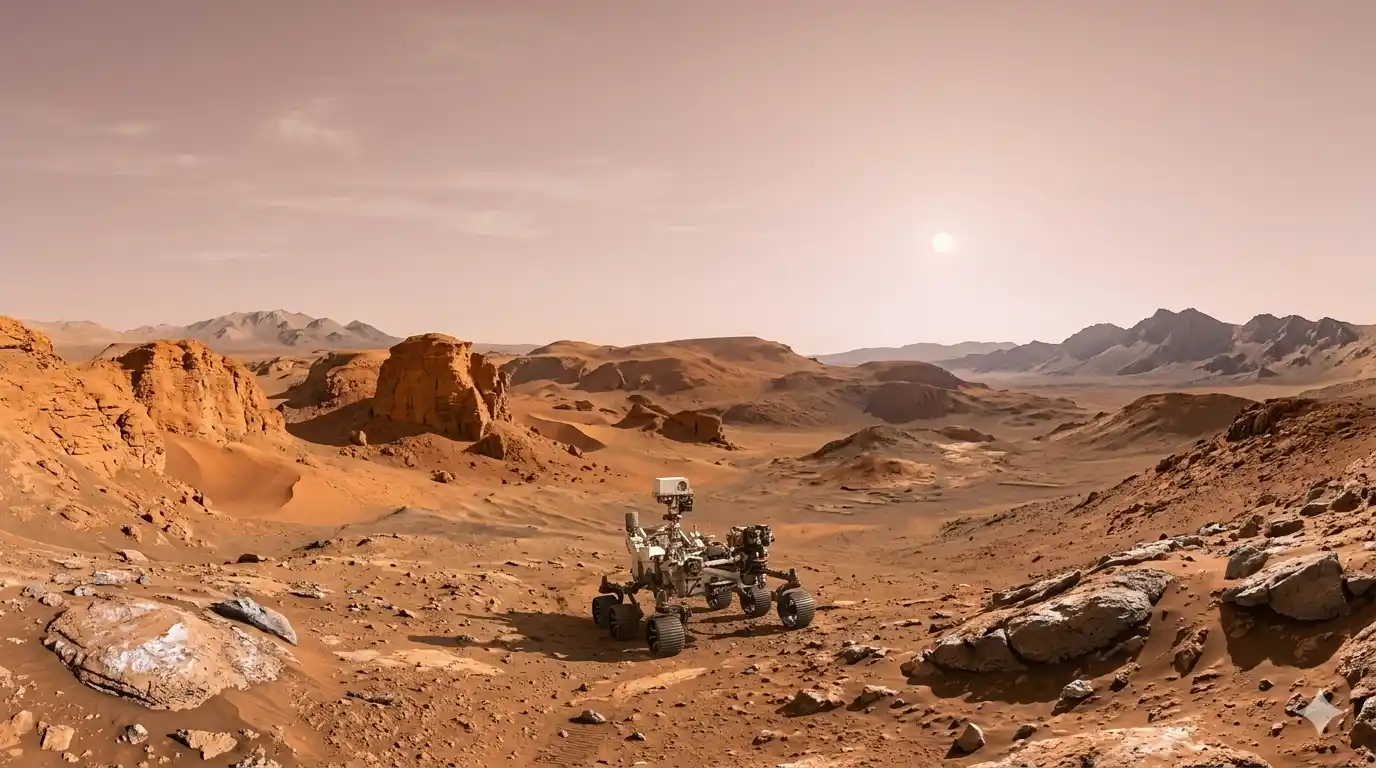
🔴 Mars Weather Station
While Earth enjoys a relatively stable climate, our neighbor, the Red Planet, is a world of extreme environmental shifts, global dust storms, and bone-chilling cold. Through our direct integration with NASA's Planetary Data System, we provide you with real-time telemetry.
Current Mars Temperature: How Cold is the Red Planet?
Unlike Earth’s thick atmosphere, which traps heat, the Martian atmosphere is 100 times thinner, consisting primarily of carbon dioxide. This results in dramatic temperature swings that would be unsurvivable for unprotected humans.
At the equator, a summer day might reach a comfortable 20°C (70°F), but as soon as the sun sets, the lack of thermal insulation causes the mercury to plummet to -84°C (-119°F). Near the poles, during the deep Martian winter, temperatures can drop as low as -153°C (-243°F), cold enough for carbon dioxide to freeze directly out of the atmosphere as "dry ice" snow.
Mars Weather Report: Dust Storms and Low Pressure
A Mars weather report is vastly different from an Earthly forecast. You won’t find rain here; the pressure is too low for liquid water to exist on the surface. Instead, the primary weather drivers are wind and dust. Martian surface pressure hovers around 600 to 700 Pascals—less than 1% of Earth’s sea-level pressure.
Despite the thin air, Mars hosts the largest dust storms in the solar system. These can start as local "dust devils" but occasionally escalate into global events that shroud the entire planet for months, blocking out the sun and posing a significant challenge to solar-powered missions like the late Opportunity rover.
NASA Mars Rover Data: Live from Jezero and Gale Crater
The data powering our Mars temperature tracker comes from the most advanced scientific instruments ever sent to space. Currently, two primary locations provide us with daily weather updates:
- Jezero Crater (Perseverance Rover): As the site of an ancient river delta, Perseverance monitors the weather to help NASA engineers plan helicopter flights for Ingenuity and prepare for future sample returns.
- Gale Crater (Curiosity Rover): Curiosity has been providing consistent climate data for over a decade, allowing us to track long-term seasonal shifts and the Martian "Sol" cycle.
By analyzing NASA Mars rover data, we can observe the transition between Martian seasons, which last nearly twice as long as Earth’s due to Mars’ 687-day orbital period.
Martian Atmosphere and Air Composition
To understand the climate of Mars, one must look at its atmospheric composition. Mars is roughly 95% Carbon Dioxide, 3% Nitrogen, and 1.6% Argon. While there are traces of Oxygen and water vapor, they are insufficient for human respiration.
The thinness of the Martian atmosphere also means that radiation from space hits the surface with much higher intensity than on Earth. This is why our weather station also monitors solar activity; without a global magnetic field, Mars is at the mercy of the solar wind, which continues to slowly strip away its remaining atmosphere.
Life on Mars: Could Humans Survive the Martian Climate?
The extreme Mars temperature and radiation levels are the biggest hurdles for future colonization. Space agencies like NASA and SpaceX are currently developing "Martian-grade" habitats that can withstand the external vacuum-like pressure and the thermal stress of -100°C nights.
Understanding the daily weather on Mars is the first step toward becoming a multi-planetary species. By tracking the Sol-to-Sol changes in temperature and pressure, we aren't just looking at data; we are scouting the frontier of the next great human leap.
Compare Mars vs. Earth Weather: A Planetary Contrast
| Planetary Feature | 🌍 Earth | 🔴 Mars |
|---|---|---|
| Average Temperature | +15°C (59°F) | -62°C (-80°F) |
| Atmosphere | Nitrogen / Oxygen | 95% Carbon Dioxide |
| Surface Pressure | 1013.25 hPa | ~7 hPa |
| Liquid Water | Abundant Oceans | None (Subsurface Ice) |
| Surface Gravity | 1.0g | 0.375g (38%) |
| Day Length | 24h 00m | 24h 39m (1 Sol) |
Why Follow the Mars Temperature Live Tracker?
Space exploration is moving faster than ever. With the Artemis missions paving the way for a moon-to-Mars pipeline, the Red Planet is no longer a distant dot in the sky—it is a future destination. Our live Mars weather dashboard ensures you are always up to date with the latest telemetry from the final frontier.
Whether you are a student, a researcher, or a space enthusiast, knowing the current temperature on Mars connects you to the rovers currently wheeling across the red sands. Stay tuned to SpaceInformer.com for daily updates, mission news, and the most accurate planetary data available.
Mars FAQ
The current temperature on Mars varies drastically depending on the location and time of day. In regions like Gale Crater or Jezero Crater, daytime highs can reach -12°C (10°F) in the summer, while nighttime lows often plummet to -84°C (-120°F). Our live tracker provides the latest telemetry from NASA’s rovers.
Mars is significantly colder than Earth primarily due to two factors: its distance from the Sun (about 1.5 times further away) and its extremely thin atmosphere. The Martian atmosphere is 100 times thinner than Earth's and consists of 95% carbon dioxide, which is insufficient to trap heat effectively through a greenhouse effect.
A day on Mars, known as a "Sol," is slightly longer than an Earth day. One Sol lasts approximately 24 hours, 39 minutes, and 35 seconds. This similarity in day length makes it one of the few environmental factors that humans could adjust to relatively easily.
No, it does not rain on Mars. The atmospheric pressure on the Martian surface is so low (less than 1% of Earth's) that liquid water would instantly boil or freeze. However, Mars does experience "dry ice" snow (frozen carbon dioxide) at the poles and water-ice frost in some craters.
The gravity on Mars is much weaker than on Earth, measuring approximately 0.375g. This means that if you weigh 100 kg on Earth, you would weigh only 37.5 kg on Mars. This lower gravity allows for massive volcanoes like Olympus Mons to grow three times taller than Mount Everest.
No, humans cannot breathe the Martian atmosphere. It is composed of 95% carbon dioxide, 3% nitrogen, and only trace amounts of oxygen. Furthermore, the air is so thin that even if it were pure oxygen, you would still need a pressurized suit to survive the lack of surface pressure.
Martian dust storms are caused by solar heating of the atmosphere. When the sun warms the thin air, it creates convection currents that lift fine dust into the sky. During the Martian summer, these local storms can merge into a global dust storm that covers the entire planet for months.
No, the weather on Mars is highly seasonal and dynamic. Mars experiences seasonal changes similar to Earth, but because its orbit is more elliptical, the seasons are much longer. You can expect dramatic variations in temperature and dust activity depending on whether the planet is near perihelion (closest to the Sun) or aphelion (farthest from the Sun).
Mars is incredibly cold. While Earth’s average temperature is about +15°C, Mars averages around -62°C. Even on a "warm" day at the equator, you would still be experiencing sub-zero temperatures, and at night, it drops to levels that would instantly freeze exposed equipment or biological organisms.
A "Sol" is the term used for a Martian day. It lasts 24 hours, 39 minutes, and 35 seconds—just slightly longer than an Earth day. Space missions use "Sols" to track time on the surface so that mission schedules stay synchronized with the local Martian sunrise and sunset.