
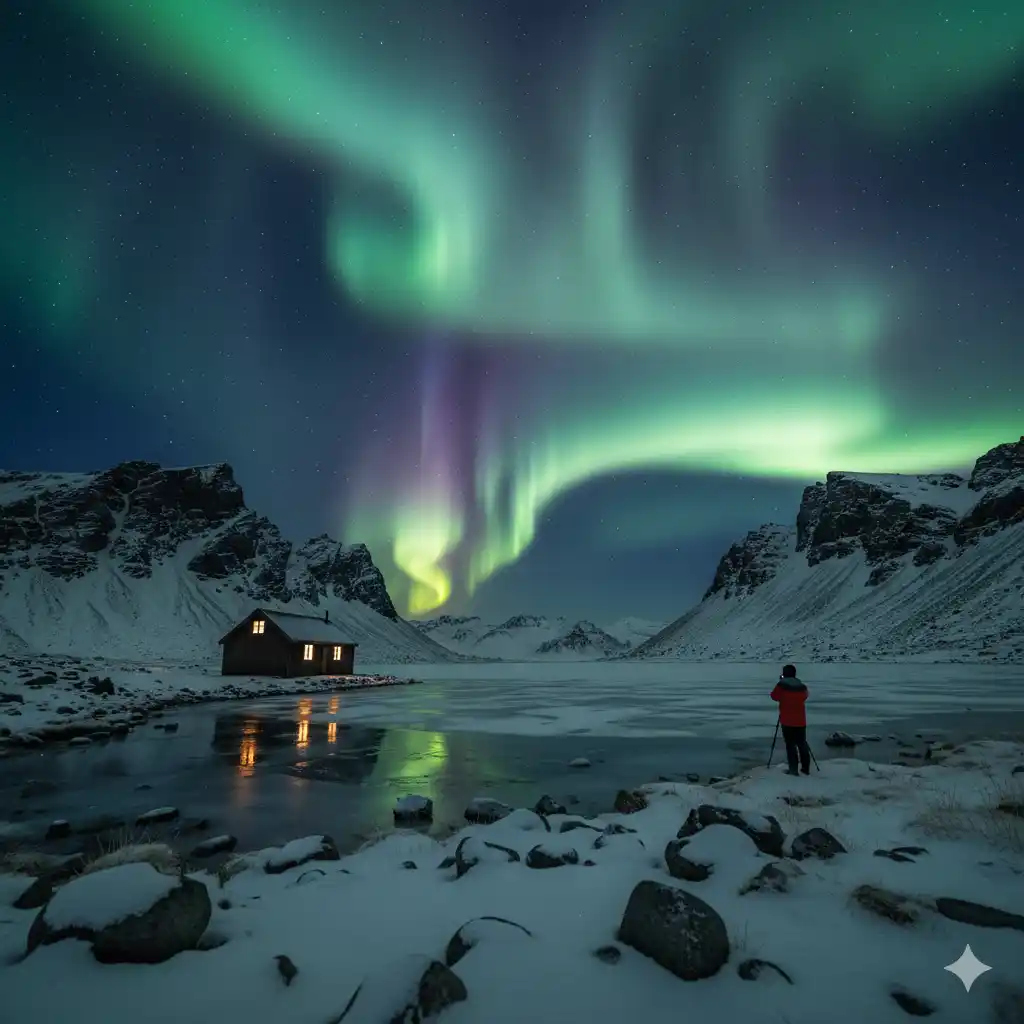
Track the Northern Lights live with our real-time Kp-Index monitor and Aurora Oval map. See if the Aurora Borealis is visible in your location right now with our expert solar storm forecast and visibility guide.
🌌 Northern Lights Live Tracker
Real-time Solar Storm & Aurora Activity Monitoring
Loading…
Connecting to NOAA space weather satellites…
Aurora Visibility Guide
✨ Data updates frequently. Refresh for the latest solar activity.
Current Aurora Oval (Satellite View)

Data provided by NOAA / Space Weather Prediction Center
Explore Local Live Forecasts
Traveling to the Southern Hemisphere?
🌍 Switch to Southern Lights (Aurora Australis) Tracker →How to use this tracker
I have constructed this real-time Aurora tracker by collecting data from NASA and NOAA satellites. Rather than depend on traditional weather tracking applications, this site refreshes itself every few minutes to inform you about the current condition of the geomagnetic fields of our planet. The following instruction will help you understand when it is appropriate to step out.
The Pulse: Understanding the Kp-Index
At the very top of this page, you will find a gauge called the Planetary K-index. This index can be considered as the “volume knob” of the Aurora. Its value can fluctuate anywhere between 0 and 9; knowing your “threshold number” is what separates wasted nights from unforgettable experiences.
Reading the Aurora Oval (The “Ring of Fire”)
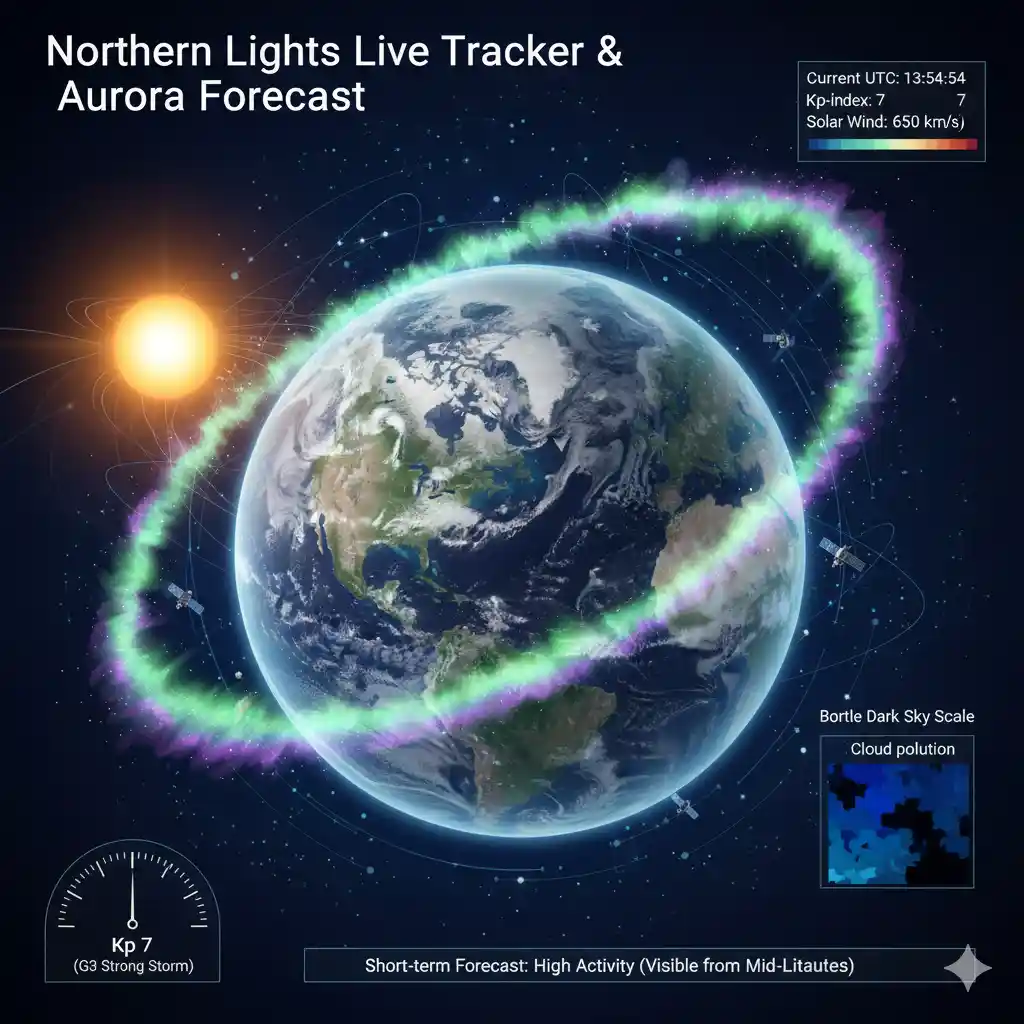
The satellite map below the Kp-gauge shows the Aurora Oval. This is a real-time visualization of where the “auroral rain” is falling. Notice how it’s not a perfect circle? It’s a dynamic ring of charged particles hitting Earth’s atmosphere, shaped by our planet’s magnetic field.
Pro Tip: Look at the “Midnight Line.” The aurora is usually most intense around magnetic midnight (roughly 11 PM to 1 AM). If the red intensity zone on the map is pushing toward your latitude, stop reading and start driving. Even if you are in the “green” zone on the map, a high Kp-index means the lights can be seen from hundreds of miles away if you have a clear, dark view of the North.
The Secret Ingredient: The Bz-Value
If you want to hunt like a professional, you need to look beyond the Kp-index. The most important “secret” metric is the Bz-value of the Interplanetary Magnetic Field (IMF).
Think of Earth as having a magnetic shield. For the solar wind to get in and create light, the solar wind’s magnetic field needs to “reconnect” with ours. This happens best when the Bz-value points South (a negative number).
- Positive Bz: Earth’s “door” is closed. Even with a high Kp, the aurora might be faint.
- Negative Bz (e.g., -10 or -20nT): The door is wide open. Expect an explosion of light.
How to Photograph the Lights with a Smartphone
You don’t need a $3,000 DSLR anymore. Most modern smartphones have a “Night Mode” that is surprisingly capable.
- Use a Tripod: Even a tiny bit of hand-shake will blur the pillars.
- Manual Focus: Set your focus to “Infinity.”
- Exposure Time: Aim for 3 to 10 seconds. Any longer, and the stars will start to trail, and the aurora will look like a blurry smudge instead of distinct curtains.
- Turn off Flash: It sounds obvious, but you’d be surprised how many people ruin their night vision (and everyone else’s) with a flash.
Pro-Chaser Checklist:
- Check the Kp-Index: Is it 4 or higher for mid-latitudes?
- Check the Bz-Value: Is it negative?
- Weather Check: Are there clear skies or “holes” in the clouds?
- Dark Sky: Are you away from city glow?
- Battery: Is your phone/camera warm? Cold kills batteries!
Northern Lights FAQ
While the sun is active all year, the best times are around the Equinoxes (September and March). Due to the “Russell-McPherron effect,” Earth’s magnetic field is more likely to misalign with the solar wind during these months, creating more frequent and intense storms.
This is due to “scotopic vision.” Human eyes are terrible at seeing color in the dark. Our “cones” (color sensors) shut down, and our “rods” (light sensors) take over. The camera sensor, however, doesn’t have this limitation. It collects photons and reveals the true colors that are actually there.
Ideally, you want to be in a “Bortle 4” area or lower. If you can see the Milky Way with your naked eye, you are in a good spot. Use our Light Pollution Map to find a dark park or coastal area facing North.
Yes! The Sun follows an 11-year cycle of activity. We are currently experiencing Solar Cycle 25’s peak in 2026. This means more sunspots, more Coronal Mass Ejections (CMEs), and the best aurora displays we’ve seen in over a decade.
Unfortunately, no. The Aurora happens 60 to 200 miles up in the atmosphere. Clouds are only a few miles up. Even a thin layer of cloud can obscure the lights. Always check a local cloud-cover map before heading out.
A CME is a massive burst of solar wind and magnetic fields rising above the solar corona or being released into space. When these are directed toward Earth, they cause the most violent geomagnetic storms—and the most beautiful auroras.