
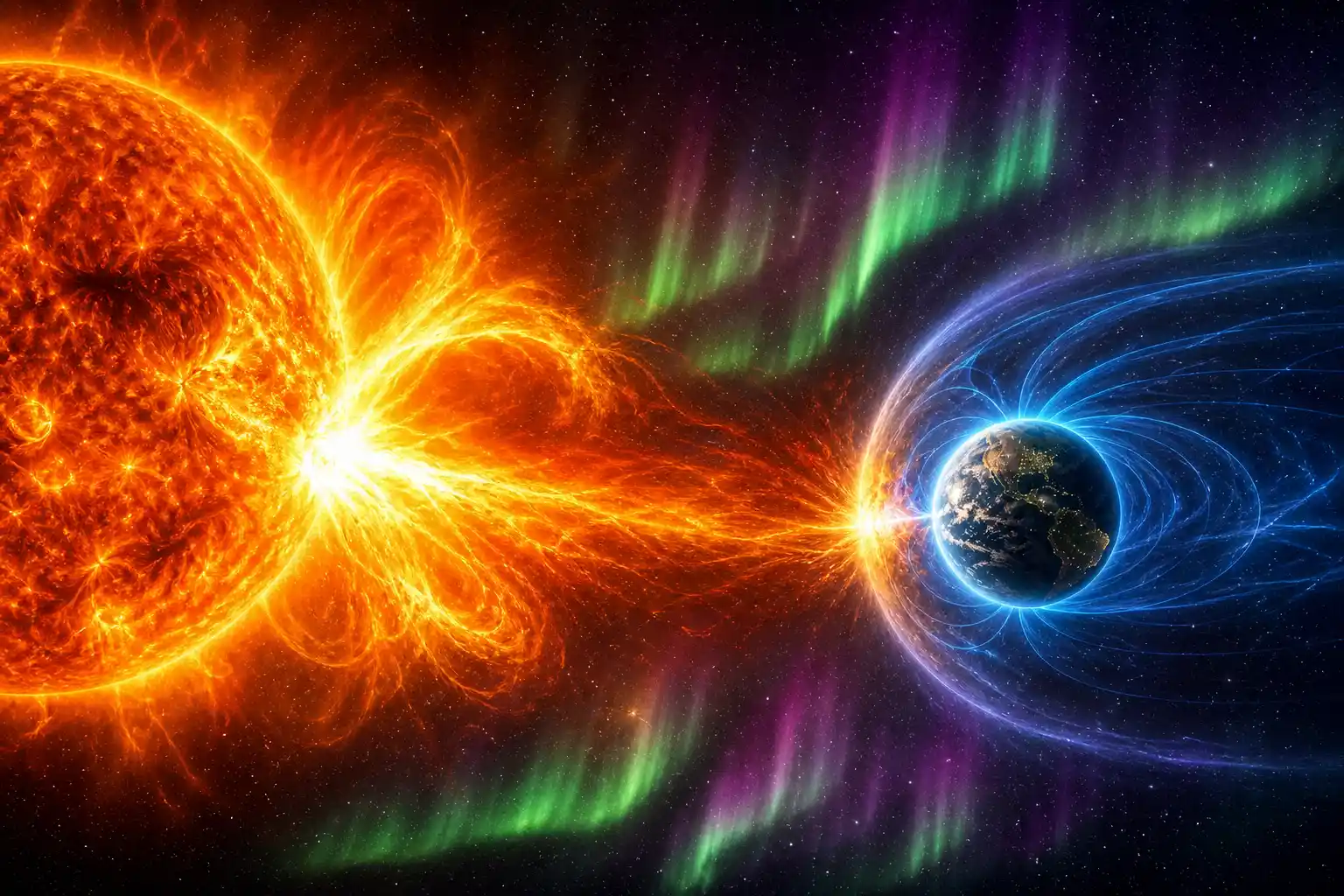
Will the Northern Lights be visible from your location tonight? This live dashboard tracks solar flares, geomagnetic activity, and the Kp-index in real-time. Use our interactive space weather forecast to stay ahead of the next major solar storm and find the best time for aurora hunting.
🛰️ Live Solar Storm Tracker & Aurora Forecast
Aurora Viewing Forecast – Live
| City / Location | Visibility Prob. | Optimal Window | Status |
|---|
Understanding Solar Storms and the Kp-Index
To master the art of aurora hunting, one must first understand the powerhouse behind the phenomenon: the Sun. A solar storm forecast tracks the release of solar energy, primarily in the form of solar flares and Coronal Mass Ejections (CMEs). When these charged particles reach Earth, they interact with our planet’s magnetic field, creating what scientists call a geomagnetic storm.
The most critical metric in any aurora tracker is the Kp-index. The Kp-index is a scale from 0 to 9 used to characterize the magnitude of geomagnetic storms.
| Kp-Index Level | Storm Magnitude | Aurora Visibility & Reach |
|---|---|---|
| Kp 0 – 3 | Quiet / Calm | Auroras are usually confined to high latitudes such as Iceland, Northern Norway, and Alaska. |
| Kp 4 – 5 | Unsettled / Minor Storm | The “Aurora Oval” expands. Lights become visible from mid-to-low latitudes like Southern Scandinavia and Northern UK. |
| Kp 6 – 9 | Severe / Extreme Storm | Rare, high-energy events. Can push the Northern Lights as far south as Central Europe and the Northern United States. |
By monitoring our live Kp-index tracker, you can determine exactly when the geomagnetic field is disturbed enough to produce a visible display in your specific region.
Real-Time Space Weather Monitoring
In 2026, we are approaching the Solar Maximum, a period in the Sun’s 11-year cycle where activity is at its peak. This means more sunspots, more frequent solar flares, and a significantly higher probability of witnessing intense Northern Lights displays.
A reliable space weather dashboard does more than just show the current Kp-index. It monitors the solar wind speed and density. When solar wind speeds exceed 500 km/s and the Interplanetary Magnetic Field (IMF) tilts southward (known as a negative Bz), the “doors” to Earth’s atmosphere open, allowing solar particles to pour in. This is the recipe for a spectacular aurora show. Our live space weather map integrates data from NOAA and DSCOVR satellites to give you a 30-to-60-minute “heads up” before the particles hit our atmosphere.
Aurora Tracker: Will the Northern Lights Be Visible Tonight?
“Will I see the lights tonight?” is the most common question for any stargazer. The answer depends on three factors: solar activity, your latitude, and local weather conditions. While our aurora forecast tells you if the Sun is cooperating, you must also ensure you have a clear, dark sky away from city light pollution.
For those located in “aurora hotspots” such as Tromsø, Reykjavik, or Fairbanks, a Kp-index of 2 or 3 is often sufficient for a beautiful overhead display. However, if you are tracking the Southern Lights (Aurora Australis) from Tasmania or New Zealand, or looking for the Northern Lights from the UK or the northern US, you typically need to wait for a solar storm alert indicating a Kp-index of 5 or higher.
How to Read Solar Flare Alerts
Not all solar activity results in an aurora. Solar flares are intense bursts of radiation coming from sunspots. They are classified by letter: B, C, M, and X.
- C-Class flares: Small and have little effect on Earth.
- M-Class flares: Medium-sized; they can cause brief radio blackouts and trigger minor solar storms.
- X-Class flares: The monsters. An X-class flare can trigger massive geomagnetic storms and vibrant auroras globally.
Our solar storm forecast specifically looks for CMEs that often follow these flares. A flare reaches Earth in eight minutes (at the speed of light), but the plasma cloud (CME) takes 1 to 3 days to arrive. This delay is what allows us to provide a highly accurate 2026 solar storm forecast, giving you time to travel to a dark-sky location.
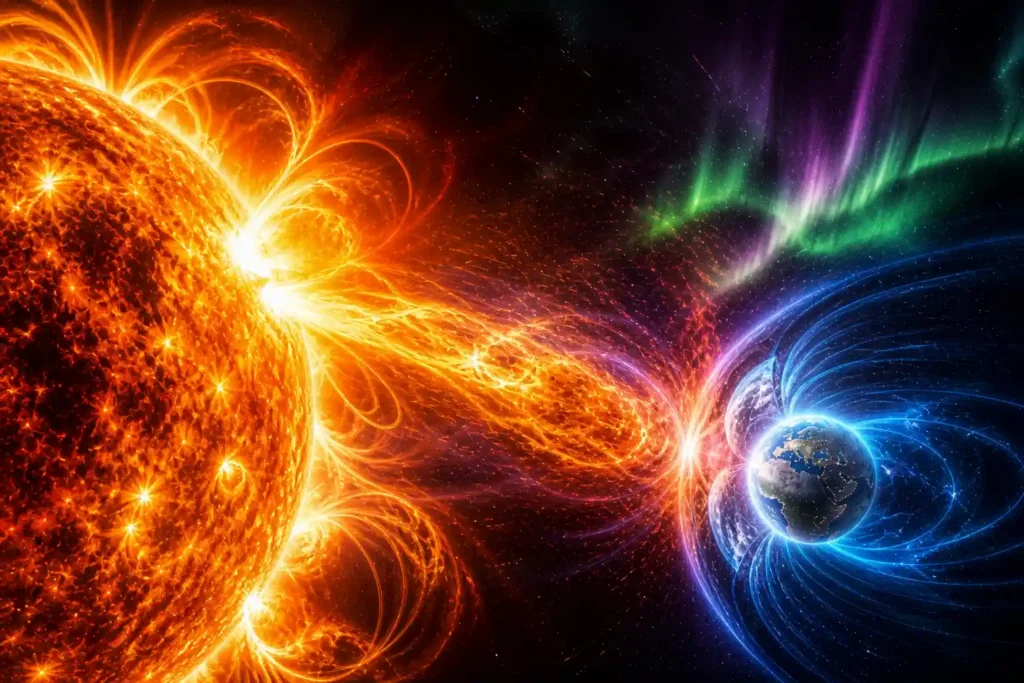
Sunspots and Solar Flares: What They Mean for Space Weather
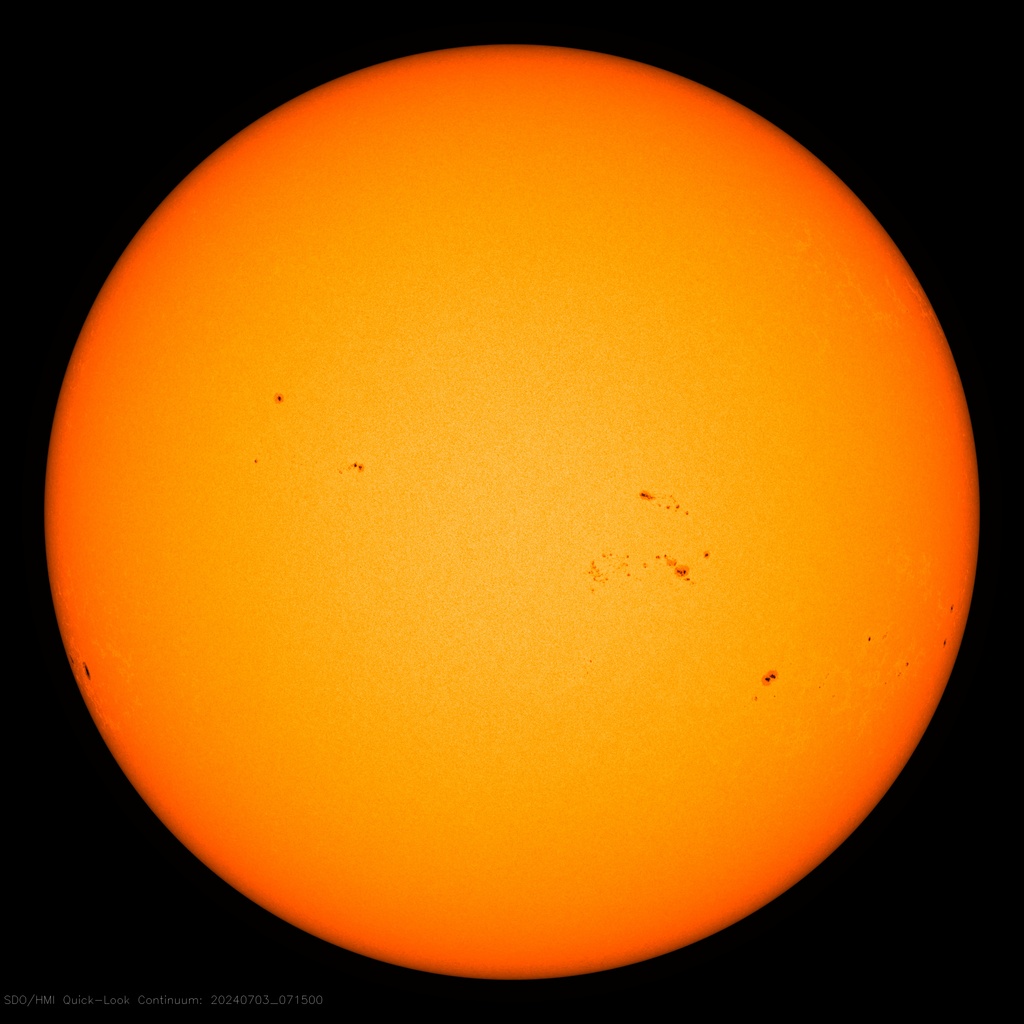
Sunspots are cooler, darker patches on the Sun where magnetic fields are concentrated. They are the main source of solar flares, so more sunspots usually means a higher chance of space weather activity. Sunspot numbers rise and fall in a cycle of about 11 years. The current one, Solar Cycle 25, began in December 2019.
A solar flare is a sudden burst of radiation. Flares are ranked by strength in five classes: A, B, C, M and X. Each class is 10 times stronger than the one before. X-class flares are the strongest, and M-class and X-class flares can cause radio blackouts on the sunlit side of Earth. The light from a flare reaches Earth in about 8 minutes and 20 seconds.
Flares are often followed by a coronal mass ejection (CME), a cloud of charged particles. A CME typically takes between 1 and 3 days to reach Earth, and the fastest can arrive in about 15 hours. If its magnetic field lines up the right way with Earth’s, it can trigger a geomagnetic storm.
Geomagnetic storms are rated on the G-scale from G1 (minor) to G5 (extreme), based on the Kp index, which runs from 0 to 9. Kp 5 or higher counts as a storm. Storms can produce aurora far from the poles and, at the strongest levels, disturb GPS, radio and power grids. The strongest storm on record, the Carrington Event in 1859, set telegraph equipment on fire.
Use the forecast above to check the current Kp index and solar wind, or open our Northern Lights Live Tracker to see if aurora is possible near you tonight.
The Kp-index is a scale from 0 to 9 used to measure geomagnetic activity. A higher Kp-index indicates a stronger solar storm. For stargazers, a Kp-index of 5 or higher is usually required to see the Northern Lights at lower latitudes, while high-latitude regions like Iceland only need a Kp 2 or 3.
Visibility depends on three factors: the Kp-index, clear skies, and your geographic location. Check our live solar storm tracker for real-time updates. If the Kp-index is above 5 and you have a clear northern horizon away from city lights, there is a high probability of seeing the aurora.
While the light from a solar flare reaches Earth in just 8 minutes, the actual Coronal Mass Ejection (CME)—the cloud of charged particles—typically takes between 15 to 72 hours to arrive. This delay allows us to provide accurate solar storm forecasts a day or two in advance.
Most solar storms only affect satellite communications, GPS, and power grids. While extreme G5-class storms can cause temporary interference with radio signals, they do not pose a direct threat to personal electronics like smartphones or laptops.
In the Northern US or the UK, you typically need a Kp-index of at least 6 to see the Aurora Borealis clearly. During extreme solar storms (Kp 8 or 9), the lights can be seen as far south as the Midwest US or Central Europe.
The Solar Maximum is the peak of the Sun’s 11-year solar cycle, characterized by a massive increase in sunspots and solar flares. We are currently approaching the Solar Maximum in 2026, which means this year will offer some of the most frequent and intense Northern Lights displays in over a decade.