
🚀 SpaceX Mission Control
Starlink Group 18-4
ID: SL-1804Track Satellites Live – ISS, Starlink & More
Falcon 9: The Workhorse of Modern Orbit
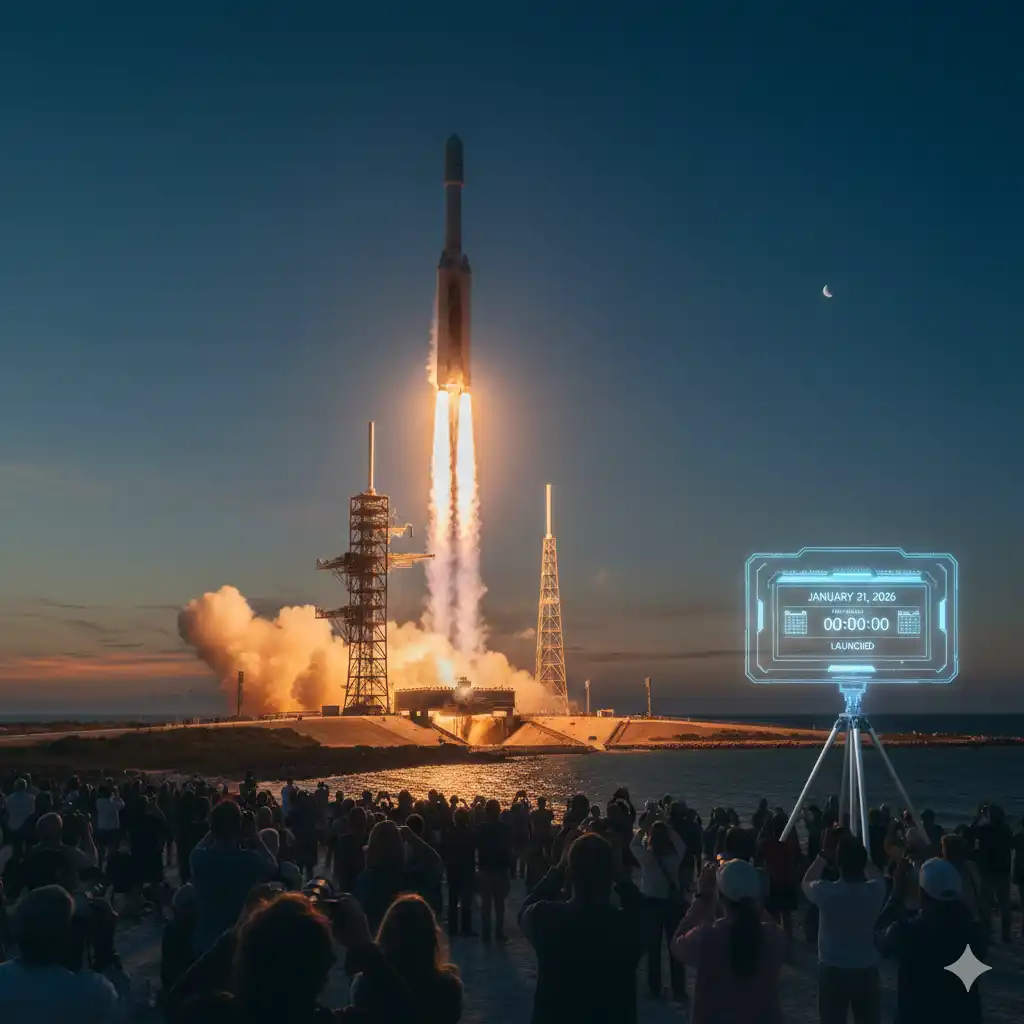
The Falcon 9 is the first orbital-class rocket capable of re-flight, a breakthrough that fundamentally altered the economics of space access. Unlike traditional expendable launch vehicles, the Falcon 9 features a reusable first-stage booster that executes a controlled descent, either landing back at the launch site or touching down on an Autonomous Spaceport Drone Ship stationed in the Atlantic or Pacific. This recovery process is not just a feat of engineering; it is the backbone of SpaceX’s high-cadence launch schedule, allowing for the rapid deployment of Starlink constellations that now provide global internet coverage.
Understanding Launch Windows and Orbits
Every SpaceX mission is constrained by a precise “launch window,” dictated by the specific orbital plane required for the mission. For Starlink deployments, the rocket must reach a specific inclination to sync with the existing constellation. Conversely, missions headed to the International Space Station must time their liftoff to coincide with the station’s orbital path, ensuring a successful rendezvous. Because these orbital mechanics are fixed, launch windows are often limited to a few minutes; missing this window requires a “scrub” and a 24-hour delay to realign the rocket with its target trajectory.
The Evolution of the Starship Program
While the Falcon 9 handles routine cargo and satellite delivery, the Starship program represents the shift toward super-heavy lift capabilities. Designed for full and rapid reusability, Starship is the most powerful launch vehicle ever built, featuring the Super Heavy booster and the Starship upper stage. Unlike the modular nature of the Falcon 9, Starship’s architecture is designed to support long-duration spaceflight, including potential human transit to the Moon and Mars. Monitoring these test flights requires tracking not just the countdown, but the mission’s specific “test objectives,” such as stage separation milestones and atmospheric re-entry profiles.
Telemetry and Mission Success Criteria
Tracking a launch involves more than watching the countdown; it is about monitoring live telemetry. During the launch sequence, key milestones such as “Max-Q”—the moment of maximum aerodynamic pressure on the vehicle—and Main Engine Cut-Off (MECO) signal the transition from launch to orbital insertion. For missions involving satellite deployment, the true success of the mission is confirmed only after the secondary payload is successfully released and the solar arrays have deployed. By following the live telemetry, observers can understand the critical phases of a mission and determine, in real-time, whether the flight profile is proceeding as planned.
Types of SpaceX Launches You Can Track
SpaceX missions vary widely, making every launch exciting in its own way:
- Satellite Deployments: Falcon 9 launches often carry satellites for global communications, Earth observation, or scientific research. Watching these launches lets you see technology from around the world reaching orbit.
- ISS Cargo Missions: Some launches deliver critical cargo to the International Space Station, including experiments, equipment, and supplies for astronauts.
- Starship Tests: The Starship program is SpaceX’s ambitious plan to make humans multiplanetary. Test flights and orbital missions are fascinating glimpses into the future of space travel.
No matter the mission type, our tracker ensures you never miss a moment.
Upcoming Launches
While this tracker focuses on the next SpaceX launch, it serves as a gateway to following future missions as well. Every time a new launch is scheduled, the tracker updates automatically with the latest information. This makes it an evergreen resource for anyone interested in space exploration.
SpaceX FAQ
You can use our live SpaceX Launch Tracker, which provides a real-time countdown, detailed mission objectives, and an embedded livestream. Our data is pulled directly from the official SpaceX API to ensure you have the most accurate lift-off times and mission technicalities.
The exact launch time for SpaceX missions often changes due to weather or technical checks. Our live SpaceX Launch Tracker syncs directly with the official SpaceX API to provide the most accurate, real-time T-minus countdown and local lift-off time available.
Launch schedules are highly dynamic. Our tracker updates instantly if a mission is “scrubbed” or postponed. By monitoring our live status indicator and countdown, you will be the first to know if the launch window has been moved or if the mission is “Go” for launch.
Each Falcon 9 mission has unique objectives, ranging from deploying Starlink satellites for global internet to resupplying the International Space Station (ISS). You can find the specific payload details, mission ID, and booster flight history (e.g., B1085) in our real-time mission info section.
While our tracker focuses on the live launch event, you can see the specific Starlink Group ID (such as Group 12-1) currently being deployed. Once in orbit, these satellites can be tracked using specialized satellite maps to see when they will pass over your location.
SpaceX primarily launches from Cape Canaveral Space Force Station (SLC-40) and Kennedy Space Center (LC-39A) in Florida, or Vandenberg Space Force Base in California. Our tracker automatically displays the correct launch site location for the upcoming mission.
Most Starlink missions feature a booster recovery on an Autonomous Spaceport Drone Ship (ASDS) stationed in the Atlantic or Pacific Ocean. Our mission details section confirms the planned landing zone for the current Falcon 9 booster.