
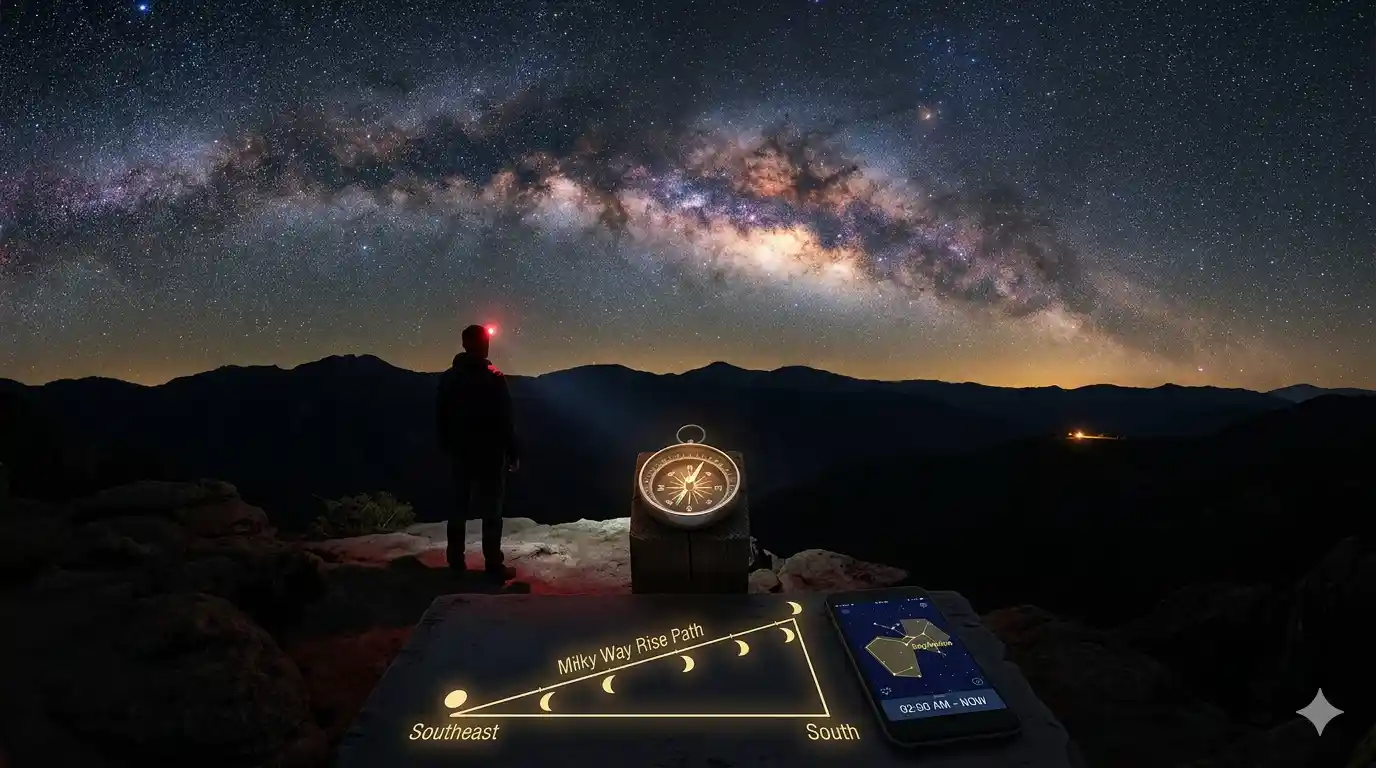
Find out exactly where the Milky Way is in the sky tonight. Learn which direction to look, how to find the Galactic Center using constellations, and the best time for viewing right now.
Milky Way Locator
| Month 2026 | Direction (Azimuth) | Best Viewing Time | Elevation |
|---|---|---|---|
| January | Not Visible | N/A (Too close to Sun) | Below Horizon |
| February | South-East | 04:00 AM – Dawn | Very Low |
| March | South-East | 02:00 AM – 05:00 AM | Low |
| April | South | Midnight – 04:00 AM | Rising Mid-Sky |
| May | South | 11:00 PM – 03:00 AM | Medium High |
| June | South | 10:00 PM – 02:00 AM | Highest Peak |
| July | South-West | 09:30 PM – 01:00 AM | Highest Peak |
| August | South-West | 09:00 PM – Midnight | Medium High |
| September | South-West | 08:00 PM – 10:30 PM | Descending Low |
| October | West-Southwest | 07:30 PM – 09:00 PM | Very Low |
| November | Not Visible | N/A (Below Horizon) | Setting Early |
| December | Not Visible | N/A (Sun Proximity) | Below Horizon |
The 10-Second Compass Trick
No compass? No problem! To find the Milky Way tonight, first locate the North Star (Polaris). Once you find it, simply turn your body 180 degrees to face the opposite direction.
You are now facing South, where the brightest part of the Milky Way (The Galactic Center) resides. Look slightly to the left (Southeast) in Spring or slightly to the right (Southwest) in Autumn.
How to Find the Milky Way Tonight: A Practical Guide
Finding the Milky Way isn’t just about looking up; it’s about looking in the right direction at the right time. Because our planet is constantly rotating and orbiting the Sun, the “river of stars” we call our galaxy changes its position every single hour.
To see the Milky Way tonight, you need to understand the celestial mechanics of the Galactic Center. This is the brightest, most star-dense region of the Milky Way, located in the direction of the Sagittarius constellation. If you follow this guide, you will know exactly where to point your eyes (or your camera) to witness the core of our galaxy in all its glory.
What Direction Should I Look to See the Milky Way?
For most observers in the Northern Hemisphere, the rule of thumb is simple: Look South. The Galactic Center never rises in the North. However, the exact azimuth (the compass direction) shifts throughout the 2026 season.
Seasonal Directions for the Galactic Center:
- Spring (March – May): In the early season, the Milky Way rises in the Southeast during the pre-dawn hours. It appears as a diagonal arc stretching from the horizon toward the East.
- Summer (June – August): During the peak of summer, the Milky Way is at its highest and brightest. It stands directly in the South around midnight. This is the best time for “wide-angle” viewing.
- Autumn (September – October): As the season ends, the Milky Way shifts toward the Southwest and appears more vertical in the sky shortly after sunset.
The Best Time to View the Milky Way Tonight
Even if you are looking in the right direction, timing is critical. The Milky Way follows a predictable schedule. Every night, it rises approximately 4 minutes earlier than the night before. This cumulative shift is why the “Milky Way Season” moves from pre-dawn in the Spring to early evening in the Autumn.
To find the best time tonight, check our Milky Way Locator Tool above. It calculates the optimal viewing window based on the current date in 2026. Generally, you want to wait until “Astronomical Twilight” has ended—this is when the Sun is at least 18 degrees below the horizon, and the sky is truly dark.
Identifying the Galactic Center: Look for the “Teapot”
If you are standing in a dark location and see a band of clouds, how do you know if it’s the Milky Way or just Earth-bound weather? The key is to look for specific “markers” in the stars.
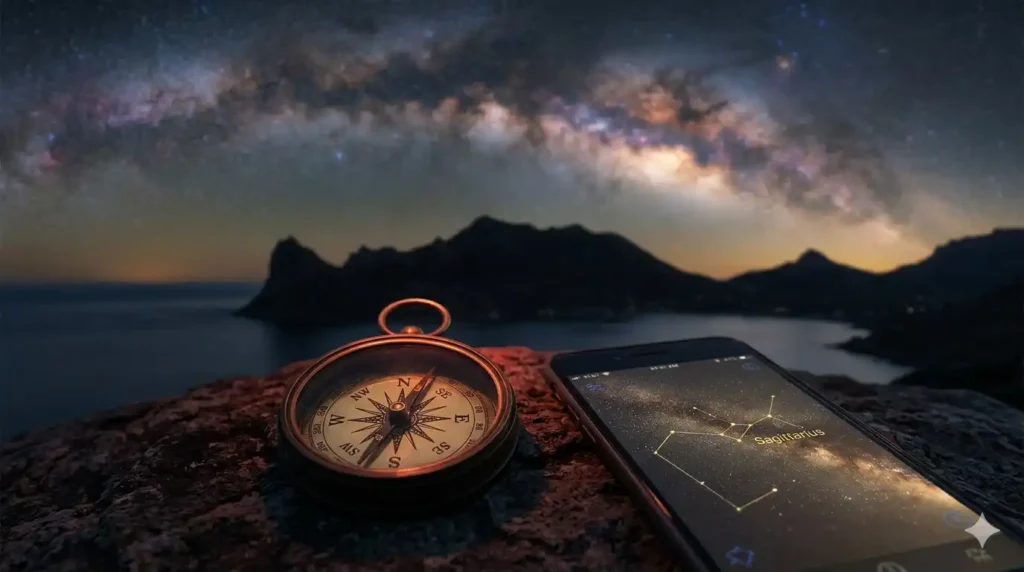
The most famous marker for the Milky Way core is the Teapot asterism in the constellation Sagittarius.
- Locate the stars that form the shape of a small teapot.
- Look at the “spout” of the teapot (pointing West).
- The “steam” rising from the spout is actually the billion-star glow of the Galactic Center.
In 2026, the planet Saturn or Jupiter might be nearby depending on the month, often acting as “gatekeepers” to the Milky Way. Using these bright planets as anchors makes finding the galaxy much easier for beginners.
Light Pollution: The Silent Star-Killer
You can have the most expensive telescope in the world, but if you are standing under city lights, the Milky Way will remain invisible. Light pollution “washes out” the faint contrast of the galaxy.
To see the Milky Way tonight, you must travel to a location with a low Bortle Scale rating.
- Bortle 1-2: Pristine dark skies. The Milky Way casts shadows on the ground.
- Bortle 3-4: Rural skies. The Milky Way is clearly visible with great detail.
- Bortle 5-6: Suburban skies. You can see a faint glow, but most details are lost.
- Bortle 7-9: City skies. Visibility is near zero.
We strongly recommend using a Light Pollution Map to plan your trip. Even a 30-minute drive away from city centers can increase the number of visible stars by thousands.
Common Mistakes When Searching for the Milky Way
Many people give up on finding the galaxy because of a few simple, avoidable errors. If you can’t see it tonight, check these three factors:
1. Your Eyes Haven’t Adjusted
It takes about 20 to 30 minutes for your eyes to achieve “night vision” (scotopic vision). If you look at your smartphone screen for even a second, your night vision is reset, and the Milky Way will disappear. Use a red-light flashlight if you need to see your path.
2. The Moon is Too Bright
A common mistake is forgetting the Moon. A Full Moon is 100 times brighter than the Milky Way. Even a small crescent moon can hide the “Great Rift” (the dark dust lanes in the galaxy). Only search for the Milky Way during the New Moon window (5 days before or after).
3. High Altitude Haze
Sometimes the sky looks clear, but high-altitude moisture or smoke creates a “haze” that blurs the stars. If the stars are “twinkling” aggressively, it’s a sign of atmospheric turbulence, which makes for poor viewing.
Using Technology to Enhance Your Search
While the naked eye is the best way to experience the scale of the galaxy, technology can help you confirm what you are seeing.
- Augmented Reality (AR) Apps: Apps like Stellarium or SkyGuide allow you to point your phone at the sky to see a digital overlay of the constellations.
- Long Exposure Photography: Modern smartphones with “Night Mode” can often capture the Milky Way even when it’s hard to see with the eye. Set your phone on a tripod and take a 10-30 second exposure to reveal the hidden colors of the cosmos.
By combining the 2026 Compass Data from our table above with a truly dark sky, you are guaranteed to have a successful stargazing session tonight. The universe is waiting—just look South.
FAQ
To see the brightest part of the Milky Way (the Galactic Center), you should look toward the South. In the Spring, it rises in the Southeast; during Summer, it is directly South at midnight; and in Autumn, it shifts toward the Southwest before setting.
The Milky Way rises approximately 4 minutes earlier each night. In early Spring (March), it rises around 02:00 AM. By mid-summer (June/July), the core is visible as soon as it gets fully dark, usually around 10:00 PM, and remains visible until the early morning hours.
You can use augmented reality (AR) apps like Stellarium, Star Walk, or SkyGuide. Simply point your phone at the sky, and the app will overlay the position of the Milky Way and the Sagittarius constellation, showing you exactly where the Galactic Center is located relative to your position.
The Milky Way is visible to the naked eye if you are in a Dark Sky location (Bortle Class 4 or lower) and there is no bright Moon in the sky. It appears as a faint, milky band of light stretching across the sky. If you are in a city, light pollution will make it invisible.
The Galactic Center is located in the constellation Sagittarius. A popular way to find it is to look for the “Teapot” asterism within Sagittarius; the densest part of the Milky Way appears like “steam” rising from the teapot’s spout.
No, a Full Moon is too bright and will wash out the faint light of the Milky Way. To see the galaxy, you should plan your viewing during the New Moon phase or when the Moon has already set or not yet risen.
During the winter months (November to January), the Earth’s night side faces away from the bright Galactic Center. The core of our galaxy is positioned near the Sun in the sky during this time, meaning it is only “up” during the day when the bright sunlight hides it.