
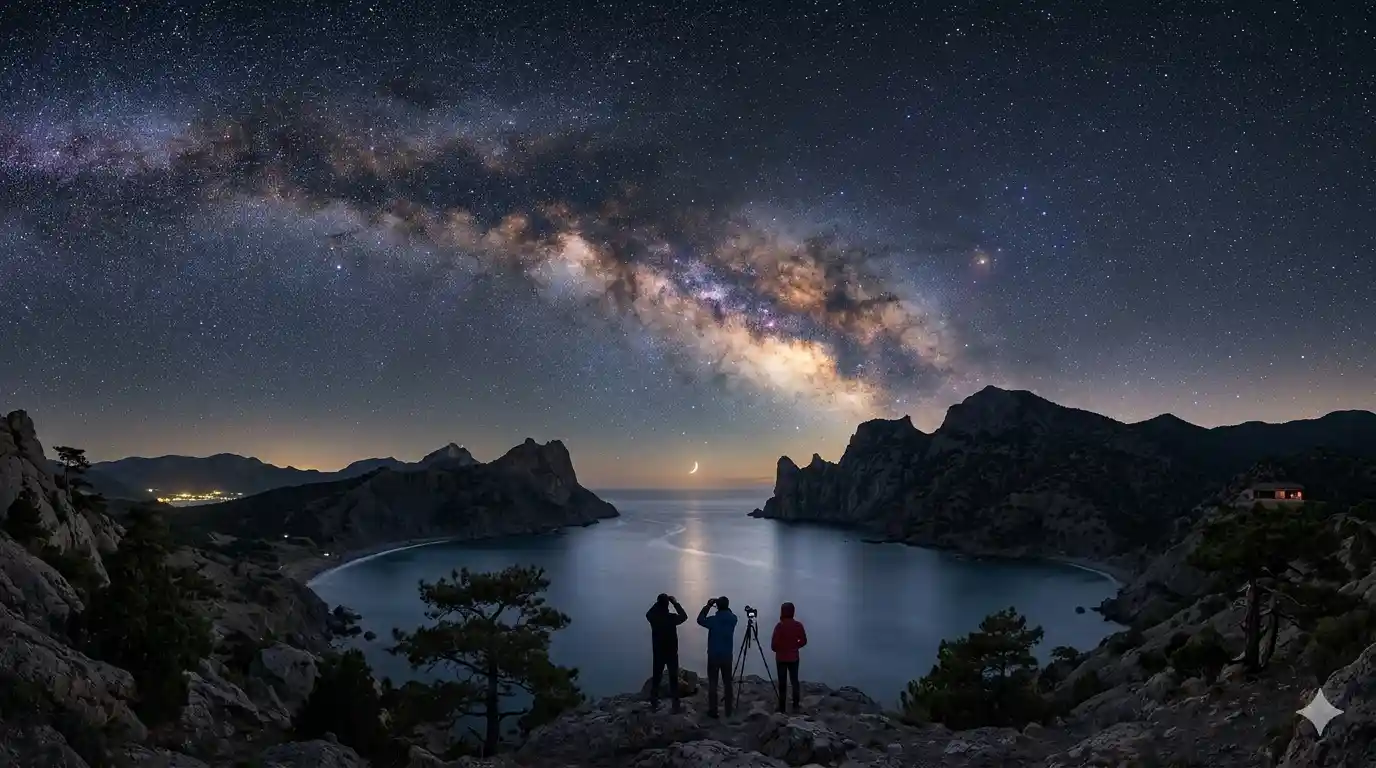
Planning to see the stars? Our 2026 Milky Way calendar shows you exactly when the Galactic Center is visible. Find the best dates for stargazing based on moon phases, dark sky windows, and seasonal peak times for the Northern and Southern Hemispheres.
| Month | Best Window (New Moon) | Visibility Status | Peak Viewing Time |
|---|---|---|---|
| January | Jan 14 – Jan 24 | Off-Season | Not Visible |
| February | Feb 12 – Feb 22 | Start of Season | 04:00 AM – Dawn |
| March | Mar 14 – Mar 24 | Good | 02:00 AM – Dawn |
| April | Apr 12 – Apr 22 | Excellent | Midnight – Dawn |
| May | May 11 – May 21 | Peak Visibility | 10:00 PM – 03:00 AM |
| June | Jun 10 – Jun 20 | Peak Visibility | 09:30 PM – 02:00 AM |
| July | Jul 09 – Jul 19 | Peak Visibility | 09:00 PM – 01:00 AM |
| August | Aug 08 – Aug 18 | Excellent | 08:30 PM – Midnight |
| September | Sep 06 – Sep 16 | Good | 08:00 PM – 11:00 PM |
| October | Oct 06 – Oct 16 | End of Season | 07:30 PM – 09:30 PM |
| November | Nov 04 – Nov 14 | Off-Season | Too Low / Horizon |
| December | Dec 04 – Dec 14 | Off-Season | Not Visible |
The Ultimate Guide to Milky Way Visibility in 2026
Seeing the Milky Way with your own eyes is a bucket-list experience that connects us to the cosmos. However, catching a glimpse of our galaxy’s brilliant core—the Galactic Center—requires more than just looking up. It requires precise timing, a dark sky, and an understanding of the Earth’s rotation.
In 2026, astronomical conditions offer several “perfect windows” for stargazers. Whether you are a night-sky photographer or a casual observer with a pair of binoculars, this guide provides the exact data you need to plan your next celestial adventure.
Why Timing is Everything: The 2026 Milky Way Season
The Milky Way is always “there,” but the bright, dusty core that we all recognize from photographs is not visible year-round. This is due to the Earth’s orbit around the Sun. During the winter months, the Sun stands between Earth and the Galactic Center, meaning the core is only above the horizon during the day.
The 2026 Visibility Window:
- Early Season (February – April): The core rises in the Southeast in the pre-dawn hours.
- Peak Season (May – August): This is the “Golden Era” for stargazing. The core is visible for most of the night, rising higher in the southern sky.
- Late Season (September – October): The core is visible immediately after sunset in the Southwest but sets quickly.
The Moon: Your Greatest Ally or Worst Enemy
To see the galaxy in its full glory, you must aim for the New Moon phase. Our 2026 Milky Way Calendar highlights the 10-day window surrounding each New Moon. During these nights, the sky is at its darkest, allowing the faint light of billions of stars to reach your eyes without interference.

How to Find the Galactic Center in the Night Sky
Finding the Milky Way doesn’t require expensive equipment, but it does require a bit of orientation. In 2026, the Galactic Center is located in the constellation Sagittarius.
Step-by-Step Location Guide:
- Identify South: In the Northern Hemisphere, the brightest part of the Milky Way will always be toward the southern horizon.
- Look for the “Teapot”: The constellation Sagittarius looks remarkably like a small teapot. The “steam” rising from the spout of the teapot is actually the densest part of the Milky Way galaxy.
- Use an App: Tools like Stellarium or SkySafari can help you pinpoint the exact rise and set times for your specific GPS coordinates.
Top Factors That Impact Your Viewing Experience
Even during a New Moon in July, certain factors can ruin your visibility. To ensure you get the best possible view (and the best photos), consider these three variables:
1. Light Pollution (Bortle Scale)
You cannot see the Milky Way from a major city. You need to find a location that is at least a Bortle Class 4 or lower. Use our integrated Light Pollution Map to find “Dark Sky Parks” near you.
2. Atmospheric Clarity and Humidity
Dust, smoke, and high humidity can scatter light and blur the stars. Crisp, cold nights or nights immediately following a rainstorm often provide the most “transparent” skies.
3. Elevation
The higher you are, the less atmosphere you are looking through. If possible, head to a mountain or a high plateau to escape the haze of the lower atmosphere.
Milky Way Photography in 2026: Quick Settings
For those looking to capture the galaxy on camera, 2026 is a fantastic year for astrophotography. If you are using a DSLR or Mirrorless camera, start with these baseline settings:
- Lens: Wide-angle (14mm to 24mm) with a fast aperture (f/2.8 or lower).
- ISO: 3200 to 6400 depending on your camera’s sensor noise.
- Shutter Speed: Use the Nifty 500 Rule (500 divided by your focal length) to avoid star trailing. For a 20mm lens, aim for 20-25 seconds.
Planning Your 2026 Stargazing Trips
Using our Interactive Milky Way Tracker and the 2026 Visibility Table, you can now cross-reference your vacation days with the best astronomical windows. We recommend booking your trips for the months of June or July to ensure you have the maximum number of hours under a dark, star-filled sky.
Remember, the universe doesn’t wait. The Galactic Center is a fleeting beauty that reminds us of our place in the cosmos. Use the tools on this page to ensure you never miss a “clear sky” opportunity again.
FAQ
The best time to see the Milky Way is during the “Milky Way Season,” which runs from February to October. Specifically, you should look for the Galactic Center during the 10-day window around the New Moon each month, as a dark sky without moonlight is essential for visibility.
Yes, but only if you are in a “Dark Sky” location with minimal light pollution. To the naked eye, the Milky Way looks like a faint, milky cloud stretching across the sky. You won’t see the vibrant colors found in long-exposure photographs, but the structure of the Galactic Center is clearly visible in dark conditions.
The peak months for Milky Way photography in 2026 are May, June, and July. During this period, the bright Galactic Center is visible for the longest duration during the night and rises higher in the sky, providing the most dramatic photographic opportunities.
Absolutely. The Moon is the biggest “light polluter” in the night sky. Even a Quarter Moon can wash out the delicate details of the Milky Way. Always plan your stargazing trips within 5 days before or after a New Moon for the best experience.
In the Northern Hemisphere, you should look toward the South. Early in the season (Spring), the Galactic Center rises in the Southeast. By mid-summer, it is positioned directly South, and by Autumn, it moves toward the Southwest before disappearing for the season.
During the winter months (November to January), the Earth is tilted in a way that the sun stands between us and the bright Galactic Center. This means the core of our galaxy is only “up” during the daytime, making it invisible against the bright blue sky.
The Galactic Center is the rotational center of the Milky Way galaxy. It is the brightest and most densely packed part of our galaxy, containing a supermassive black hole and billions of stars. This is the “core” that most stargazers and photographers are looking for.