
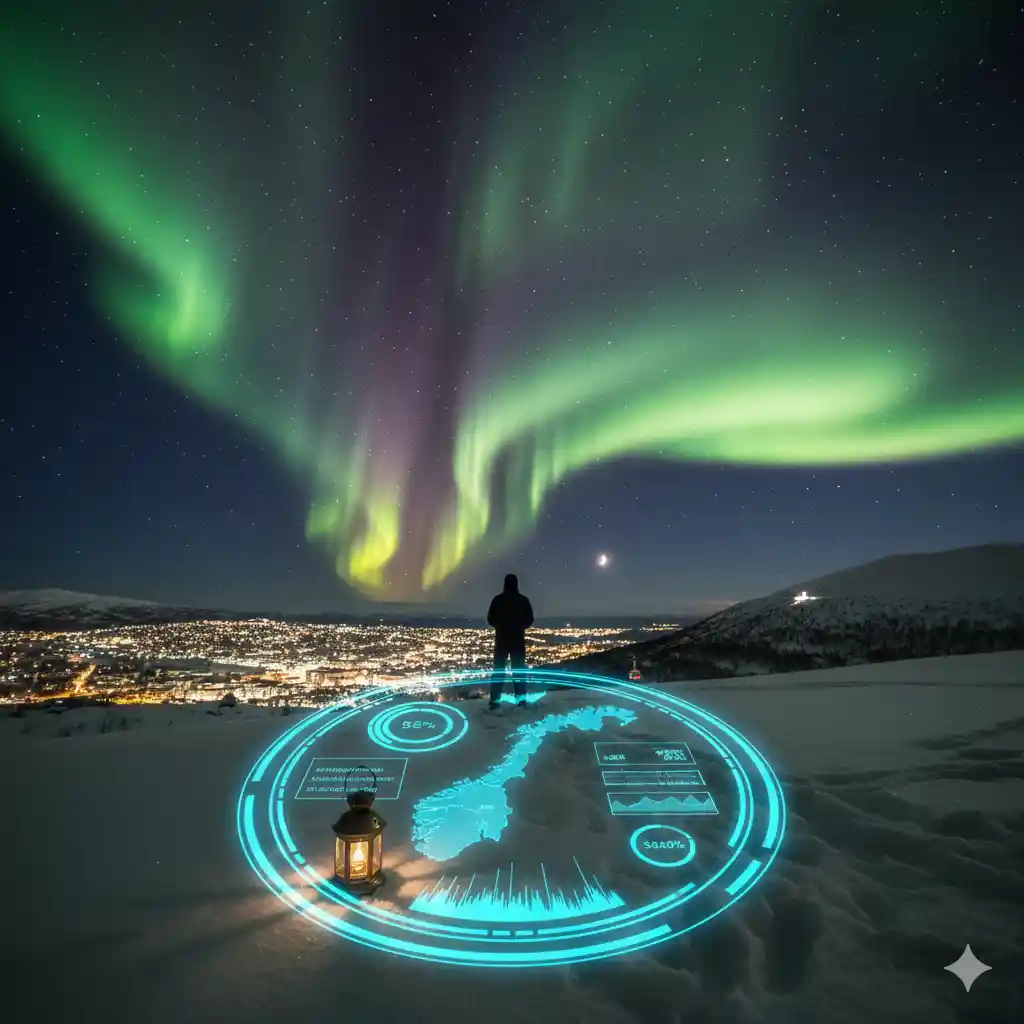
🌌 Tromsø Aurora Live Tracker
Real-time Northern Lights Forecast for Tromsø, Norway
Loading…
Connecting to NOAA space weather satellites…
Aurora Visibility Guide
✨ Data updates frequently. Refresh for the latest solar activity.
Current Aurora Oval (Satellite View)
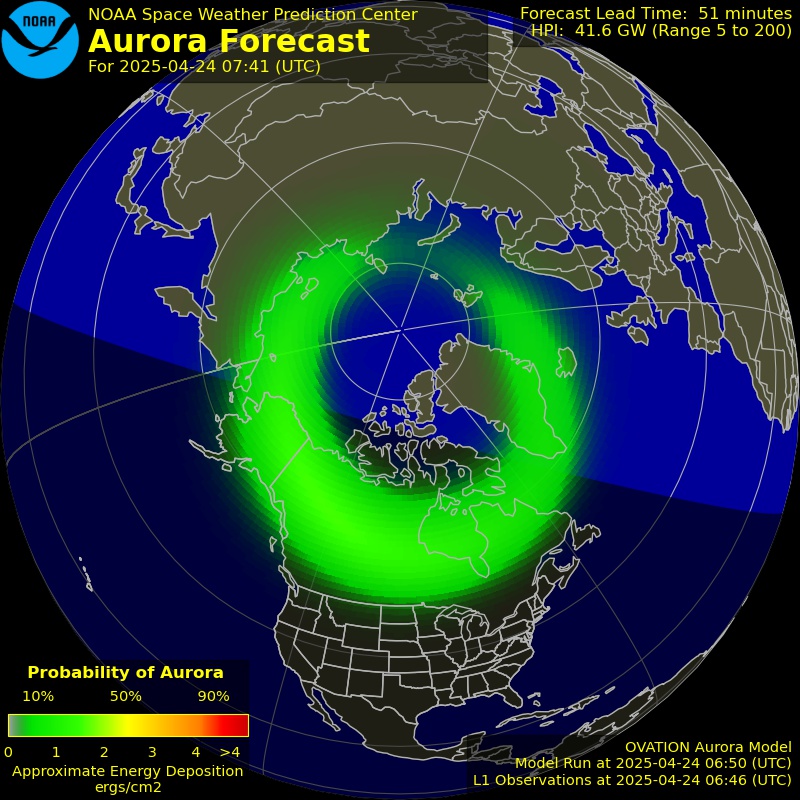
Data provided by NOAA / Space Weather Prediction Center
Check Other Northern Lights Hubs
The Gulf Stream Paradox
Tromsø sits 350 km north of the Arctic Circle, at roughly the same latitude as parts of northern Alaska — yet its winters rarely drop below -5°C, while places at similar latitudes freeze far harder. The reason is the Gulf Stream, which carries warm Atlantic water up the Norwegian coast and keeps the fjords ice-free year-round. That warmth is a mixed blessing for aurora hunters: it makes Tromsø comfortable enough to stand outside for hours, but it also means the same ocean that warms the city feeds it fast-moving weather systems. Clear skies here rarely last all night — they arrive and vanish in windows, which is exactly why “aurora chasing” is a real, organized activity in Tromsø in a way it isn’t in drier, more stable climates.
Why Locals Drive, Not Wait
Because Tromsø is surrounded by steep mountains, islands, and narrow fjords, cloud cover is intensely local — one valley can be socked in while a fjord twenty minutes away is glass-clear. Tour operators here don’t set up in one fixed spot and hope; they watch live cloud radar and drive toward whichever pocket of clear sky is opening up that night, sometimes crossing to Kvaløya island or heading inland toward Finnish territory to escape coastal cloud entirely. If you’re on your own rather than with a guide, treat this as your main strategy too: don’t commit to the first dark pull-off you find. Check a short-term cloud forecast — not just the aurora forecast — and be willing to move.
Reading the Sky in Polar Night
From late November to mid-January, Tromsø experiences the mørketid — the polar night, when the sun never rises above the horizon at all. This isn’t quite 24-hour darkness; there’s a soft blue twilight around midday. But it does mean aurora hunting isn’t confined to a narrow evening window the way it is farther south — a strong geomagnetic night can produce visible activity at 5 PM as easily as 1 AM. Outside polar night, the practical viewing window runs roughly 6 PM to 1 AM from September through March, narrowing as the days lengthen toward the March equinox, which is itself one of the more geomagnetically active periods of the year.
Getting Away From the City — By Land or Water
Telegrafbukta, a beach on the southern tip of Tromsøya island, is the closest real option to downtown — walkable in decent weather, with an open view north over the sound. Prestvannet, a frozen lake near the island’s highest point, trades the sea view for elevation and a darker sky pocket ringed by low hills. For something with more depth to it, Ersfjordbotn on Kvaløya puts jagged fjord peaks behind the display, and it’s far enough from town that light pollution stops being a factor entirely. Increasingly, though, the most reliable option isn’t a fixed location at all: small-boat aurora cruises head out into the fjords specifically because open water offers an unobstructed horizon and the flexibility to reposition mid-trip if the captain spots a break in the clouds elsewhere.
What a Strong Night Actually Looks Like
None of this changes the core math for Tromsø: the strongest geomagnetic storm in the world does nothing for you if the cloud bank sitting over the fjord doesn’t move. That’s the real difference between chasing the aurora here and chasing it somewhere with steadier weather — success in Tromsø is decided less by how active the sky is and more by whether you were willing to get in the car, or onto the boat, when the gap in the clouds finally opened. The locals who see it most aren’t the ones with the best gear. They’re the ones who left the house.