
🌌 Fairbanks Aurora Live Tracker
Real-time Northern Lights Forecast for Fairbanks, Alaska
Loading…
Connecting to NOAA space weather satellites…
Aurora Visibility Guide
✨ Data updates frequently. Refresh for the latest solar activity.
Current Aurora Oval (Satellite View)
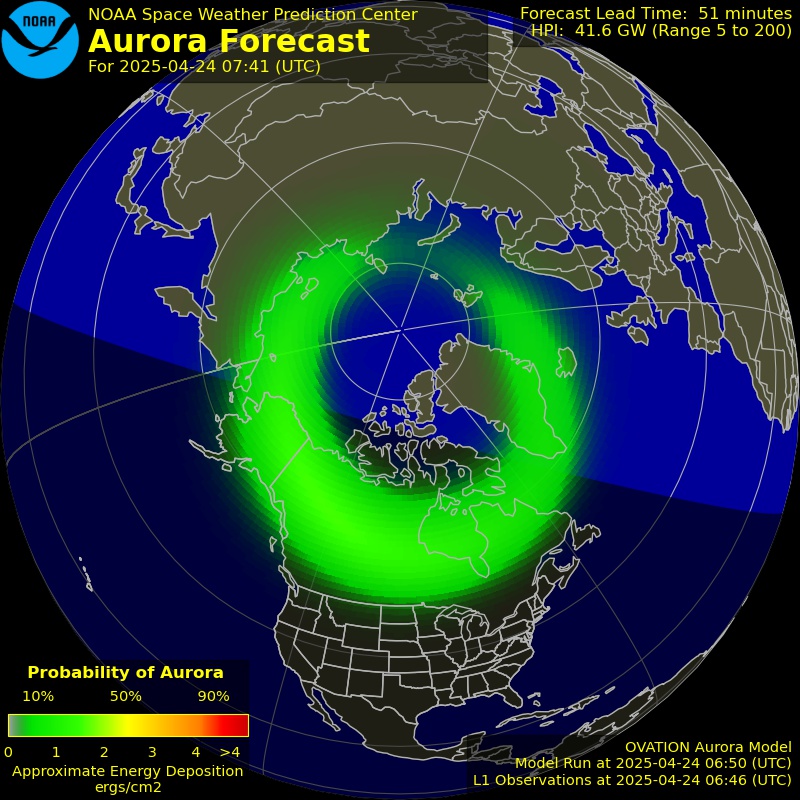
Data provided by NOAA / Space Weather Prediction Center
Check Other Northern Lights Hubs
Why Fairbanks Sits at the Statistical Center of the Oval
Most aurora destinations sit somewhere near the edge of the auroral oval, which means their odds swing hard with solar activity. Fairbanks is different: at roughly 65°N, deep in Alaska’s interior, it sits close to the statistical center of the auroral zone — the band of sky where the oval is present on the highest number of nights per year, regardless of how active the sun is. That’s the reason Fairbanks tourism boards can quote a specific number rather than a vague promise: stay three nights during aurora season and you have roughly a 90% chance of a clear sighting. It’s not marketing optimism — it’s a direct consequence of sitting inside the zone the oval occupies most reliably, rather than at its shifting southern boundary.
The Geophysical Institute Forecast
Fairbanks is home to the University of Alaska Fairbanks Geophysical Institute, which runs its own 27-day and 3-day aurora forecasts specifically for the region — a resource that predates most commercial aurora apps and is still treated as the authoritative local source. A few miles outside town sits Poker Flat Research Range, the only university-owned rocket range in the world, where scientists launch sounding rockets directly into active aurora to study the particle physics involved. That’s not a tourist detail — it’s the reason Fairbanks’ own forecast tools tend to be more precise about local timing than generic global Kp trackers, because they’re built by people studying this exact patch of sky.
Ice Fog and the Dry Cold Advantage
Interior Alaska’s cold isn’t like coastal cold. Fairbanks sits in a valley shielded by the Alaska Range to the south, which blocks most Pacific storm systems from reaching it — the tradeoff for winter temperatures that regularly fall below -30°F is exceptionally dry air and an unusually high number of clear nights. The one quirk this produces is ice fog: on the very coldest nights, moisture from car exhaust, power plants, and even human breath can freeze directly into a low-hanging fog over town. It rarely extends far outside city limits, but it’s a real reason locals head a short distance out of Fairbanks proper even on a clear night — not to escape light, but to escape the fog bank sitting directly over downtown.
Where People Actually Wait It Out
Because clear Fairbanks nights are common but the cold is genuinely dangerous to sit in for hours, an entire local industry has grown around waiting for the aurora in comfort rather than standing exposed to it. Chena Hot Springs Resort, about an hour from town, pairs an aurora-viewing dome and heated cabins with its geothermal pools, and runs its own aurora alert system to wake guests when activity picks up. Closer to the city, Cleary Summit and Murphy Dome — both accessible by road and both above the valley’s ice fog layer — are the default spots for anyone driving out rather than booking a lodge, offering wide, elevated views with none of the terrain-blocking that a river valley location would give you.
A Season Built Around Reliability, Not Luck
Fairbanks’ aurora season runs from roughly August to April — dates the Geophysical Institute itself uses, based on when the sky is dark enough for viewing rather than any seasonal change in solar activity. That same institute times its Poker Flat rocket launches around forecast windows it trusts enough to bet real equipment on, which says something about how this location behaves compared to most: elsewhere, a forecast is a guess about whether the display will reach you at all. In Fairbanks, the question being answered is closer to “how big will it be,” not “will it happen” — the kind of confidence that comes from sitting inside the zone the researchers next door have spent decades studying.
Not in Fairbanks? Go back to our Northern Light Live Tracker!