
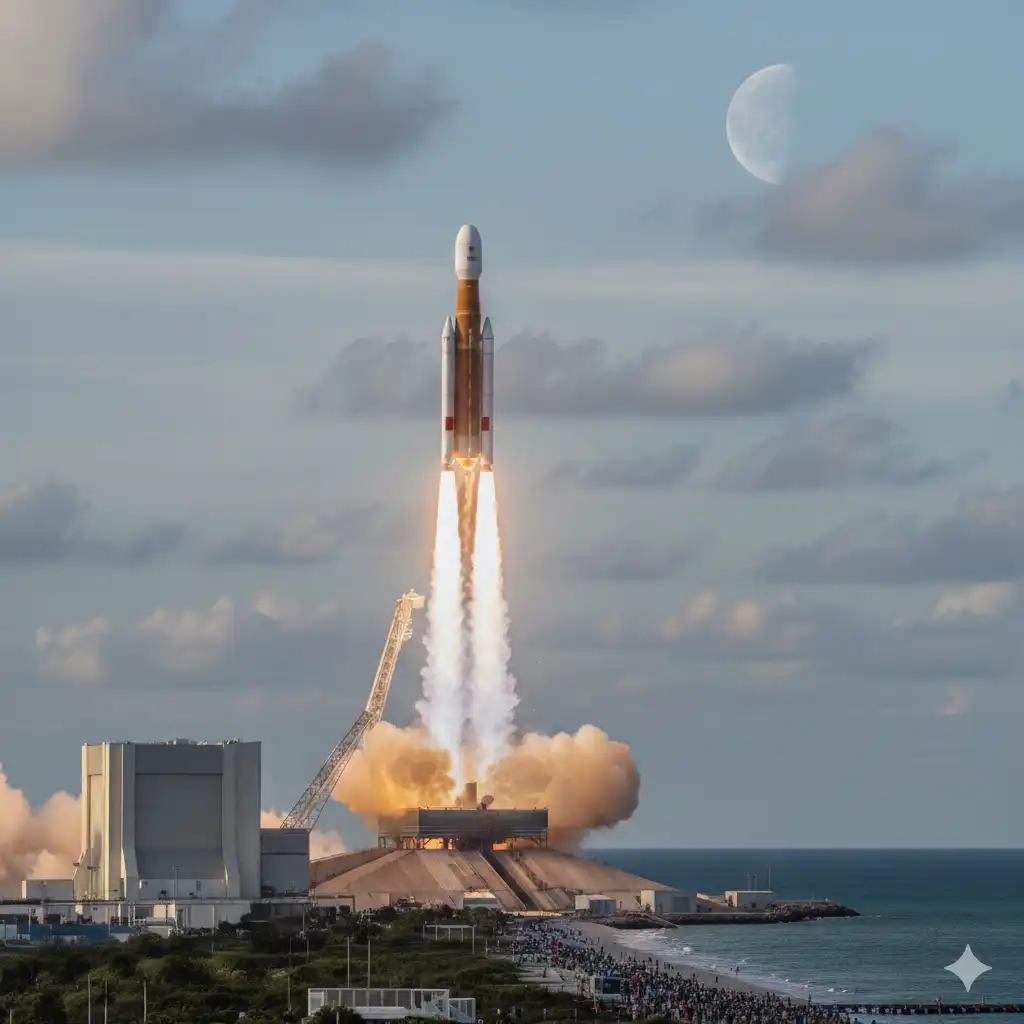
Experience the historic Artemis II mission in real-time. Follow the four-person crew as they journey beyond the Moon and back in the Orion spacecraft. Use our live tracker, mission countdown, and flight telemetry to stay updated on every second of this monumental leap for deep space exploration.
Artemis II Status Update: April 11, 2026
Following a historic journey around the Moon and a flawless return through deep space, NASA has confirmed that Artemis II is officially a success. The Orion spacecraft successfully completed its high-stakes atmospheric reentry and executed a perfect splashdown in the Pacific Ocean. With the crew safely recovered, this mission marks the first time humans have ventured to the lunar vicinity in over 50 years, proving that the systems are ready to return humanity to the Moon’s surface.
Artemis II Mission Report
The Orion spacecraft has safely returned to Earth.
Pacific Ocean Recovery Successful
Total Mission Duration: 10 Days
Artemis II: A Historic Success
The crew has safely returned. Relive the journey of humanity’s return to the Moon!
Artemis 2: Mission Flight Profile
🚀 DAY 1: LIFTOFF
The SLS Rocket ignites at Kennedy Space Center. After reaching orbit, the crew performs critical health checks on the Orion capsule.
🌍 DAY 2: LEAVING EARTH
Trans-Lunar Injection (TLI): Orion fires its main engine to break free from Earth’s gravity, setting a direct course for the Moon.
🌕 DAY 4: LUNAR FLYBY
The historic moment. The crew swings around the far side of the Moon, reaching an altitude of 4,067 miles above the lunar surface.
🛰️ DAY 5-9: DEEP SPACE TRANSIT
As Orion heads home, the crew tests high-bandwidth laser communications and monitors radiation levels during the long trek back to Earth.
🌊 DAY 10: SPLASHDOWN
Re-entry at 25,000 mph. Orion’s heat shield endures 5,000°F before a parachute-assisted landing in the Pacific Ocean.
Meet the Artemis 2 Crew
*Artemis 2 is the first crewed lunar mission since Apollo 17 in 1972.
Want to know how the mission compares to the 1960s? Read our deep-dive: Artemis vs. Apollo!
Artemis 2: The Dawn of a New Lunar Era
For the first time in over half a century, humanity is preparing to send a crewed spacecraft to the vicinity of the Moon. While the Apollo program of the 1960s and 70s was born from a Cold War race, the Artemis program is a multi-national, sustainable effort to establish a long-term presence on the lunar surface. Artemis 2 serves as the critical “proof of concept,” testing the most powerful rocket ever built and a spacecraft designed to keep humans alive in deep space. While Artemis 3 is about landing on the Moon.
The SLS Rocket: Powering the Return to Flight
The backbone of the Artemis 2 mission is the Space Launch System (SLS). As of 2026, the SLS remains the only human-rated rocket capable of sending the Orion spacecraft, astronauts, and heavy cargo to the Moon in a single mission. Standing at 322 feet, the SLS Block 1 configuration generates a staggering 8.8 million pounds of maximum thrust—15% more than the legendary Saturn V.
The core stage, flanked by two five-segment solid rocket boosters, provides the initial escape from Earth’s gravity well. For the Artemis 2 mission, the SLS must perform a perfect Trans-Lunar Injection (TLI), a maneuver that accelerates the Orion capsule out of Earth orbit and toward the lunar sphere of influence.
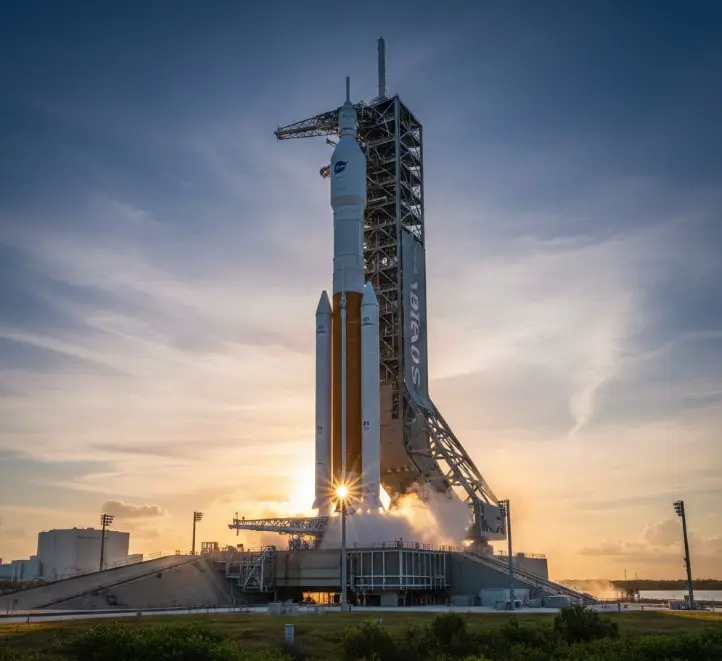
Orion Spacecraft: A Sanctuary in the Void
While the SLS provides the muscle, the Orion spacecraft provides the brain and the shield. During the 10-day journey, the four-person crew will rely on Orion’s European Service Module (ESM), provided by ESA, for air, water, and propulsion.
One of the most critical tests during Artemis 2 is the validation of the Environmental Control and Life Support System (ECLSS). Unlike the uncrewed Artemis I mission, Artemis 2 will see humans monitoring CO2 scrubbing, temperature regulation, and radiation shielding in real-time. As the crew travels thousands of miles beyond the Moon’s far side, they will experience higher radiation levels than any humans in history, making Orion’s protection systems a primary focus for NASA engineers.
Mission Profile: The Hybrid Free Return Trajectory
Artemis 2 does not follow a direct path to the Moon. Instead, it utilizes a Hybrid Free Return Trajectory. After launch and an initial orbit around Earth to verify systems, the Interim Cryogenic Propulsion Stage (ICPS) will propel the crew toward the Moon.
The beauty of this trajectory is its inherent safety. If a propulsion system fails after the TLI, Earth’s gravity will naturally pull the spacecraft back for a safe splashdown. The crew will reach a point approximately 4,067 miles (7,400 km) beyond the lunar far side. From this vantage point, they will see the “Earthrise” in a way that only 24 people in history have seen before.
If you wanna know the Moon Phase right now, use our tracker!
Why Artemis 2 is Different from Apollo
A common question among space enthusiasts is: “Why are we doing this again?” The answer lies in sustainability and diversity.
- Technological Maturity: The computing power aboard Orion is exponentially greater than that of the Apollo Guidance Computer.
- The Artemis Accords: This mission isn’t a solo act. It involves a coalition of nations, represented on this flight by the inclusion of a Canadian Space Agency (CSA) astronaut.
- Path to Mars: NASA’s “Moon to Mars” strategy uses Artemis as a testbed. The technologies validated on the 2026 mission—such as deep-space communication and long-term life support—are the same ones that will eventually take humans to the Red Planet.
Science and Objectives: What We Hope to Learn
While Artemis 2 is a flight test, it is also a scientific opportunity. The crew will perform a “proximity operations” demonstration. After separating from the ICPS, the crew will use the Orion spacecraft to maneuver back toward the spent rocket stage. This tests Orion’s manual handling qualities, which will be essential for future missions that involve docking with the Lunar Gateway (a planned space station in lunar orbit).
Furthermore, the mission will collect vital data on the Van Allen Radiation Belts. Passing through these belts is one of the most dangerous parts of the journey. By measuring how the spacecraft and the human body react to this environment, NASA can better prepare for the years-long journeys required for Mars exploration.
The Road to the Lunar Surface (Artemis 3 and Beyond)
Artemis 2 is the final gatekeeper before the actual landing. Once the crew of Artemis 2 successfully splashes down in the Pacific Ocean and validates that all systems are “Go,” NASA will turn its attention to Artemis IV . That mission will utilize a variant of SpaceX’s Starship as the Human Landing System (HLS) to put the first woman and the first person of color on the lunar South Pole.
The South Pole is the ultimate goal because of its “permanently shadowed regions” (PSRs). These craters are believed to contain water ice—a “gold mine” that can be converted into oxygen and rocket fuel, enabling a permanent lunar base.
We got the Moon Phase Calendar ready for you!
Artemis FAQ
Artemis II successfully launched from Kennedy Space Center on April 1, 2026, carrying a four-person crew on a historic 10-day lunar flyby before safely splashing down in the Pacific Ocean on April 11, 2026.
No, Artemis 2 is a lunar flyby mission. The crew will fly around the Moon to test life support systems. The actual landing will happen during the Artemis IV mission.
The crew consists of Commander Reid Wiseman, Pilot Victor Glover, and Mission Specialists Christina Koch and Jeremy Hansen.
The mission is expected to last approximately 10 days from launch to splashdown.
The main objective is to confirm that all of the Orion spacecraft’s systems, including life support and communication, operate as designed with humans aboard in the deep space environment.
Artemis 2 will be launched by the Space Launch System (SLS) rocket, which is currently the most powerful rocket in the world.
The crew will travel thousands of miles beyond the Moon, reaching a point farther from Earth than any human has ever traveled before.
The astronauts will live and work inside the Orion spacecraft, which is specifically designed for long-duration human spaceflight beyond low Earth orbit.
The mission will conclude with a splashdown in the Pacific Ocean, where the Orion capsule and its crew will be recovered by a joint NASA and U.S. Navy team.