
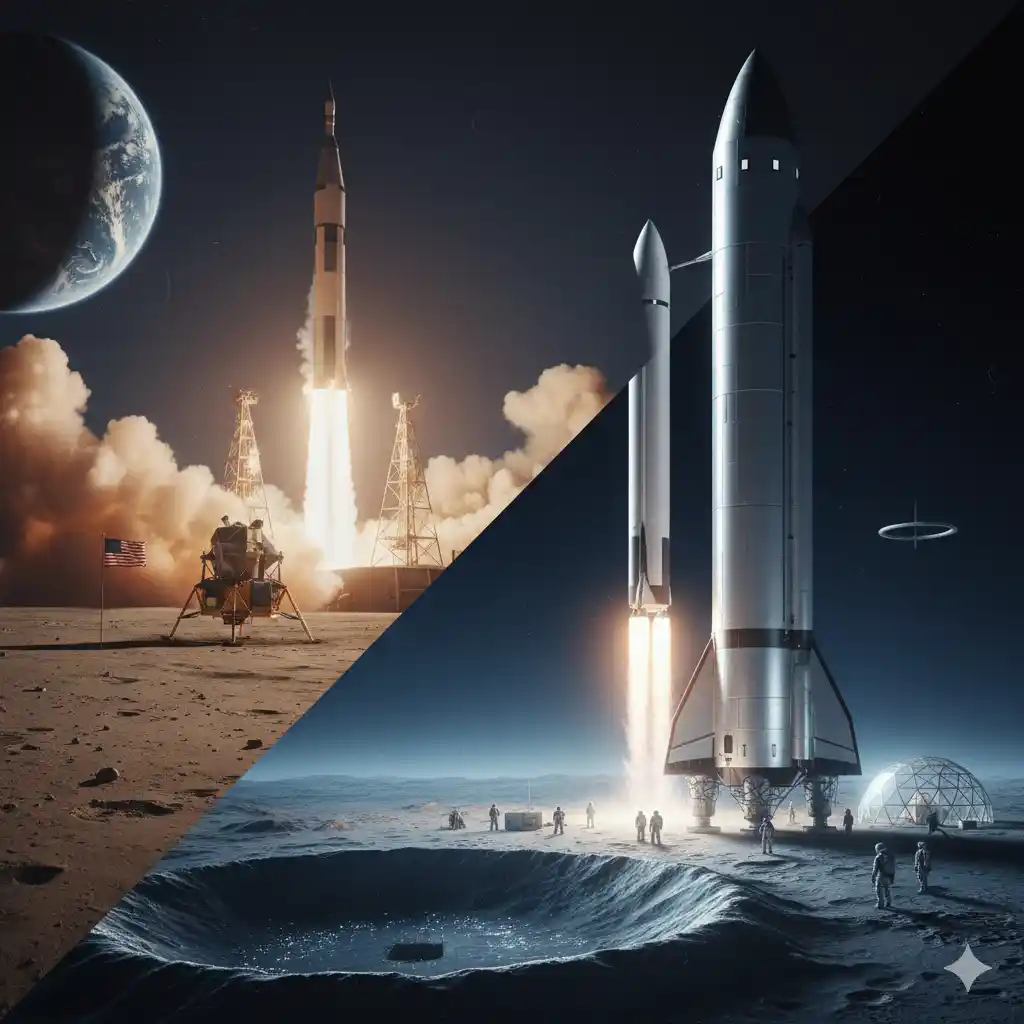
It’s been more than 50 years. Apollo 11. Everyone’s heard of the Apollo mission. Humans went to the Moon – and now we’re on our way again. A lot of people have asked themselves ‘why has it taken so long to get back to the Moon?’. In this deep-dive we’ll explain why, how it’s gonna happen and when. There’s a massive technological difference between Artemis and Apollo.
The Technology Leap: From 8-Bit Computers to Autonomous Starships
While Neil Armstrong and Buzz Aldrin landed on the Moon with less computing power than a toaster has today, the technology leap from then to now is almost unfathomable. The Apollo Guidance Computer, though an incredible piece of technology at the time, ran at an astonishing 0.043 MHz. Today, while the Artemis program uses autonomous technology capable of processing millions of data points in one second, the Apollo program used manual switches and paper checklists.
The most obvious change is in the landing craft. The original Lunar Module (LM) was a delicate, one-time-use craft intended for two people and a 72-hour visit. The new program will employ the Starship HLS (Human Landing System). This gargantuan, reusable craft has more living room than most luxury apartments and can haul tons of cargo. Unlike the LM, Starship is intended for autonomous docking and refueling in orbit. This is a move from “getting there” to “operating there.” It is a move from a delicate lunar spider to a robust deep-space freighter.
Safety Standards: Why We Can’t Take “Apollo Risks” Anymore
In the 1960s, the Space Race was a geopolitical battle. NASA had a mantra of “Failure is Not an Option,” but they took risks that would be considered absurd today. The Apollo missions were like a sprint. If one piece of hardware failed during descent, the chances of survival for the astronauts on board were low. We live in a world where everything is watched in 4K resolution, and if a failure occurs, the stakes are higher.
This is why the Artemis Mission Timeline appears “slow” in comparison to the 1960s. NASA, along with partners like SpaceX, has a much lower tolerance for risk in space exploration. Every piece of hardware has to have triple redundancy. We are no longer trying to sprint ahead of the Soviet Union; we are trying to build a reliable transportation network for permanent habitation of space. The extensive uncrewed testing of the SLS (Space Launch System) and the heat shield is a testament to this new era of space exploration. We are not just trying to get to the Moon; we are trying to get there safely and then back again every single time.
The Moon’s South Pole vs. The Equatorial Plains
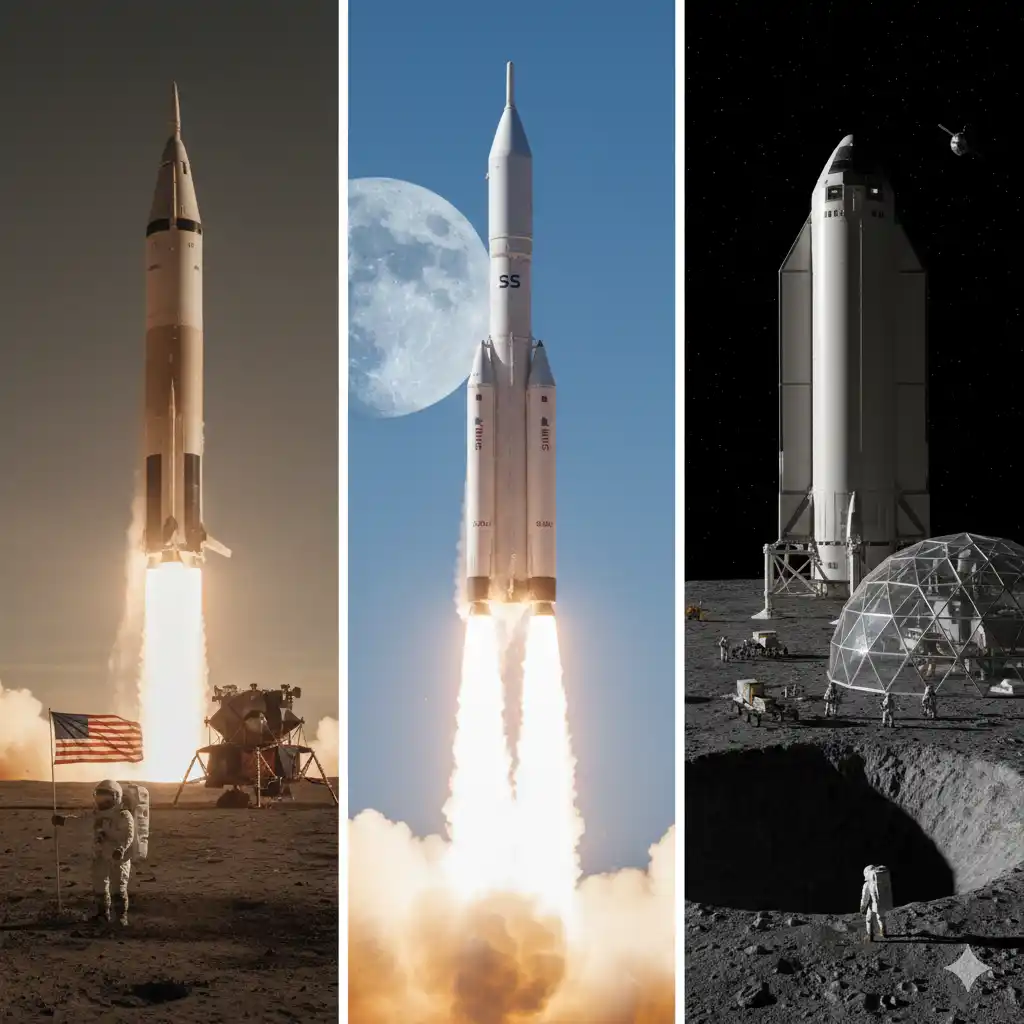
If you examine the Apollo landing map, you will see that all six missions landed close to the Moon’s equator. This was because it was a flat, bright, and easily accessible area from an orbital perspective. It was a “safe” place to park the spacecraft for a quick visit. But the Artemis mission has its sights set on the South Pole of the Moon, which is an area of intense shadows and very rough terrain.
Why would you want to go to such a dangerous place? The answer is water. While the equatorial regions were hot and dry, like the Apollo landings, the South Pole has “permanently shadowed regions” where the temperature never exceeds -250°F. In these craters, billions of tons of water ice have been lying undisturbed for millions of years. Water is more valuable than gold for a sustainable mission, and it can be purified for drinking, used for agriculture, or separated into hydrogen and oxygen for fuel. This is the difference between camping out in the backyard and settling a homestead in the wilderness.
Sustained Presence vs. Flags and Footprints
These missions are commonly referred to as “Flags and Footprints” missions. These were incredible feats of engineering and exploration, but they are also short-term scientific forays. Collect the samples and plant the flag—mission accomplished! There is nothing left behind, nothing that allows us to remain on the Moon. Artemis is a completely different proposition. And with the Artemis 3 Mission, people will actually land on the surface of the moon.
One of the key concepts of Artemis is the construction of a small space station that will orbit the Moon. This space station will serve as a communication relay, a science lab, and a short-term residence for astronauts. No longer will we make a single journey from Earth to the Moon’s surface. Instead, we are designing a multi-stage highway. And this highway is merely a stepping stone for our ultimate destination—Mars! We are learning how to live on the Moon for months at a time, and this is merely a precursor for our journey that will take years to reach Mars. We are no longer merely visiting this celestial body—we are moving in!
Radiation and Deep Space Survival: Modern Challenges
One of the most discussed topics by space enthusiasts is how the Apollo astronauts managed to survive in the Van Allen Belts. Although it is true that these missions did not last long enough, and therefore the amount of radiation was tolerable, it is still true that Artemis faces an even more deadly challenge. This is because, unlike in the Apollo missions where astronauts stayed only briefly, in Artemis, astronauts will be staying on the Moon for weeks or months and thus exposed to SPE and GCR.
In the 1960s, our knowledge of long-term exposure to radiation and its effects on the human body was in its early stages of development. Now we know that exposure to deep space radiation can cause DNA damage, leading to an increased risk of cancer and heart disease. The astronauts will have access to state-of-the-art radiation vests, and lunar bases will probably have a thick layer of lunar soil to protect against radiation. Space suits are no longer just bags with a pressurized environment; they are spacecraft that can withstand the jagged lunar dust that caused so many problems for the Apollo astronauts. At last, we have the knowledge and tools to survive in the harshest environment that humans have ever encountered.