
Planet
Orbital Period: days
Distance from Sun: AU
Live Planetary Alignment
Select a date to view positions. Click any planet to zoom in and see details.
How much do I weigh on Jupiter? Find out with our Calculator!
Live Solar System Positions in Real 3D Space
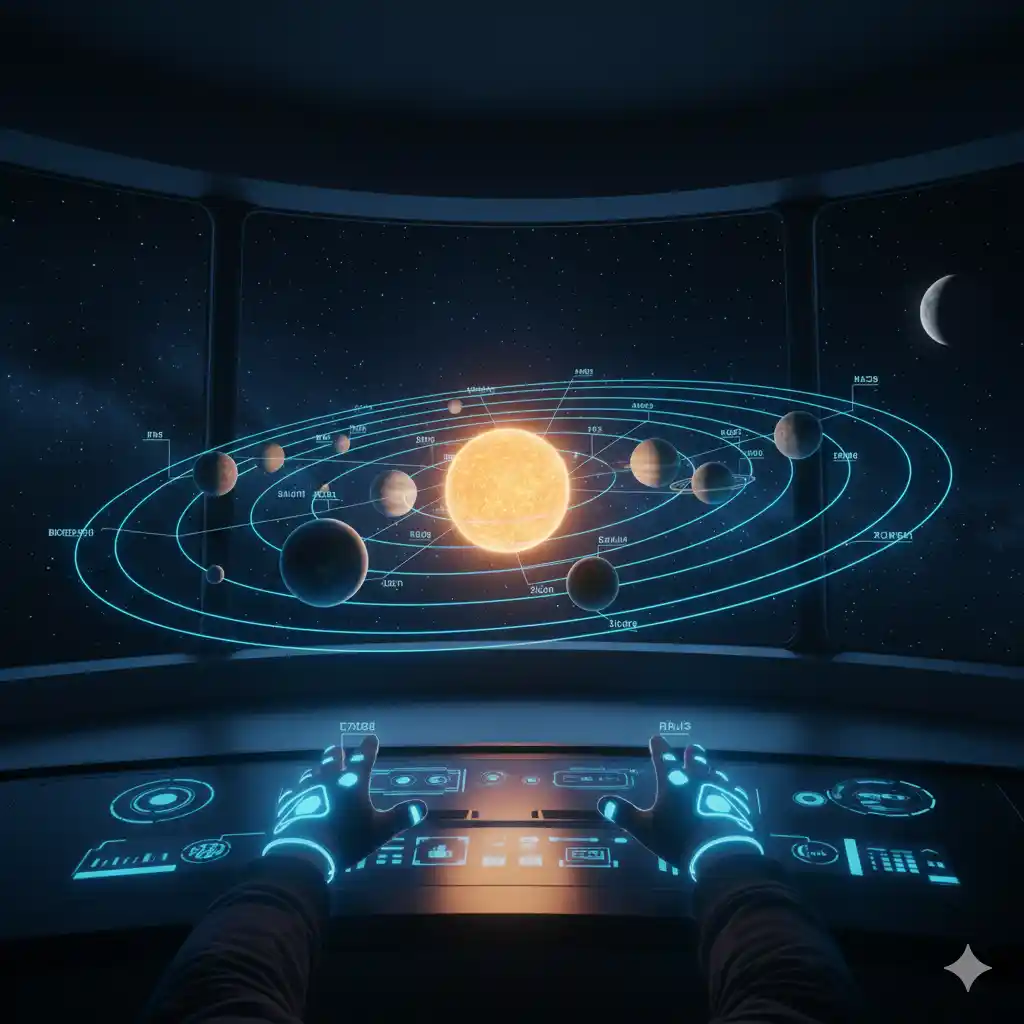
If you’ve ever looked up into the night sky and wondered where the planets are right now, you’re not alone. This page exists for one reason only: to show planet positions today in real, living space — not in a static diagram, not in a textbook illustration, but in a fully interactive 3D solar system that updates as time moves on.
This is not a poster.
This is the solar system live.
Every planet you see in the model above is placed based on real orbital mechanics calculated from the J2000 astronomical epoch. When you select a date, you are literally traveling through time and watching the planets slide along their true orbital paths around the Sun.
So yes — this is where the planets are right now.
Why “Where Are the Planets Now” Matters
The phrase where are the planets now is searched every single day by skywatchers, astrophotographers, amateur astronomers, telescope owners, astrology researchers, students, and curious night-sky lovers.
And for good reason.
Planet positions today affect:
• What you can see in the sky tonight
• Which planets are rising before sunrise
• Which planets dominate the evening sky
• Planetary alignments
• Conjunctions and oppositions
• Retrograde motion
• Telescope visibility
• Astrophotography targets
Knowing where the planets are right now literally changes what the sky looks like above your head.
What You’re Actually Looking At
This is a true 3D solar system simulator, not a flat animation.
Each planet is positioned by calculating:
• Orbital period
• Distance from the Sun (AU)
• Angular displacement since J2000
• Real heliocentric orbital rotation
That means when you rotate the model, zoom in on Mars, or jump ten years into the future — you are watching the real solar system geometry evolve in real time.
This is why the model feels alive. Because it is.
Planet Positions Today – What Each World Is Doing Right Now
Mercury – The Speed Demon
Mercury orbits the Sun in just 88 days, making it the fastest planet in the solar system. That’s why its position changes dramatically even within a single week. If you’re checking planet positions today to spot Mercury, timing is everything — it never strays far from the Sun and is best seen during brief morning or evening windows.
When does the Moon Go Down? Use our Tracker here!
Venus – Earth’s Bright Twin
Venus dominates the sky when it appears. Its slow graceful orbit makes it the brightest object in the night sky after the Moon. Watching Venus slide around the Sun in real 3D shows exactly why it becomes the Morning Star… then the Evening Star… then disappears again.
Earth – Your Moving Platform
Earth is not standing still. Our planet is constantly shifting position in relation to Mars, Jupiter, and Saturn. That changing geometry is why planetary oppositions happen — and why Mars sometimes becomes spectacularly bright in our sky.
Mars – The Red Planet
Mars takes 687 days to orbit the Sun. When you look at Mars positions today, you are literally seeing whether Earth is catching up to Mars (opposition) or falling behind. This directly controls how bright Mars appears in your telescope.
Jupiter – The Giant
Jupiter’s slow majestic orbit controls major sky events for years at a time. Watching Jupiter move through the solar system live makes it painfully obvious why some years give us stunning Jupiter seasons — and others barely show it at all.
Saturn – The Ringed King
Saturn’s 29-year orbit makes its sky placement long-term and predictable — but no less magical. Seeing Saturn’s path in this simulator explains why its rings tilt differently over the decades.
Where is the Sun right now? Look at our map!
Uranus & Neptune – The Ice Giants
These distant giants move slowly, quietly, and beautifully through space. Most people have never actually seen their real orbital motion. Here — you can.
Why This Tool Is So Powerful
Most planet websites show tables.
This shows reality.
• Rotate freely
• Zoom to any planet
• Travel forward and backward in time
• See real heliocentric geometry
• Understand why alignments happen
• Visualize distances and angles
• Learn orbital mechanics intuitively
This is how astronomers think.
Planet Positions Today = Real Sky Tonight
When you ask “where are the planets now,” what you’re really asking is:
• Which planet can I see tonight?
• Where should I point my telescope?
• Is Mars close to Earth right now?
• Is Jupiter rising after sunset?
• Are any alignments happening?
This simulator answers all of that — visually, instantly, accurately.
Space is not static.
The solar system is a living clockwork machine — and you are watching it in motion.
This page doesn’t show you a diagram.
It shows you the real solar system. Right now.
And now you finally know:
Where the planets are now. 🌍🚀
Planets FAQ
The positions of the planets change constantly as they orbit the Sun at different speeds. Our Live 3D Solar System Simulator uses real-time astronomical data to show the exact current coordinates of all eight planets, allowing you to track their movement across the ecliptic plane from your specific location.
The planets visible to the naked eye are Mercury, Venus, Mars, Jupiter, and Saturn. Whether they are visible depends on if they have risen above your horizon and if the Sun has set. Use the simulator to “look ahead” and see which planets will be up during your local night hours.
Opposition is the best time to observe a planet. It occurs when Earth is directly between the Sun and another planet (like Mars, Jupiter, or Saturn). During opposition, the planet rises at sunset, sets at sunrise, and appears at its largest and brightest through a telescope.
The simplest way is the “Twinkle Test.” Stars twinkle; planets do not. Because planets are closer to Earth, they appear as tiny disks rather than points of light, which stabilizes the light passing through our atmosphere. If a bright object in the sky is shining with a steady, flat light, it is almost certainly a planet.
Retrograde motion is an optical illusion that happens when Earth “overtakes” a slower-moving outer planet or is overtaken by a faster inner planet. On the 3D map, you will see the planet appear to slow down and momentarily move backward against the stars. It is a purely perspective-based phenomenon, like passing a slower car on the highway.
Planetary speed is determined by distance from the Sun (Kepler’s Laws). Mercury is the fastest, completing an orbit in just 88 days, while Neptune takes about 165 years. The simulator accurately reflects these orbital velocities to show you the real-time “race” around the Sun.
A planetary alignment occurs when several planets appear in the same region of the sky from Earth’s perspective. While the planets never form a perfectly straight line in 3D space, they often cluster along the ecliptic (the Sun’s path), creating a spectacular visual “parade” for stargazers.