
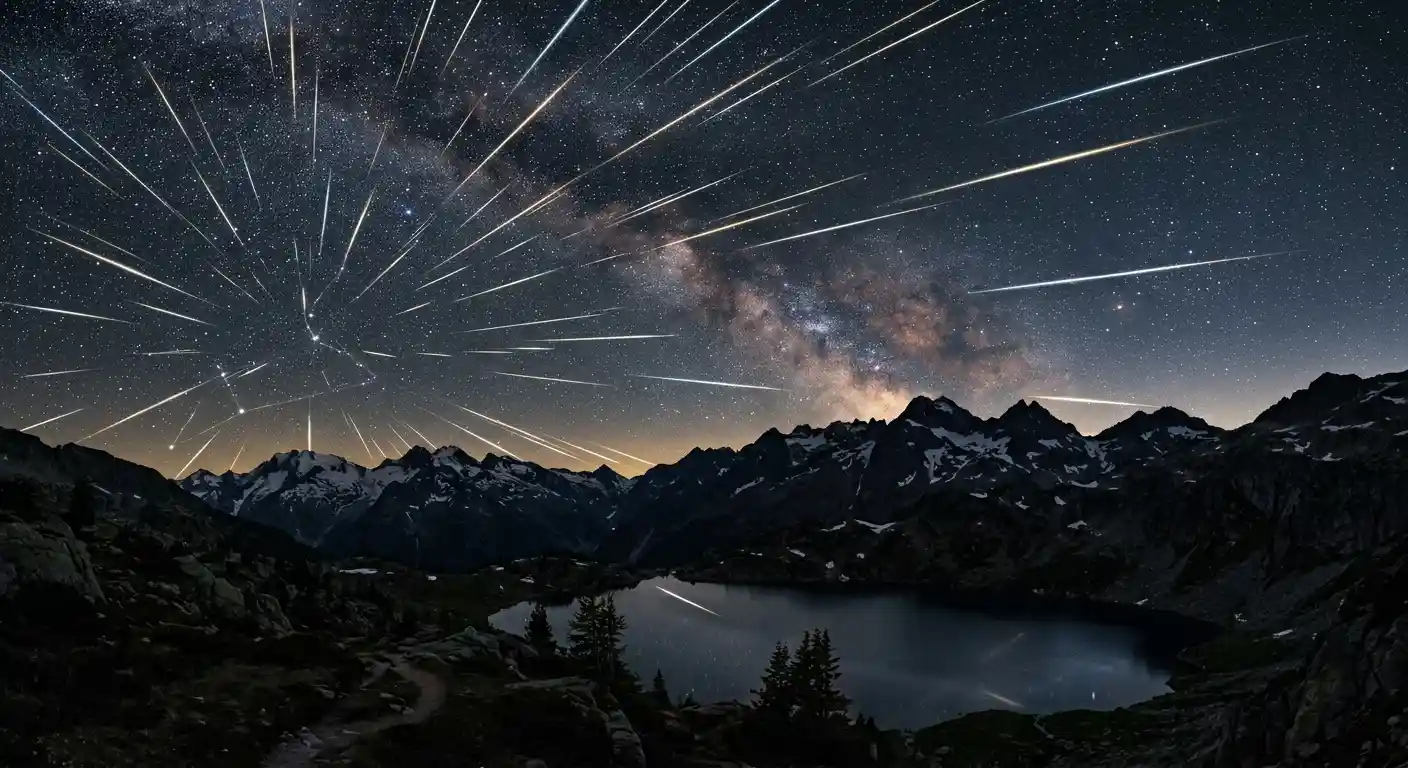
Peak night November 17 · about 15 meteors per hour · the fastest meteors of the year
Leonid Meteor Shower Countdown
Leonids peak every year around November 17
About 15 meteors per hour. Best viewing from 2 AM until dawn, local time.
Meteor storms: the Leonids’ record
Every 33 years the parent comet comes close to the Sun and leaves a fresh trail of dust. If Earth hits that trail, the Leonids turn into a storm, with thousands of meteors per hour.
Last big storm: 2002. Next comet return: 2031.
Speed compared to other showers
Meteor speed when hitting the atmosphere, in km/s. Fast meteors are often bright and leave glowing trains that last a few seconds.
What to expect in a normal year
The radiant in Leo rises around midnight, so the hours before that are quiet. The best time is from 2 AM to dawn.
What are the Leonids?
The Leonids are a November meteor shower with a big reputation. In a normal year they are modest, about 15 meteors per hour under a dark sky. But they are the fastest of the major showers, hitting the atmosphere at about 71 km/s (159,000 mph), and they produce bright fireballs and glowing trails that can last a few seconds.
They come from comet 55P/Tempel-Tuttle, which goes around the Sun every 33 years. Each time it passes, it leaves a fresh trail of dust. Most years Earth crosses the thin, old part of that trail. Once in a while it hits a new, dense part, and the Leonids turn into a storm.
The Leonid storms
In 1833 the Leonids put on a show that people wrote about for decades. Estimates run above 100,000 meteors per hour over North America. In 1966 observers in the western US saw thousands per minute for a short time. The last strong displays came between 1999 and 2002, a few years after the comet’s last visit in 1998.
There is no storm forecast for 2026. The comet comes back in 2031, and the years around that date have the best chance of strong rates. Until then, expect a quiet shower with a few good fireballs.
When to watch in 2026
The Leonids are active from November 6 to 30, and the peak is on November 17. Rates stay close to the maximum for a day or two on each side, so November 16 and 18 are also worth a try.
The constellation Leo, where the meteors seem to come from, rises around midnight. Before that, you will see very little. The best time is from 2 AM until dawn, when Leo is high in the sky. If you want to see them, go to bed early and set an alarm.
The Moon in 2026
New Moon is on November 9. By the peak night, the Moon is about half lit. It sets around midnight or 1 AM local time, so the last hours before dawn are dark. That is a good match, because those are the hours when you want to be outside.
How many will you see?
In a normal year, this is what to expect:
- City center: 1 to 3 per hour
- Suburb: 4 to 6 per hour
- Rural area: 8 to 12 per hour
- Dark sky site: 12 to 15 per hour
The numbers are lower than for the Geminids, but the Leonids make up for it in brightness. Many of the meteors you see will be fast and bright, and a few will leave a trail that stays in the sky after the meteor is gone.
How to watch
Dress for the cold. November nights are cold, and you will be lying still for an hour or more. Wear a winter coat, a hat and warm socks, and bring a blanket.
Look at the whole sky. Meteors near Leo look short. The long ones show up 40 to 60 degrees away from it. You don’t need to find the constellation.
Give your eyes 20 minutes. A phone screen ruins your night vision. Use a red light if you need one.
Skip the telescope. Binoculars and telescopes only show a small part of the sky. A reclining chair is the best equipment.
Check the cloud forecast. If your area is covered, drive to a spot that is clear. A clear sky matters more than anything else.
Photography
Put your camera on a tripod with a wide lens (14 to 24 mm), f/2.8 or lower, ISO 3200 and 10 to 15 second exposures. Use an interval timer and shoot as many frames as the battery allows. Face away from the Moon and street lights. Leonids are fast, so each meteor shows up as a short, sharp line, which is easier to catch than the slow Geminids.
The stronger Geminids follow four weeks later, on December 14.
The shower is active from November 6 to 30, with the peak on November 17. November 16 and 18 are also good if the peak night is cloudy.
From 2 AM until dawn, local time. Leo rises around midnight, so the early evening hours are quiet.
Up to about 15 under a dark sky. In a city, expect 1 to 3 per hour, and in the countryside 8 to 12.
No. A storm needs Earth to cross a dense, fresh dust trail, and none is expected this year. The comet returns in 2031, and the chances of a storm are highest around then.
The comet orbits the Sun in the opposite direction to Earth, so the dust hits us head-on at about 71 km/s. That is twice the speed of the Geminids, which is why Leonids are bright and often leave glowing trails.
Not much. The Moon is about half lit and sets around midnight or 1 AM, so the best hours before dawn are dark.
Look at the whole sky, not only at Leo. Lie back and keep your eyes wide open. The longest meteors appear 40 to 60 degrees from the constellation, and a spot away from street lights helps the most.