
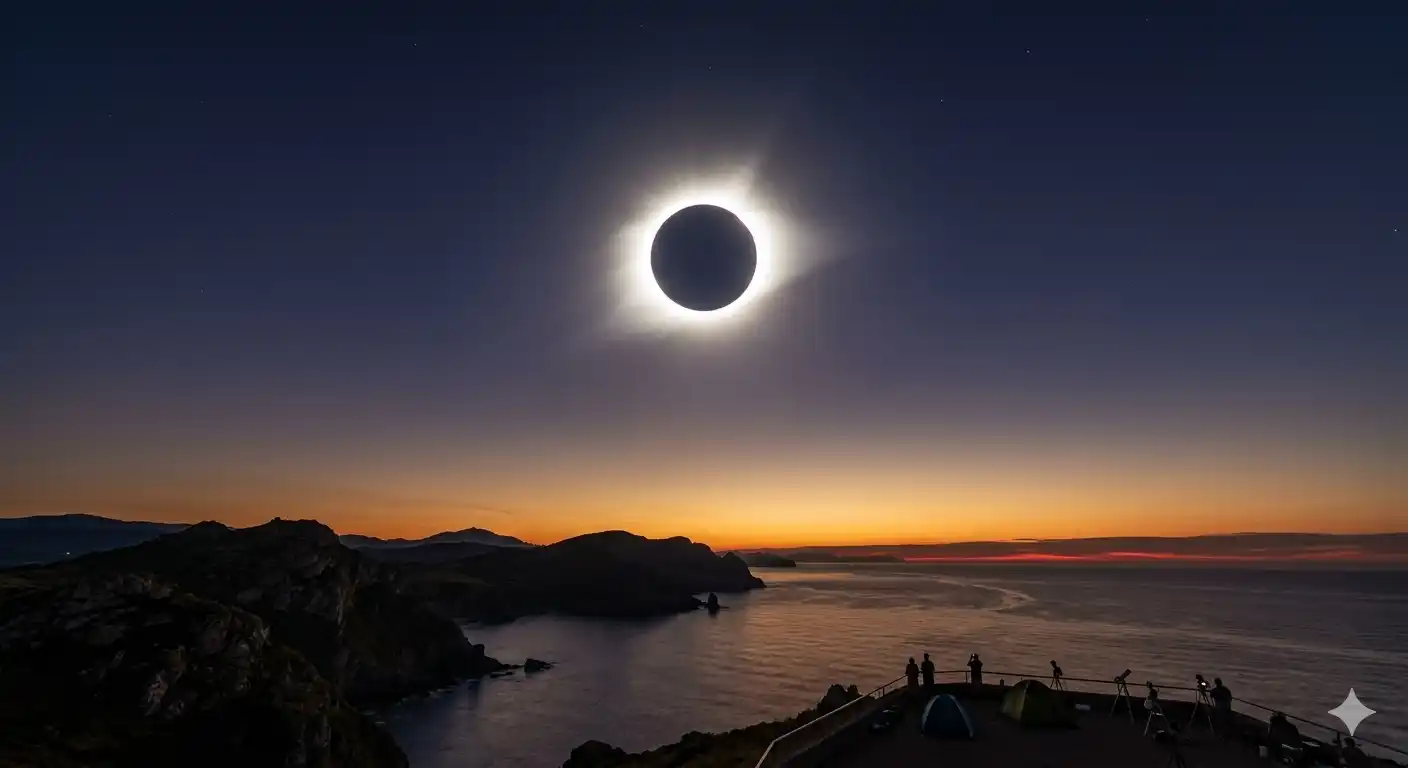
Get ready for the most spectacular astronomical event of the decade. On August 2, 2027, a total solar eclipse will sweep across southern Europe, North Africa, and the Middle East, plunging parts of Spain, Gibraltar, North Africa, and Egypt into darkness. Use our interactive live tracker to find the exact second of totality in your location, explore the path of the moon’s shadow, and ensure you don’t miss this once-in-a-lifetime cosmic shadow play.
🌑 TOTALITY COMMAND CENTER
📍 Spain / Gibraltar: European Mainland Totality
📍 North Africa: Morocco, Algeria, Tunisia, Libya
📍 Egypt & Middle East: Maximum Duration Zone (Luxor)
The 2027 Celestial Event: A Deep Dive into the August 12 Total Solar Eclipse
The astronomical community is currently bracing for one of the most significant events of the 21st century: the Total Solar Eclipse of August 2, 2027. This event marks a historic milestone as the “Eclipse of the Century,” featuring an exceptionally long duration of totality across southern Spain, North Africa, and the Middle East. Unlike partial eclipses, a total solar eclipse provides a rare window into the Sun’s corona—the ethereal, outer atmosphere that is usually invisible to the naked eye.
For researchers, astrophotographers, and eclipse chasers, the 2027 path of totality offers a unique laboratory. The shadow of the moon will race across the Strait of Gibraltar, tracking through southern Spain, Morocco, Algeria, Tunisia, Libya, Egypt, and Saudi Arabia. Because this eclipse occurs during a period of high solar activity, the corona is expected to be particularly dynamic, featuring prominent solar flares and a complex magnetic structure.
Scientific Significance and Orbital Mechanics
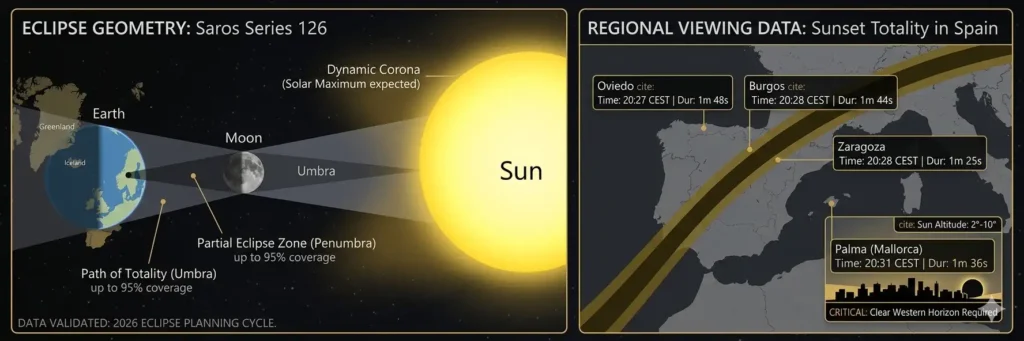
The mechanics of the August 2 eclipse are governed by a precise orbital alignment where the Moon passes directly between the Earth and the Sun, appearing large enough in the sky to completely cover the solar disk. This specific event belongs to Saros Series 136, the same famous family responsible for some of the longest and most remarkable eclipses in history.
From a scientific perspective, the 2027 event is critical for studying “shadow bands”—the mysterious, low-intensity waves of light seen on the ground just before totality—and the “Diamond Ring” effect. In southern Spain and Egypt, the high altitude of the Sun during totality provides optimal optical clarity, allowing for high-contrast observations of the solar corona under brilliant daytime conditions.
The Path of Totality: Spain, North Africa, and the Middle East
The lunar shadow, or umbra, touches continental Europe first in southern Spain and Gibraltar, offering up to 4.5 minutes of totality high in the morning sky. As the shadow moves southeast across the Strait of Gibraltar, it sweeps over North Africa, crossing Morocco, Algeria, Tunisia, and Libya.
The eclipse reaches its maximum duration point near Luxor, Egypt, where observers will experience over 6 minutes and 22 seconds of total darkness under clear desert skies. The path then crosses the Red Sea into Saudi Arabia and Yemen, making it one of the most widely accessible and heavily populated eclipse paths in decades.
Safety and Observation Excellence
To observe this event safely, adherence to international safety standards is mandatory. Viewing any part of the partial phases without ISO 12312-2 certified solar filters can cause permanent retinal damage. Total solar eclipses are only safe to view with the naked eye during the brief window of totality—the exact moment the Sun is 100% obscured.
- Solar Filters: Ensure your eclipse glasses are not scratched or older than three years.
- Vantage Points: For the 2027 event in southern Spain and Egypt, the Sun will be high in the sky (37° to 39° altitude in Spain), meaning no special horizon clearance is required.
- Astrophotography: If using a telescope or DSLR, you must use a specialized solar filter on the front of the lens. Removing the filter is only permissible during the several minutes of totality.
Weather Prospects and Climate Analysis
Climatological data is the most important factor in “eclipse chasing.” Historical weather patterns for August 2 suggest that southern Spain (Andalusia) and North Africa offer exceptionally high probabilities of clear skies and hot, dry conditions.
While minor marine mists can occasionally brush immediate coastal straits in the morning, they typically burn off quickly as temperatures rise. The deserts of Egypt and Saudi Arabia present virtually guaranteed cloud-free viewing, making them the ultimate destinations for professional astronomers seeking pristine atmospheric transparency.
The Impact on the Ionosphere and Wildlife
A total solar eclipse is more than just a visual spectacle; it is a physical event that affects the Earth’s atmosphere. During the 2027 eclipse, the sudden drop in solar radiation will cause a measurable cooling of the ionosphere. This can lead to temporary changes in radio wave propagation, an area of active study for ham radio operators and atmospheric scientists.
Furthermore, biological “eclipse effects” are frequently documented. As totality approaches, the rapid onset of darkness and the drop in temperature often trigger nocturnal behaviors in wildlife. Birds may return to their nests, and crickets may begin to chirp, providing a multi-sensory experience that underscores the profound connection between solar cycles and life on Earth.
Planning for August 2, 2027
With millions of people expected to travel into the path of totality, logistics are a primary concern. Most high-quality accommodations in the “Greatest Totality” zones of Andalusia and Luxor are booked well in advance.
Whether you are a casual observer or a seasoned astronomer, the August 2, 2027 Total Solar Eclipse represents a rare convergence of duration, accessibility, and scientific wonder. By positioning yourself within the moon’s shadow, you are participating in a tradition of cosmic observation that dates back to the dawn of humanity, viewing the Sun not as a static yellow disk, but as a dynamic, roaring star that defines our place in the universe.
FAQ
The timing depends on your specific location. In southern Spain (Cádiz and Tarifa), totality begins at approximately 10:45 AM CEST. As the lunar shadow races east across North Africa and into Egypt (Luxor), totality occurs around midday. Because this eclipse features exceptionally long durations (up to over 6 minutes in Egypt), check our live city-tracker for your exact coordinates.
For the absolute longest duration of totality (approx. 6 minutes and 22 seconds), the best place is in Upper Egypt, specifically around Luxor. However, for European observers, the southern coast of Spain and the Strait of Gibraltar offer stunning seaside viewing with durations approaching 4.5 minutes.
The USA and Canada will not see this eclipse, as it takes place across the Eastern Hemisphere. The United Kingdom will experience a moderate partial eclipse (around 30% to 40% coverage in southern England) during the morning hours, but you must travel south into the path of totality (Spain, North Africa, or Egypt) to see the Sun’s corona.
You must never look at the Sun during the partial phases without ISO 12312-2 certified solar eclipse glasses. You can only safely remove your glasses during the brief window of totality—when the Moon completely blocks the Sun. As soon as the “Diamond Ring” effect appears and the Sun peeks out, glasses must go back on immediately.
Widely known as the “Eclipse of the Century,” the 2027 event is historic because of its extreme duration of totality—reaching over 6 minutes in Egypt—and its high sun altitude. Unlike low-horizon eclipses, the Sun will be high in the sky (about 37° to 39° in Spain and near zenith in North Africa), providing crystal-clear viewing conditions and zero horizon obstacles.
While a total solar eclipse causes a temporary drop in ionospheric temperature, it typically does not disrupt Starlink or GPS signals for more than a few minutes. However, the high solar activity expected around this period means the corona will be much larger and more active than usual, which is a major point of interest for radio atmospheric researchers.