
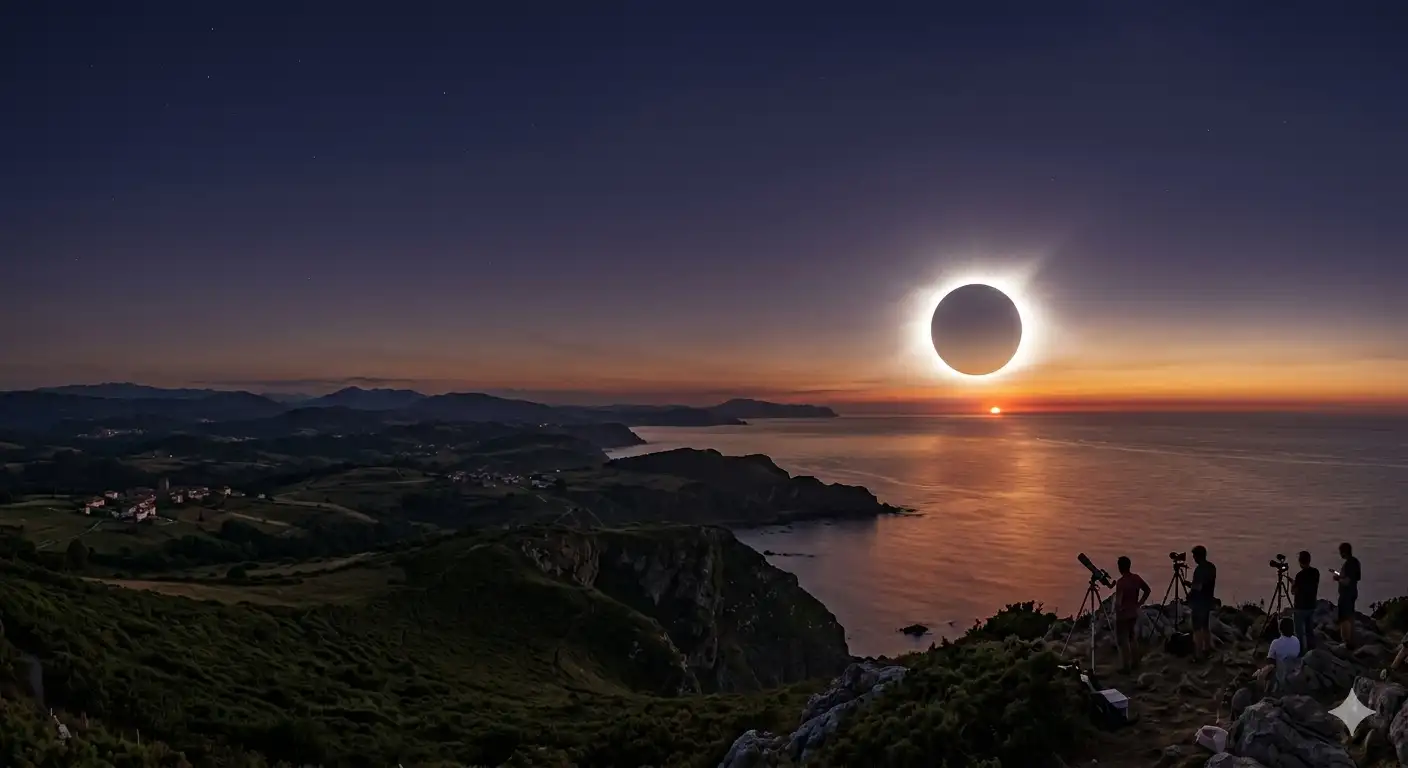
Spain is the ultimate destination for the 2027 Total Solar Eclipse. As the lunar shadow sweeps across the Iberian Peninsula, millions will witness a rare “Sunset Totality” where the Sun’s corona glows just above the western horizon. From the rugged peaks of the Picos de Europa to the Mediterranean shores of Mallorca, discover the best locations, precise timings, and weather prospects for this historic Spanish celestial event.
🌑 SPAIN COMMAND CENTER
☀️ High Sun Altitude: Optimal viewing conditions
🌅 Phenomenon: Long Duration Totality
📍 Best Area: Andalusia & Strait of Gibraltar
Southern Spain Totality Schedule: August 2, 2027
| City / Location | Totality Begins (CEST) | Duration | Sun Altitude |
|---|---|---|---|
| Cádiz | 10:45:17 | 2m 53s | 37° |
| Tarifa | 10:45:00 | 4m 38s | 37° |
| Algeciras | 10:45:19 | 4m 26s | 38° |
| Gibraltar | 10:45:39 | 4m 28s | 38° |
| Marbella | 10:46:42 | 3m 17s | 39° |
| Málaga | 10:48:02 | 1m 50s | 39° |
| Ceuta (Spanish North Africa) | 10:45:13 | 4m 48s | 38° |
Unlike the 2026 horizon-skimming eclipse, the August 2, 2027 “Eclipse of the Century” takes place in the late morning with the Sun climbing high in the sky (around 37° to 39° altitude). Head to the stunning southern coast of Andalusia (such as Tarifa or Gibraltar) to maximize your totality window to nearly 4.5 minutes under optimal viewing conditions!
Viewing the 2027 Total Solar Eclipse in Spain: The Ultimate Guide
Spain is officially the premier European destination for the August 2, 2027, Total Solar Eclipse. While the path of totality also crosses North Africa and the Middle East, southern Spain offers exceptional viewing conditions during a rare late-morning peak. In this guide, we break down the best viewing locations, weather prospects, and the essential technical data you need to witness this once-in-a-lifetime event.
What is the “Sunset Totality”?
The 2027 eclipse is distinct because, for observers in Spain, it occurs in the middle of the morning (around 10:45 a.m. CEST). As the Moon’s shadow sweeps across the Strait of Gibraltar from west to east, the Sun will be high in the sky—around 37° to 39° altitude.
This creates optimal optical clarity. Unlike low-horizon eclipses, the 2027 event allows you to observe the solar corona without atmospheric distortion or interference from surface obstacles, providing maximum visibility and extended durations of up to 4 minutes and 38 seconds on the Spanish mainland.
Top Viewing Locations in Southern Spain
The path of totality cuts directly across the southernmost tip of the Iberian Peninsula. To experience 100% totality, you must be positioned within this specific corridor.
- The Strait of Tarifa: Tarifa offers one of the longest totality durations on the European mainland, approaching nearly 4.5 minutes under high sun conditions.
- The Coast of Cádiz: Cities like Cádiz and Algeciras sit squarely in the path, featuring robust coastal infrastructure, open sea views, and more than 2.5 to 4 minutes of darkness.
- The Western Costa del Sol (Marbella & Málaga): As the shadow tracks eastward, Málaga experiences a shorter yet substantial window of totality just before 11:00 a.m. CEST.
- Autonomous Cities (Ceuta and Melilla): Ceuta records the longest totality within Spanish territory at nearly 4 minutes and 48 seconds, accessible via a short ferry crossing from the mainland.
Weather Prospects: Why Spain is the Best Bet
Historically, August in Andalusia is characterized by intense dry heat and clear blue skies, offering a very low probability of precipitation.
However, observers directly on coastal straits should monitor potential morning marine mist or low stratus clouds rolling in from the water. For the most reliable visibility, positioning yourself slightly inland or on elevated coastal ridges guarantees clear skies.
Essential Observation Gear
Because the Sun will be high and intense during late morning, proper safety and equipment handling are critical:
- ISO 12312-2 Certified Glasses: The Sun remains dangerously bright at all partial phases; certified filters must be worn continuously until total immersion.
- Solar Filters for Optics: Telescopes, binoculars, and cameras require secure front-mounted solar filters.
- Sun Protection: With summer temperatures frequently peaking high during August mornings, adequate hydration, hats, and UV protection are necessary for outdoor viewing.
Cultural Impact and Local Events
The 2027 eclipse is projected to draw massive international scientific and tourist interest to Andalusia. Municipalities across Cádiz and Málaga are organizing designated public viewing zones. Booking accommodation and transport—particularly ferry crossings to North Africa or local transit across the Costa de la Luz—well in advance is strongly recommended due to high seasonal demand.
No. While Madrid and Barcelona will experience a deep partial eclipse, they are both outside the path of totality. In these cities, the sky will dim significantly, but you will not see the solar corona. To experience the total eclipse, you must travel south into the Andalusia totality corridor (e.g., toward Cádiz or Málaga).
Known widely as part of the “Eclipse of the Century,” this event occurs in the late morning (around 10:45 AM CEST) rather than at sunset. Because of this timing, the Sun is positioned high in the sky (roughly 37° to 39° altitude), providing crystal-clear optical conditions, zero horizon obstruction concerns, and much longer totality durations than the 2026 event.
On the Spanish mainland, cities like Cádiz and Tarifa experience impressive durations ranging from nearly 3 to over 4.5 minutes. However, the absolute longest totality within Spanish territory is found across the Strait in the autonomous African city of Ceuta, which enjoys roughly 4 minutes and 48 seconds of totality.
Southern Spain (Andalusia) offers exceptional summer weather prospects with hot, dry conditions and predominantly clear blue skies. While minor morning Atlantic marine mists can occasionally brush immediate coastal straits, they typically burn off quickly as temperatures rise under the August sun.
Yes. You must use ISO 12312-2 certified solar eclipse glasses for all partial phases. They can only be safely removed during the exact window of totality. Because the Sun will be high overhead, standard solar filters for cameras, binoculars, and telescopes are essential, and no special horizon clearance is required.
No. Unlike the 2026 eclipse (which coincided with the Perseids), the August 2, 2027 eclipse takes place during mid-morning and does not align with a major meteor shower peak, though it stands unmatched for its brilliant daytime corona and long totality duration.