
🌌 Sky Tonight: Live Observer
Sky Inventory
What Can I See in the Sky Tonight? Planets, Moon, ISS & Meteor Showers Live
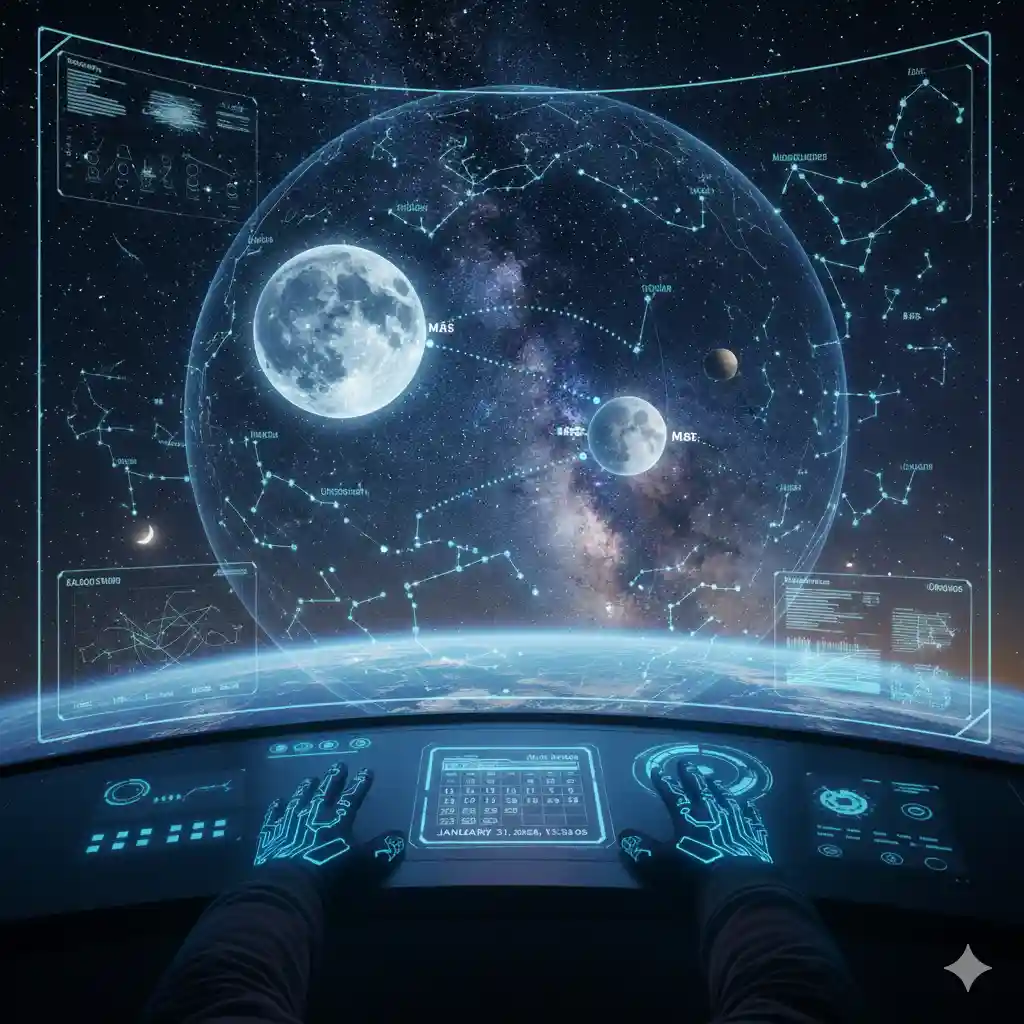
This page pulls together everything currently visible from your location — planets, the Moon, satellite flyovers, and active meteor showers — using live positional data instead of a static guide.
Visible Planets Tonight
Which planets you can see depends on where they sit relative to the Sun. Mercury and Venus never stray far from the horizon — Venus is often the brightest object after the Moon, visible low in the west after sunset or east before sunrise. Mars, Jupiter, and Saturn can appear anywhere in the sky and are visible for most of the night when well-placed in their orbits. Uranus (magnitude ~5.7) and Neptune (magnitude ~7.8) are both too faint for the naked eye — you’ll need at least 7×50 binoculars and a star chart to pick them out from the background stars.
The tracker shows each planet’s real-time altitude and azimuth, so instead of “Jupiter is up tonight,” you get “Jupiter is 34° above the horizon at 142° azimuth (SE)” — enough to point a telescope directly at it.
The Moon: Phase, Rise, and Set
The Moon’s brightness is the single biggest factor in what else you can see. A full moon adds enough skyglow to wash out anything fainter than magnitude 3–4, cutting down visible stars from a few thousand to a few hundred. A new moon removes that interference entirely, which is why serious deep-sky observing is usually planned around the week surrounding new moon.
The tracker shows today’s phase, moonrise and moonset times, and current position — including when the Moon passes near a planet or bright star, which happens several times a month and is easy to spot even in a city.
ISS and Satellite Flyovers
The ISS orbits at roughly 400 km altitude and 27,600 km/h, completing a lap of Earth every 92 minutes. It’s visible only during the brief window around sunrise or sunset, when it’s still lit by the Sun but the sky is dark — a pass typically lasts 2–6 minutes and can reach magnitude −4, brighter than any star. The tracker gives you the exact start time, direction, and peak altitude for your location.
Beyond the ISS, thousands of Starlink satellites and telescopes like Hubble cross the sky nightly. A single Starlink “train” shortly after a launch can show a dozen or more satellites moving in a line — distinctive enough that it’s often mistaken for a UFO sighting.
Meteor Showers
Meteor showers peak on specific nights when Earth crosses a comet’s debris trail — the Perseids peak in mid-August at up to 100 meteors/hour under dark skies, the Geminids in mid-December at a similar rate. Actual visible counts are almost always lower once you account for light pollution and moonlight; a full moon during a shower’s peak can cut visible meteors by 75% or more. The tracker flags which showers are currently active and their expected peak date, so you can cross-reference against the Moon phase before planning a night out.
FAQ
The planets visible tonight depend on your location, date, and local time. Bright planets like Venus, Mars, Jupiter, and Saturn are often visible without a telescope when they are above the horizon. Use our live sky tracker to see exactly which planets are visible from your location right now.
You can often see the Moon, bright planets, stars, constellations, satellites, and sometimes the International Space Station with the naked eye. The best objects to watch depend on your location, weather conditions, and the current position of celestial objects.
Yes, the International Space Station can often be seen from Earth as a bright moving object crossing the night sky. Visibility depends on your location and the timing of the flyover. Our ISS tracker shows when and where the ISS will pass overhead.
Venus, Mars, Jupiter, and Saturn are the easiest planets to see without equipment when they are positioned correctly in the sky. Their brightness makes them stand out from nearby stars, allowing many people to spot them with the naked eye.
The Moon is usually the brightest object visible at night. When the Moon is not visible, planets such as Venus and Jupiter are often among the brightest objects in the sky after the Sun.
The stars and constellations visible tonight depend on your location and the season. Popular constellations such as Orion, Ursa Major, Cassiopeia, and Scorpius appear at different times throughout the year. Our sky tracker helps you identify visible stars and constellations.
The best time for stargazing is usually after astronomical twilight, when the sky is darkest. Nights with little moonlight are ideal for seeing faint stars and meteor showers, while clear skies away from city lights provide the best viewing conditions.