
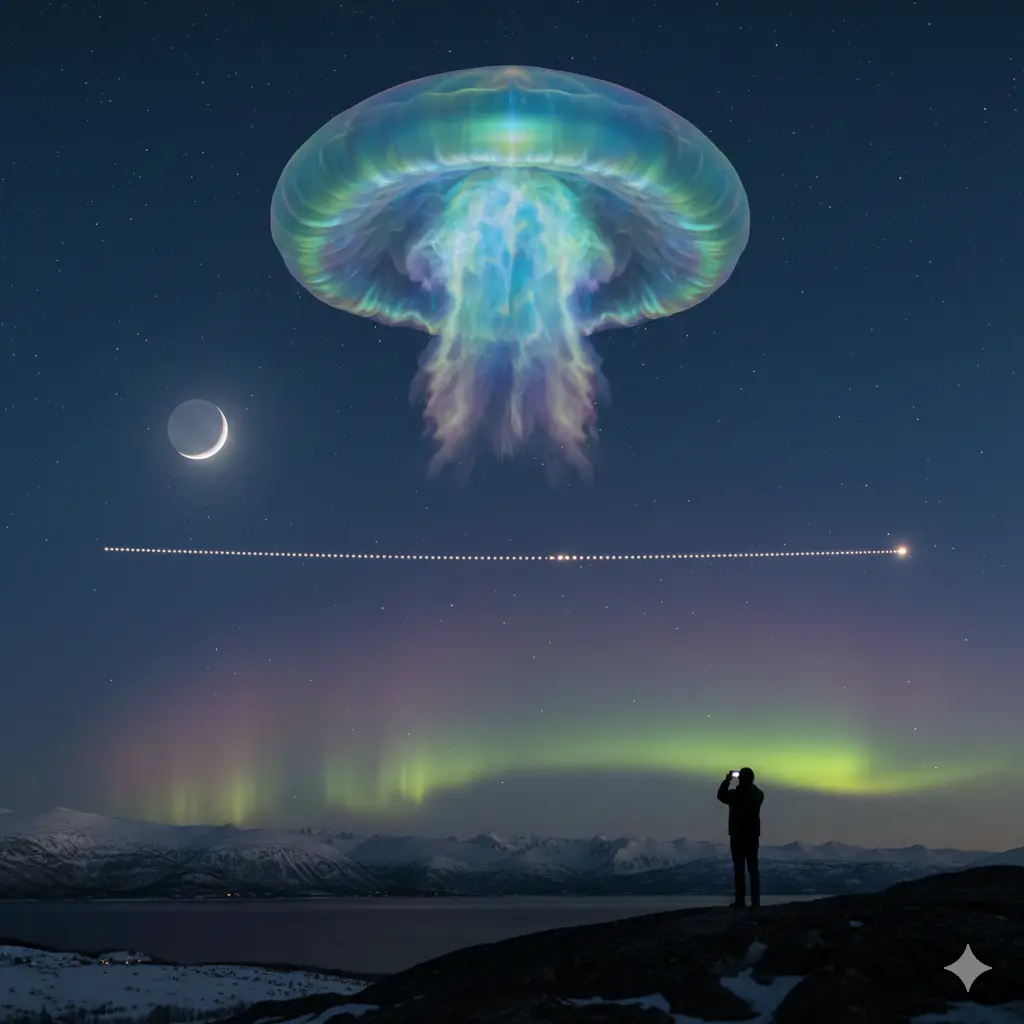
Did you just see something unexplained? From “star-trains” to fast-moving lights and glowing orbs, we help you identify exactly what you saw. Use our interactive guide below to match your observation with real-time tracking data.
What did you see in the sky?
What Was That Light in the Sky Tonight? An Identification Guide
The night sky is no longer just a canvas of distant stars. Today, it is a bustling highway of human-made technology, orbital mechanics, and celestial phenomena. If you just saw a mysterious light moving across the stars, you aren’t alone. Every night, thousands of people look up and ask: “What was that light?”
The Modern Night Sky: A Busy Neighborhood
Until a few decades ago, seeing something move in the sky usually meant it was a meteor or a high-altitude plane. Today, the situation is much more complex. With the rise of private space exploration, there are now thousands of active satellites in Low Earth Orbit (LEO).
1. Steady Movers: Satellites and the ISS
If you see a bright, steady light—roughly the speed of a high-altitude airplane but completely silent—you are likely looking at a satellite. Unlike planes, satellites do not have blinking navigation lights (red/green). They shine by reflecting sunlight even when it is dark on the ground.
- The International Space Station (ISS): This is the brightest human-made object in orbit. It can appear brighter than any star and crosses the sky in about 3–5 minutes. Because of its size, it reflects a massive amount of sunlight.
- Starlink “Trains”: One of the most common “UFO” reports today. When SpaceX launches a new batch of Starlink satellites, they appear as a tight line of 20–60 lights following one another. Over weeks, they slowly spread out into their final orbits.
2. Sudden Flashes: Meteors and Fireballs
Not everything in the sky is a permanent fixture. Meteors (shooting stars) are small pieces of space rock or dust burning up in Earth’s atmosphere at speeds of up to 70 kilometers per second.
- Meteor Showers: During specific times of the year, Earth passes through debris clouds left by comets, resulting in meteor showers like the Perseids or Geminids.
- Bolides: If you saw a flash so bright it illuminated the ground or left a trail of smoke (persistent train), you saw a bolide—a large meteor exploding in the atmosphere.
3. Stationary Giants: Planets vs. Stars
If the light isn’t moving relative to the stars, it is either a star or a planet within our solar system.
- The Twinkle Test: Stars twinkle (scintillation) because they are point sources of light being distorted by Earth’s atmosphere. Planets, being closer, appear as tiny disks; their light is more stable and rarely twinkles.
- Venus and Jupiter: These are the “Kings of the Night Sky.” Venus is often called the Morning or Evening Star and is so bright it is frequently mistaken for a drone or a hovering aircraft.
4. The “Jellyfish” Effect: Rocket Launches
One of the most spectacular sights in modern astronomy is the “Space Jellyfish.” This occurs when a rocket is launched shortly after sunset or before sunrise. As the rocket reaches high altitudes, the exhaust plumes are illuminated by the sun (which is still visible from high up), creating a glowing, expanding nebula-like shape in the dark sky.
FAQ
This is almost certainly a Starlink satellite constellation launched by SpaceX. Shortly after a launch, the satellites appear in a very tight “train,” following each other in a straight line. Over several weeks, they use their onboard ion thrusters to move into higher orbits and spread out, becoming less visible to the naked eye.
If the light is moving steadily and silently, it is likely a satellite like the International Space Station (ISS). If it appears to be “hovering” and changing colors (red, blue, white), it is often a bright star like Sirius being distorted by Earth’s atmosphere, an effect known as scintillation.
The easiest way is the “twinkle test.” Stars twinkle because their light is easily disrupted by atmospheric turbulence. Planets (like Venus, Jupiter, and Mars) are much closer to Earth and provide a larger “disk” of light, which makes their glow appear steady and constant.
The Moon often passes close to bright planets or stars in an event called a “conjunction.” Most frequently, the bright “star” next to the Moon is actually the planet Venus, Jupiter, or Mars. You can check our Live Solar System Simulator to confirm which planet is currently near the Moon.
Yes, the ISS is the third brightest object in the sky after the Sun and the Moon. It looks like a very bright, fast-moving airplane without blinking lights. It can only be seen for a few minutes at a time, usually shortly after sunset or before sunrise when it is reflecting sunlight against a dark sky.
This is likely a “Space Jellyfish,” created by a rocket launch (often SpaceX Falcon 9) shortly after sunset or before sunrise. As the rocket exhausts its fuel at high altitude, the plume expands and is illuminated by the sun, which is still shining in space but not on the ground. These plumes can form spectacular, expanding spirals or nebulae-like shapes that slowly fade away.
A bolide is an exceptionally bright meteor that explodes in the atmosphere. They often look like a brilliant, slow-moving flash that may change color (green or blue) or leave a lingering trail of smoke. They are not dangerous; they almost always disintegrate high in the atmosphere. Seeing one is a rare, spectacular event.
You likely witnessed a “Satellite Flare.” This happens when a satellite’s solar panels or reflective antennas catch the sunlight at just the right angle as the satellite moves, causing a sudden, dramatic spike in brightness before it dims again. It is a natural reflection, not a change in the object itself.
Sometimes, distant clouds illuminated by city lights (light pollution) can appear to pulse or move, especially if they are high-altitude cirrus clouds. If the object appears to “disappear” behind thin clouds or seems to move erratically with the wind, it is almost certainly atmospheric.
If you see steady or flashing red, green, or white navigation lights, you are looking at a conventional aircraft (airplane or helicopter). All civilian and military aircraft are required by aviation law to use these specific lighting patterns. If you see these, it is definitely not a satellite or celestial phenomenon.