
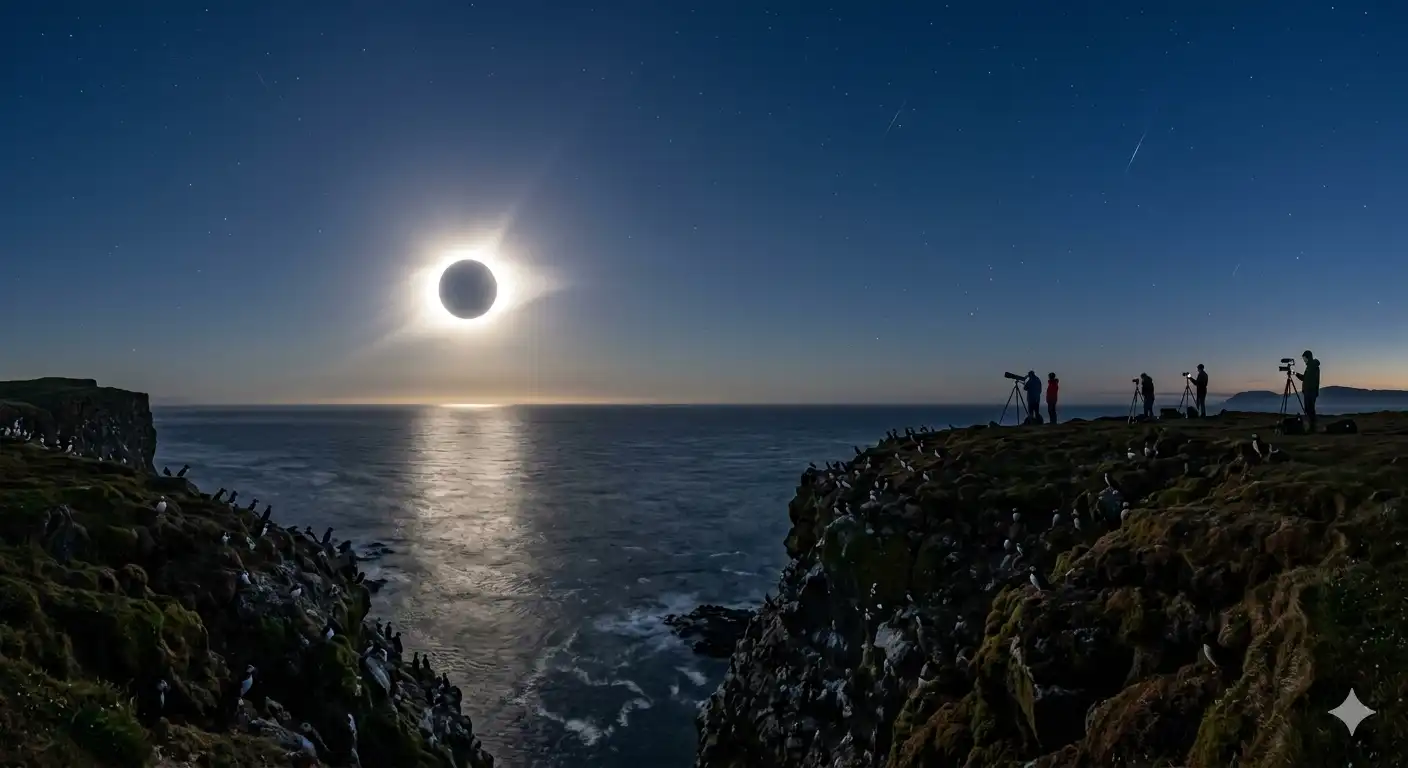
Iceland is the premier destination for the 2026 eclipse, offering the longest duration of totality on land. Whether you are viewing from the iconic cliffs of Látrabjarg or the vibrant streets of Reykjavík, this guide provides the precise timings and local insights needed for the ultimate Arctic eclipse experience.
🌑 ICELAND COMMAND CENTER
🏔️ Max Totality: Látrabjarg (2m 13s)
🏙️ Capital: Reykjavik (1m 01s)
🚢 Best View: Westfjords Coastline
Iceland Totality Schedule: August 12, 2026
| Location | Totality Begins (GMT) | Duration | Sun Altitude |
|---|---|---|---|
| Látrabjarg | 17:43:50 | 2m 13s | 26.1° |
| Ólafsvík | 17:46:10 | 2m 03s | 25.3° |
| Patreksfjörður | 17:44:02 | 2m 11s | 25.9° |
| Keflavík | 17:48:05 | 1m 39s | 24.5° |
| Reykjavík | 17:48:12 | 1m 01s | 24.3° |
| Ísafjörður | 17:43:45 | 1m 31s | 25.8° |
| Akranes | 17:48:01 | 1m 14s | 24.6° |
Unlike Spain’s low-horizon event, the Sun in Iceland will be at a comfortable 24° to 26° altitude. Your biggest challenge here is maritime cloud cover. To maximize your chances, stay mobile with a 4×4 vehicle. The Westfjords offer the longest duration, but if the forecast looks cloudy, be ready to move to the Snæfellsnes Peninsula where local topography often creates “cloud holes” during the afternoon.
Total Solar Eclipse 2026 Iceland: The Ultimate Arctic Viewing Guide
Iceland is positioning itself as the premier destination for the August 12, 2026, Total Solar Eclipse. While the path of totality touches Greenland and Spain, Iceland offers a unique combination of accessibility, dramatic volcanic backdrops, and the longest duration of totality over land. For serious astronomers and “umbraphiles,” Iceland is the high-stakes choice for 2026. This guide explores the best viewing locations, weather strategies, and local logistics for witnessing the lunar shadow across the Land of Fire and Ice.
The Scientific Significance of the 2026 Iceland Path
The 2026 event is scientifically significant because the “Point of Greatest Eclipse”—the location where the axis of the Moon’s shadow passes closest to the center of the Earth—is located in the Denmark Strait, just off the coast of Iceland. This means that those positioned in Iceland’s Westfjords will be as close as humanly possible to the maximum theoretical duration of this eclipse.
Because the eclipse occurs near Solar Maximum, the Sun’s corona is expected to be exceptionally “busy,” with plumes and streamers extending in all directions. In the clear, crisp air of the North Atlantic, the high-contrast view of this active corona against the darkened sky will be unrivaled.
Prime Viewing Locations: From the Westfjords to Reykjavík
The path of totality in Iceland is roughly 290 kilometers wide, covering the western half of the country. If you are outside this path (such as in Akureyri or the Eastfjords), you will only see a partial eclipse.
1. The Westfjords (The Zone of Maximum Totality)
The Westfjords are the crown jewel of the 2026 eclipse. Because this region is closest to the centerline, it offers the longest duration of darkness.
- Látrabjarg Cliffs: As Europe’s largest bird cliffs and the westernmost point of Iceland, Látrabjarg offers 2 minutes and 13 seconds of totality. The sight of the sun vanishing over the edge of the Atlantic Ocean is expected to be the most iconic image of the 2026 event.
- Ísafjörður: The cultural heart of the Westfjords will experience over 1 minute and 30 seconds of totality, making it a perfect base for those who want to combine astronomy with local Icelandic culture.
2. The Snæfellsnes Peninsula (The Photographer’s Choice)
Often called “Iceland in Miniature,” Snæfellsnes provides the most dramatic foregrounds for eclipse photography.
- Kirkjufell: Capturing the “Diamond Ring” effect over Iceland’s most famous mountain is a top priority for international photographers. Totality here will last approximately 1 minute and 50 seconds.
- Arnarstapi: The jagged coastal rock formations here provide a surreal setting for the 17:45 GMT totality.
3. The Reykjavík Capital Area
For those who prefer convenience, Reykjavík sits just inside the northern edge of the path. While the duration is shorter—around 1 minute and 1 second—the city will host massive “Eclipse Watch” festivals. The Reykjanes Peninsula, home to the Blue Lagoon and recent volcanic activity, will see a longer duration of nearly 1 minute and 40 seconds.
Weather Prospects: The Arctic Challenge
- Cloud Coverage Statistics: Historical data for August 12 suggests a 60-70% probability of cloud cover. However, Icelandic weather is highly localized.
- The Mobility Strategy: To guarantee a view, you must be mobile. The western coast can be shrouded in fog while the inland valleys remain clear. We recommend renting a 4×4 vehicle and monitoring the Icelandic Met Office (Veðurstofa Íslands) “Cloud Cover Forecast” in the 24 hours leading up to the event.
The “Eclipse-Perseid” Double Feature
A unique factor for the 2026 Iceland eclipse is its timing. The event occurs during the peak of the Perseid Meteor Shower. In Spain, the sun sets shortly after the eclipse, but in Iceland’s late-summer twilight, the transition from totality into a night filled with “shooting stars” over volcanic fields will provide a multi-sensory experience that no other location can match.
Logistics and Travel Planning for 2026
With an estimated 100,000 extra visitors expected in Iceland for the eclipse, logistics are the primary concern for 2026.
- Accommodation: Hotels in the Westfjords and Snæfellsnes are already seeing record bookings. Consider campervan rentals as a way to remain mobile and follow the clear skies.
- Solar Safety: Even in the Arctic, the sun’s rays are dangerous during the partial phases. Ensure your eclipse glasses are ISO 12312-2 compliant.
- Eye on the Sky: The eclipse in Iceland happens at a comfortable altitude of 24° to 26°, meaning you don’t need a perfectly flat horizon like you do in Spain, but a clear view to the West-Southwest is still essential.
By positioning yourself in the path of the 2026 Iceland eclipse, you are choosing the most dramatic, scientifically significant, and visually stunning location on the planet to witness the shadow of the moon.
FAQ
The partial eclipse begins at approximately 16:47 GMT on August 12, 2026. The moment of totality (complete darkness) hits the western coast of Iceland at 17:43 GMT. In the capital city of Reykjavík, totality occurs at 17:48 GMT.
The Westfjords region offers the longest duration of totality on land, specifically at the Látrabjarg cliffs, where darkness will last for 2 minutes and 13 seconds. For the best photography, the Snæfellsnes Peninsula (Kirkjufell) is the top choice, providing nearly 2 minutes of totality against a stunning mountain backdrop.
Yes! Reykjavík is located just inside the northern limit of the path of totality. Observers in the capital will experience approximately 1 minute and 1 second of total darkness. While this is shorter than the Westfjords, the city will be the hub for major eclipse festivals and events.
August weather in Iceland is unpredictable. While the statistical cloud cover is around 60%, the air is often very clear. To increase your chances, we recommend a mobile strategy: monitor the Icelandic Met Office (Veðurstofa Íslands) cloud forecast and be prepared to drive to the western or inland regions where “clear holes” in the clouds are predicted.
In Iceland, the Sun will be much higher in the sky (approx. 24° to 26° altitude) compared to Spain (where it will be only 2° to 10°). This makes Iceland a better choice for observers who want to avoid obstructions like buildings or mountains. Additionally, Iceland is closer to the Point of Greatest Totality, offering longer duration than the Mediterranean coast.
While August is the start of the Aurora season, it is unlikely you will see the Northern Lights during the eclipse because the sky does not get “midnight black” like in winter. however, because the eclipse coincides with the Perseid Meteor Shower, you are very likely to see shooting stars once the sky darkens after sunset!