
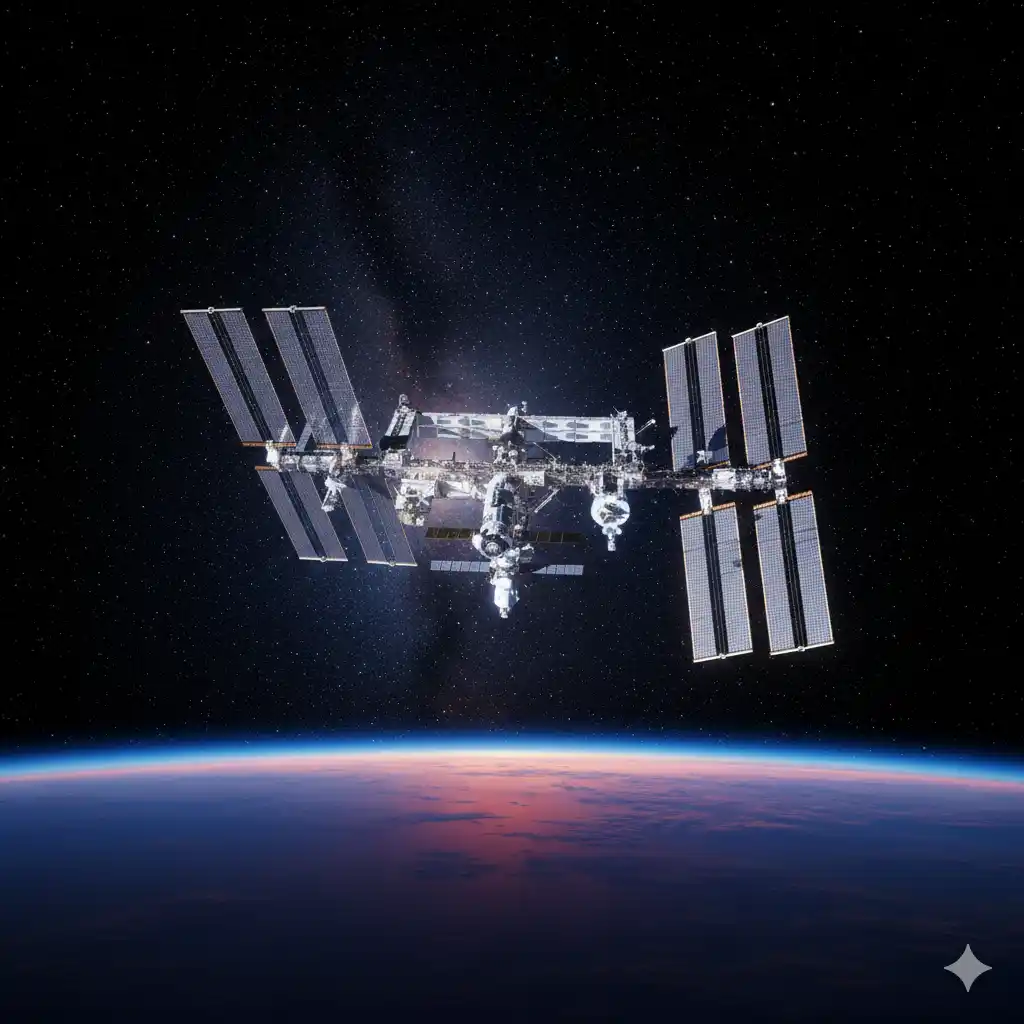
What is ISS Live Tracker?
ISS Live Tracker is a service that lets you see the current position of the International Space Station (ISS) in real time, track its orbit around Earth, and in some cases watch live video feeds directly from the station. The ISS travels at around 28,000 km/h and completes an orbit roughly every 90 minutes, passing over many locations multiple times a day.
With a live tracker, you can:
- View the real-time position of the ISS with precise coordinates.
- Access orbital data, including speed, altitude, and trajectory.
- Get predictions for visibility and know when the ISS will be visible from your area.
- Watch live camera feeds from the ISS exterior or interior.
Even when the ISS appears only as a bright dot in the sky, a tracker tells you exactly where and when to look.
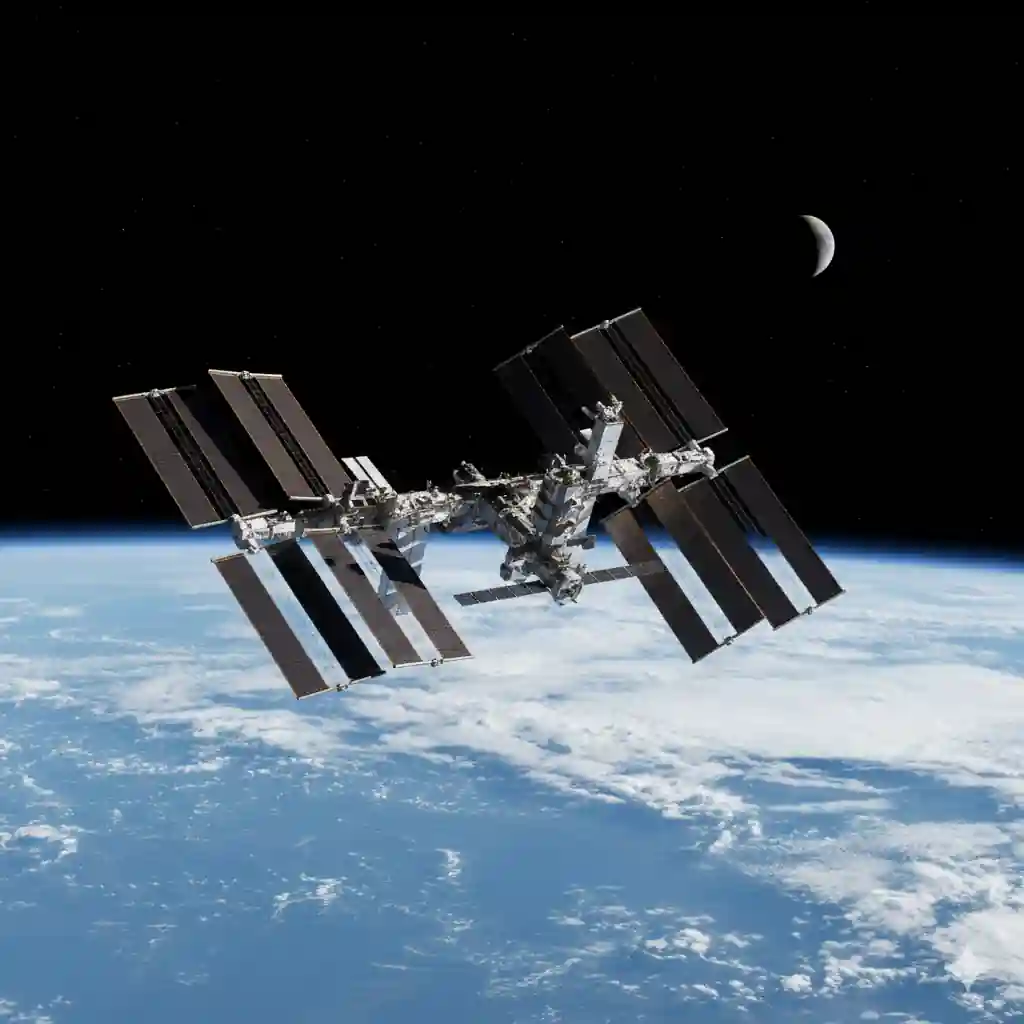
How Is the ISS Tracked So Precisely?
The position data behind any ISS tracker comes from a format called a Two-Line Element set (TLE), a compact orbital snapshot generated by NORAD’s tracking network (the ISS carries the catalog number 25544) and refreshed several times a day. Because the station isn’t in a perfectly stable orbit — atmospheric drag at 400 km still pulls it downward by roughly 100 meters a day — trackers combine this TLE data with orbital mechanics calculations (an SGP4 propagation model, in most implementations) to predict its exact latitude, longitude, and altitude between updates. This is also why the ISS needs periodic reboosts from docked cargo spacecraft like Progress or Cygnus: without them, orbital decay would eventually bring the station too low to sustain.
The 51.6-degree inclination of its orbit — chosen originally to allow launches from Russia’s Baikonur Cosmodrome — is why the ground track you see on the tracker sweeps between roughly 51.6°N and 51.6°S, meaning the station never passes directly over the poles or the deepest equatorial regions.
What the Numbers Actually Mean
The dashboard above updates every few seconds, but the numbers only help you if you know what they’re telling you.
Velocity and altitude are the raw physics — how fast the ISS is moving and how far above Earth it is right now. Both shift slightly moment to moment as the station’s orbit naturally decays and gets corrected.
Orbital period is how long one full lap around Earth takes at the current altitude — it’s why the “16 sunrises a day” fact exists. Orbits per day is just that number flipped around, and it’s the figure that determines how many chances you get at a visible pass.
Footprint radius is the more useful one for spotting: it’s roughly how far the ISS’s position can be seen or detected from, ground-side, at this exact moment. If you’re near the edge of that radius, don’t expect much — you’ll want to be well inside it.
The Daylight / Eclipse status pill is the one to watch closest. The ISS itself has no lights bright enough to see from Earth — everything you’d catch with your eyes is reflected sunlight. When the tracker shows “Eclipse,” the station has moved into Earth’s shadow and is, for all practical purposes, invisible, no matter how clear your sky is or how good the coordinates look.
ISS vs. Airplane vs. Satellite: How to Spot the Difference
What you’re actually seeing during a flyover isn’t the station’s own lights — at 109 meters end to end, roughly the length of a football field, the ISS is simply large enough and low enough (400 km up) to reflect a lot of sunlight, which is why it can outshine every star in the sky and rival Venus in brightness during a good pass. That’s also the giveaway for telling it apart from other objects: aircraft blink with red and green lights and move relatively slowly, satellites other than the ISS are typically far dimmer and harder to spot with the naked eye, and the ISS itself moves steadily across the entire sky in about the time it takes to watch — roughly 4 to 6 minutes tip to tip — before either fading out as it enters Earth’s shadow or slipping below the horizon.
Because the station orbits every 90 minutes but is only visible during the narrow windows when it’s sunlit and you’re in darkness, most locations get one or two good viewing passes per day, clustered within an hour or two of sunset or sunrise, which is why prediction accuracy matters more for ISS spotting than for almost any other stargazing target.
ISS FAQ
The International Space Station (ISS) travels at a staggering speed of 17,500 mph (28,000 km/h). This means it completes a full orbit around Earth every 90 minutes. In a 24-hour period, the astronauts on board experience 16 sunrises and 16 sunsets.
The ISS is only visible when it is flying over your area, reflecting sunlight while it is dark on the ground (usually just after sunset or before sunrise). It looks like a bright, non-blinking star moving steadily across the sky. You can use our ISS Live Tracker to see its current path and estimate when it will pass over your horizon.
The ISS maintains a Low Earth Orbit (LEO) at an average altitude of approximately 250 miles (400 kilometers). However, due to atmospheric drag, the station slowly loses altitude and requires periodic “re-boosts” from docked spacecraft to maintain its orbit.
Not usually. To see the ISS, it must be illuminated by the sun while you are in the dark. In the middle of the night, the station is in the Earth’s shadow, making it invisible to the naked eye. The best viewing windows are within 1-2 hours of dusk and dawn.
The crew size typically varies between 7 and 11 people, depending on the rotation of missions like SpaceX Crew Dragon or Soyuz.