
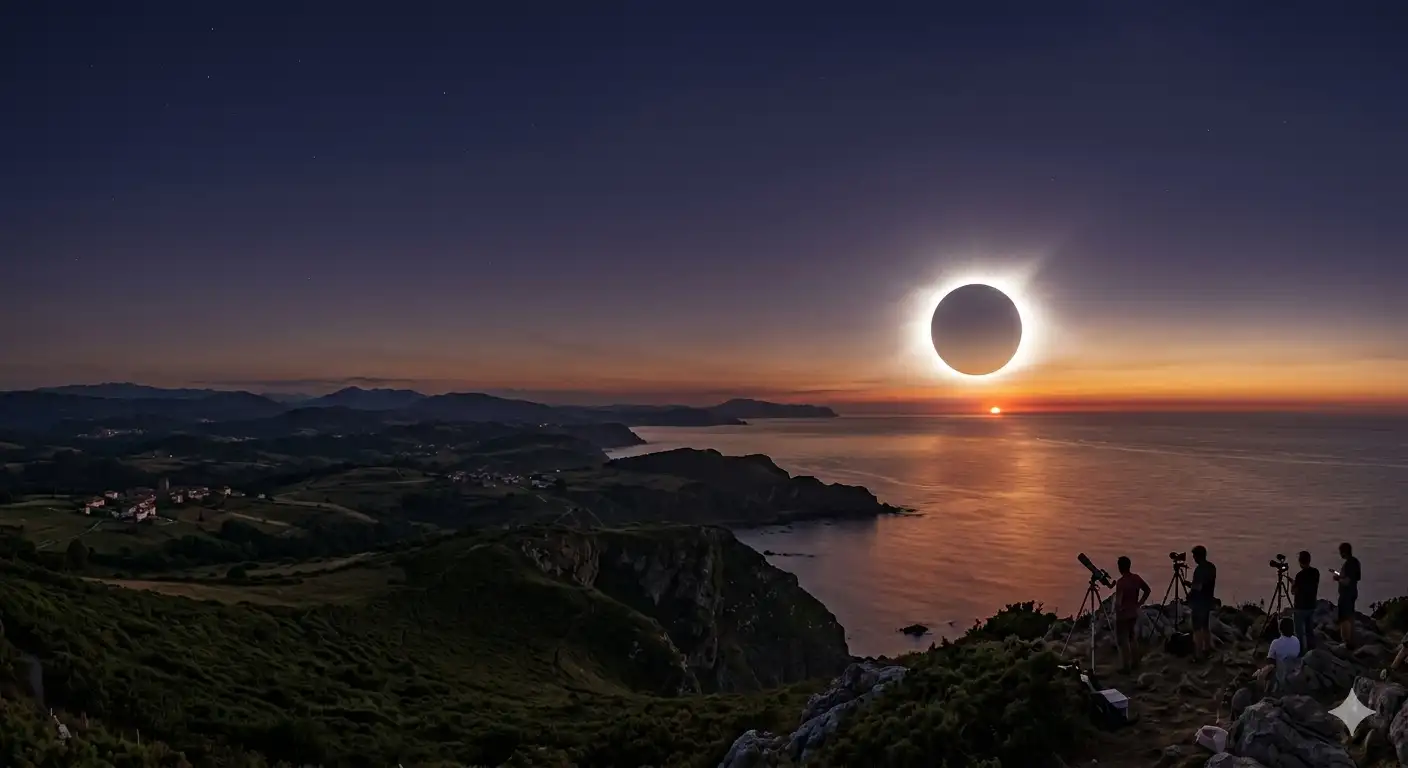
Spain is the ultimate destination for the 2026 Total Solar Eclipse. As the lunar shadow sweeps across the Iberian Peninsula, millions will witness a rare “Sunset Totality” where the Sun’s corona glows just above the western horizon. From the rugged peaks of the Picos de Europa to the Mediterranean shores of Mallorca, discover the best locations, precise timings, and weather prospects for this historic Spanish celestial event.
🌑 SPAIN COMMAND CENTER
⚠️ Low Altitude: 2° – 10° above horizon
🌅 Phenomenon: Total Eclipse at Sunset
📍 Best Area: Northern High Plains
Spain Totality Schedule: August 12, 2026
| City | Totality Begins (CEST) | Duration | Sun Altitude |
|---|---|---|---|
| Gijón | 20:27:35 | 1m 45s | 10.1° |
| Oviedo | 20:27:40 | 1m 48s | 10.2° |
| Burgos | 20:28:17 | 1m 44s | 8.4° |
| Leon | 20:27:56 | 1m 43s | 9.6° |
| Zaragoza | 20:28:46 | 1m 25s | 6.1° |
| Palma (Mallorca) | 20:31:00 | 1m 36s | 2.1° |
| Bilbao | 20:28:43 | 0m 32s | 8.3° |
Because this is a “Sunset Totality,” the Sun will be extremely low in the sky (between 2° and 10°). To ensure you don’t miss the moment, you must find a viewing spot with a completely unobstructed Western horizon. A single building, tree, or distant hill could block your view of the corona entirely. Coastal clifftops and high-altitude plains are your best bet!
Viewing the 2026 Total Solar Eclipse in Spain: The Ultimate Guide
Spain is officially the premier destination for the August 12, 2026, Total Solar Eclipse. While the path of totality crosses Greenland and Iceland, Spain offers the most favorable weather conditions and a unique visual phenomenon known as the “Sunset Totality.” In this guide, we break down the best viewing locations, weather prospects, and the essential technical data you need to witness this once-in-a-lifetime event.
What is the “Sunset Totality”?
The 2026 eclipse is distinct because, for observers in Spain, it occurs very late in the day. As the Moon’s shadow sweeps from the Northwest (Galicia/Asturias) toward the Southeast (Mallorca), the Sun will be hanging low on the western horizon—between 2° and 10° altitude.
This creates a spectacular “Golden Hour” totality. Unlike eclipses that happen high in the sky, the 2026 event allows you to see the solar corona framed against the Spanish landscape, providing a sense of scale and beauty that is rarely captured in astronomical photography.
Top Viewing Locations in Northern and Central Spain
The path of totality is approximately 290 km wide, cutting a diagonal swath across the country. To experience 100% totality, you must be positioned within this corridor.
- The Northern Coast (Gijón & Santander): These cities are among the first to see totality. Being on the coast provides a flat western horizon over the Bay of Biscay, which is perfect for a low-altitude eclipse.
- The High Plains (Burgos & Palencia): The plateau of Castile and León offers some of the best weather odds. The wide-open fields of the Meseta provide an unobstructed 360-degree view of the approaching lunar shadow.
- The Ebro Valley (Zaragoza): As the shadow moves inland, Zaragoza sits squarely in the path. The city’s historical architecture, combined with the darkening sky, will offer a surreal atmosphere.
- The Mediterranean Coast (Castellón & Tarragona): This is where the shadow leaves mainland Spain. Totality here will occur only minutes before the Sun sets into the sea.
- The Balearic Islands (Mallorca): Palma will be one of the final places on Earth to see the 2026 totality. It will be a “touch and go” event with the Sun nearly at the horizon line.
Weather Prospects: Why Spain is the Best Bet
Historically, August in Northern and Central Spain is characterized by clear, dry skies. While Iceland and Greenland face a 60-80% chance of cloud cover, the interior plains of Spain (Castile and León) have a less than 20% cloud cover probability.
However, observers on the Northern coast (Asturias and Cantabria) should be wary of the bruma—a sea mist that can roll in during the evening. For the most reliable viewing, we recommend moving slightly inland toward the southern side of the Cantabrian Mountains.
Essential Observation Gear
Because the Sun will be low, atmospheric “refraction” will be high. This means the Sun might appear slightly distorted or “flattened” as it reaches totality.
- ISO 12312-2 Glasses: Even at 99% coverage, the Sun is too bright for the naked eye.
- Tripod with Low-Angle Capability: If you are photographing the event, ensure your tripod can handle a low-angle shot without being blocked by foreground objects.
- Solar Filters for Optics: Telescopes and cameras must have front-mounted filters until the exact second of totality.
Cultural Impact and Local Events
The 2026 eclipse is expected to be the largest tourism event in Spain’s recent history. Many municipalities in the path, such as Burgos and Oviedo, are already planning “Eclipse Festivals” and designated viewing zones with scientific experts on-site. We recommend booking your accommodation at least 12 months in advance, as hotels within the path of totality are expected to reach 100% capacity.
No. While Madrid and Barcelona will experience a deep partial eclipse (over 99%), they are both outside the path of totality. In these cities, the sky will dim significantly, but you will not see the solar corona or the “night-day” transformation. To experience the total eclipse, you must travel north into the totality corridor (e.g., to Segovia from Madrid or Tarragona from Barcelona).
This is a “Sunset Totality.” Because the eclipse occurs so late in the day (around 8:30 PM CEST), the Sun will be very low—only 2° to 10° above the western horizon. This allows for incredible photography where the eclipsed Sun is framed by Spanish landmarks or the ocean, rather than being high in the empty sky.
The longest duration on land will be found in the Asturias and Galicia regions, specifically near the centerline. Cities like Oviedo and Gijón will enjoy approximately 1 minute and 48 seconds of total darkness. As the shadow moves southeast toward the Mediterranean, the duration decreases slightly.
Spain offers the best weather prospects of the entire global path. The high plains of Castile and León (Burgos, Palencia) have an 80%+ chance of clear skies. The northern coast (Asturias, Cantabria) is more prone to evening sea mists, so if you stay on the coast, have a backup plan to drive inland toward the mountains if clouds appear.
Yes. You must use ISO 12312-2 certified solar eclipse glasses for the entire partial phase. You can only remove them during the brief window of “totality” when the Sun is 100% covered. Because the Sun is so low, a completely unobstructed western horizon is more important than any telescope.
Yes! In a rare cosmic coincidence, the 2026 eclipse occurs during the peak of the Perseid Meteor Shower. Once the Sun sets after the eclipse, observers in dark-sky areas (like the Spanish interior) will be treated to one of the best meteor displays of the decade.