
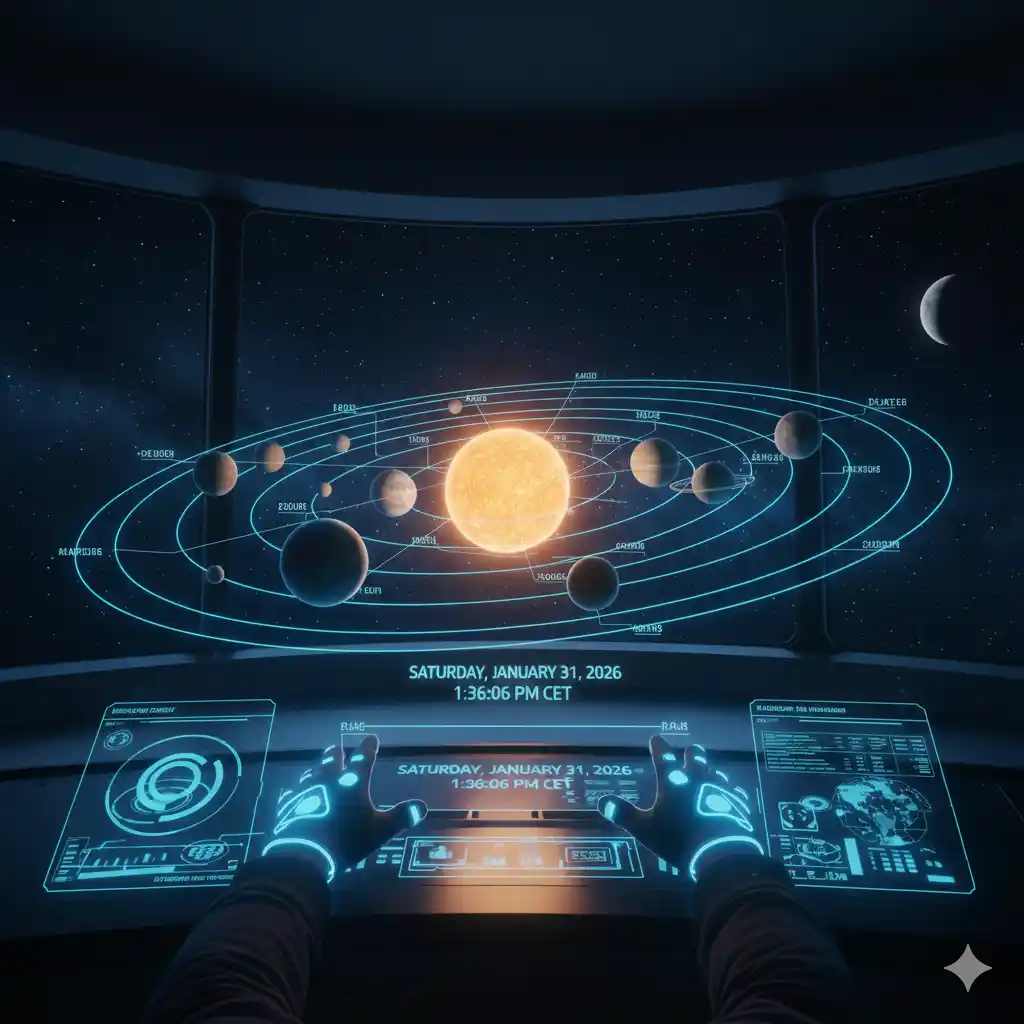
🛰️ Solar System & LEO Command
The Heliocentric Model and Orbital Projections
The map uses a heliocentric coordinate system, mapping planetary positions relative to the Sun as the central point of reference.
Because planets travel at different speeds and have varying orbital periods—a principle described by Kepler’s Third Law—their relative distances and configurations change constantly over time.
Distances and the Astronomical Unit (AU)
Distances in the solar system are measured using the Astronomical Unit (AU), which is defined as the average distance between Earth and the Sun, approximately 149.6 million kilometers.
This unit is used instead of standard kilometers to simplify the immense scale of the solar system, making it easier to read and calculate vast celestial distances—for instance, placing Neptune at a manageable roughly 30 AU from the Sun rather than billions of kilometers away.
Conjunctions and Planetary Alignment
A planetary conjunction occurs when two planets appear exceptionally close to one another in the night sky, sharing the same celestial coordinate (specifically, the same ecliptic longitude).
For anyone planning observations, conjunctions provide a fantastic opportunity to view multiple planets within the same telescope eyepiece or binoculars, making them some of the most rewarding celestial events to track.
Orbital Inclination and the Ecliptic Plane
While the map presents a simplified 2D projection, the planets actually orbit the Sun at slight inclinations relative to the ecliptic plane (Earth’s orbital plane).
This slight tilt in their paths is the exact reason why planets don’t collide or block each other when their orbits cross on a flat map, keeping the solar system dynamically stable despite its complex, intersecting trajectories.
| Planet | Distance (AU) | Orbital Period |
|---|---|---|
| Mercury | 0.39 | 88 Days |
| Venus | 0.72 | 225 Days |
| Earth | 1.00 | 365 Days |
| Mars | 1.52 | 687 Days |
| Jupiter | 5.20 | 11.9 Years |
| Saturn | 9.58 | 29.5 Years |
| Uranus | 19.22 | 84 Years |
| Neptune | 30.05 | 165 Years |
Solar System FAQ
There are eight officially recognized planets: Mercury, Venus, Earth, Mars, Jupiter, Saturn, Uranus, and Neptune. While Pluto was reclassified as a “dwarf planet” in 2006, it remains one of the most searched objects in our solar system alongside other dwarf planets like Eris and Ceres.
Jupiter is the undisputed king of the planets. It is so massive that all the other planets in the solar system could fit inside it twice over. Its “Great Red Spot” is actually a giant storm that has been raging for hundreds of years.
It’s all about the atmosphere. Mercury has almost no atmosphere to trap heat. Venus has a thick, toxic atmosphere of carbon dioxide that creates a runaway greenhouse effect, trapping heat and making its surface hot enough to melt lead.
The Asteroid Belt is a vast region of rocky debris located between the orbits of Mars and Jupiter. It contains millions of asteroids, ranging from tiny pebbles to the dwarf planet Ceres, which is about 950 km in diameter.
According to the IAU, a planet must orbit the Sun, be spherical, and have “cleared the neighborhood” around its orbit. Dwarf planets, like Pluto or Eris, meet the first two criteria but share their orbital path with other debris and objects.
The four inner planets (Mercury, Venus, Earth, Mars) are terrestrial, meaning they have solid, rocky surfaces. The four outer planets (Jupiter, Saturn, Uranus, Neptune) are gas and ice giants, composed mostly of hydrogen, helium, and water/ammonia ice, with no solid surface to stand on.
Beyond Neptune lies the Kuiper Belt, a freezing realm of icy objects and dwarf planets. Even further out is the theoretical Oort Cloud, a giant spherical shell surrounding the entire solar system that is believed to be the source of long-period comets.