
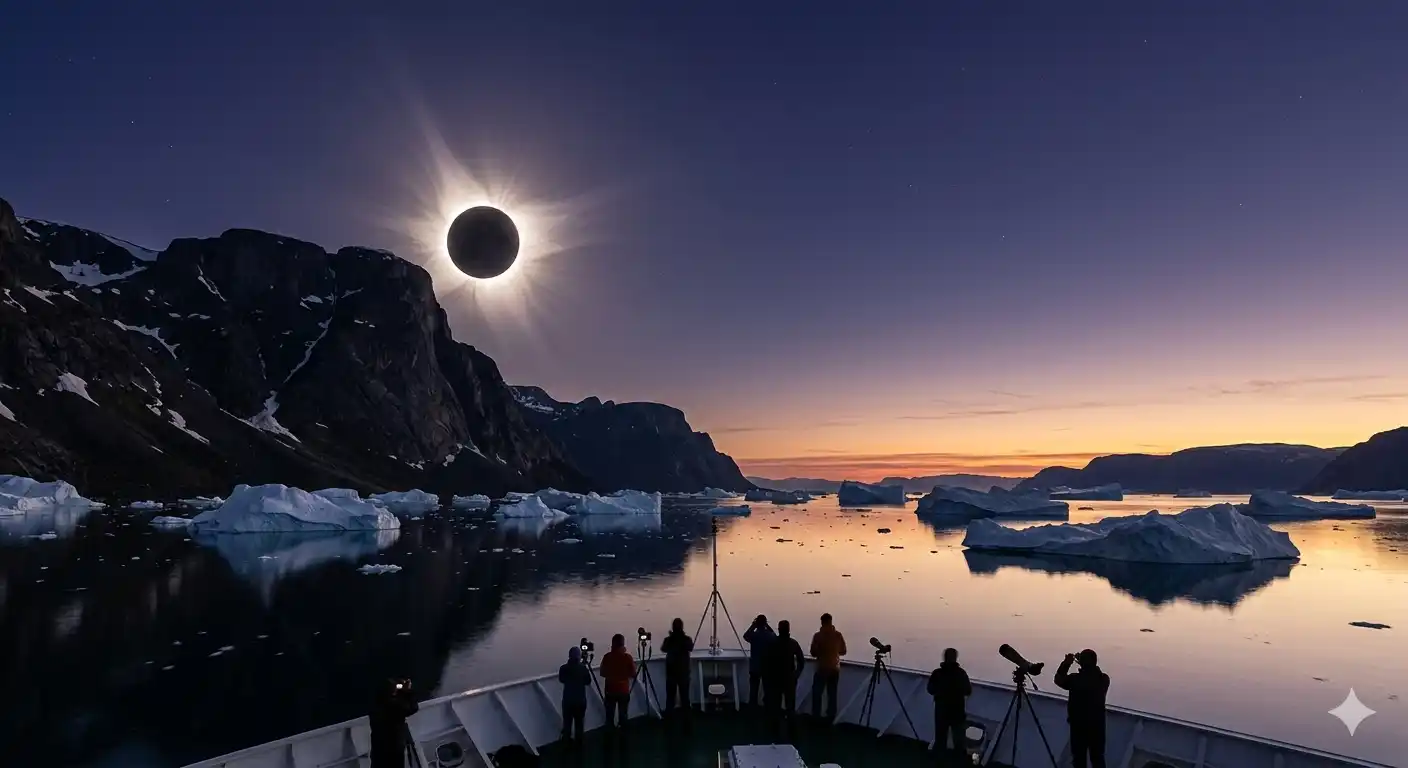
Greenland stands as the true frontier for the 2026 Total Solar Eclipse. As the Moon’s shadow first touches land over the vast, icy wilderness of the North East Greenland National Park, a select few will witness the corona glowing over towering icebergs and rugged fjords. From the remote outpost of Ittoqqortoormiit to the deep Arctic interior, discover how to navigate the logistical challenges of witnessing totality in the most pristine environment on Earth.
🌑 GREENLAND COMMAND CENTER
❄️ Primary Hub: Ittoqqortoormiit
🚢 Access: Expedition Vessel Only
🔭 Conditions: High Altitude (25°+)
Greenland Totality Schedule: August 12, 2026
| Location | Totality Begins (GMT) | Duration | Sun Altitude |
|---|---|---|---|
| Ittoqqortoormiit | 16:35:05 | 2m 10s | 26.3° |
| Scoresby Sund (Central) | 16:34:50 | 2m 12s | 26.5° |
| Constable Pynt | 16:35:12 | 2m 08s | 26.1° |
| Daneborg | 16:32:45 | 2m 06s | 27.8° |
| Gunnbjørn Fjeld Area | 16:37:30 | 2m 01s | 24.9° |
| Shannon Island | 16:31:55 | 2m 04s | 28.2° |
Greenland is the “First Contact” point for the 2026 eclipse path. While the Scoresby Sund area offers over 2 minutes of totality, remember that this is a pure wilderness experience. Most observers will be on expedition ships; if you are land-based, you must account for Polar Bear safety and the lack of roads. The high sun altitude (approx. 26°) means you won’t have to worry about the horizon blocking your view of the corona!
Total Solar Eclipse 2026 Greenland: The Ultimate Arctic Frontier Guide
On August 12, 2026, the moon’s shadow will make its grand entrance onto the terrestrial world, and Greenland will be its first host. While thousands will flock to the beaches of Spain and the fjords of Iceland, a select group of adventurers will head to the high Arctic to witness “First Contact.” This is the most remote, pristine, and logistically challenging location on the entire 2026 path of totality. In this guide, we explore the precise path through Greenland, the best expedition strategies, and what to expect from an eclipse in the world’s largest national park.
The Science of First Contact: Greenland’s Path
The 2026 total solar eclipse begins its journey over the North Pole before racing southward. Greenland is the first landmass to be touched by the umbra (the darkest part of the moon’s shadow). Because Greenland sits so far north and west on the path, the eclipse here occurs earlier in the day than in Europe—approximately 16:35 to 16:40 GMT.
For observers in Greenland, the Sun will be significantly higher in the sky than for those in Spain. At an altitude of approximately 25° to 30°, the eclipse will be perfectly positioned above the jagged skyline of the Watkins Mountains and the massive icebergs of the Greenland Sea. This height minimizes atmospheric distortion, offering a crystal-clear view of the solar corona’s delicate filaments.
Primary Viewing Zones in Greenland
The path of totality in Greenland is vast, yet almost entirely uninhabited. To see the 2026 eclipse here, you are choosing an expedition, not a vacation.
1. Ittoqqortoormiit (The Only Settlement in the Path)
Located on the eastern coast at the mouth of the Scoresby Sund fjord system, Ittoqqortoormiit is one of the most remote inhabited places on Earth. It is the only town in Greenland that lies directly within the path of totality.
- Totality Duration: Approximately 2 minutes and 10 seconds.
- The Experience: Witnessing the eclipse from a village of colorful wooden houses surrounded by sea ice is a once-in-a-lifetime visual. However, with a population of only 350 people, local infrastructure is extremely limited.
2. Northeast Greenland National Park
The northern half of the eclipse path crosses the world’s largest national park. This is a land of massive glaciers, polar bears, and absolute silence. There are no roads, no hotels, and no permanent inhabitants. Access to this region is only possible via specialized Arctic expedition vessels or private fly-in charters to remote research stations like Daneborg.
3. The Scoresby Sund Fjord System
The world’s largest fjord system sits squarely in the path of totality. For many, the ultimate 2026 eclipse experience will be on a ship deep within these fjords. The towering basalt cliffs and the mirrored surface of the water, filled with grounded icebergs, provide a natural amphitheater for the darkening sky.
Weather and Visibility: The Arctic Advantage
While the Arctic is known for its harsh conditions, August is the height of the Greenlandic summer.
- The “Arctic Desert” Effect: Northern Greenland is technically a polar desert. Inland areas near the ice sheet often have much lower humidity and clearer skies than the coastal regions of Iceland.
- Katabatic Winds: These dry, downward-sloping winds often clear the coastal fog, providing “windows” of perfect visibility even if the surrounding North Atlantic is cloudy.
- 24-Hour Daylight Transition: In August, Greenland experiences the “Midnight Sun” transition. The eclipse will provide a surreal “false night” in a season where the sun barely dips below the horizon.
Expedition Logistics: How to Get There
Logistics are the primary barrier to entry for the Greenland eclipse.
- Expedition Cruises: This is the most viable option for 90% of travelers. Several high-end polar cruise lines have already carved out itineraries that position their ships in the Greenland Sea or Scoresby Sund for totality.
- Air Travel: Flights to Ittoqqortoormiit (via Constable Point) are infrequent and rely on small aircraft from Iceland or West Greenland. These are expected to be fully booked years in advance.
- Self-Sufficiency: Anyone planning a land-based expedition must be entirely self-sufficient, carrying all food, fuel, and satellite communication, and must obtain a permit from the Government of Greenland to enter the National Park.
Why Greenland Ranks as the #1 “Elite” Spot
While Spain is the “Weather King” and Iceland is the “Accessibility King,” Greenland is the “Purity King.” There is zero light pollution. There is zero noise pollution. During the two minutes of totality, the drop in temperature will be palpable against the permafrost, and the wildlife—from muskoxen to Arctic foxes—may react in real-time to the sudden onset of “night.”
2026 for the Observers
If you seek the most scientifically pure and visually dramatic version of the 2026 Total Solar Eclipse, Greenland is your destination. It requires the most planning and the highest budget, but the reward is a view of the corona that few humans have ever seen from such a pristine vantage point.
FAQ
On August 12, 2026, Greenland will be the first landmass to experience totality. The partial phase begins at approximately 15:35 GMT, with the total eclipse (totality) hitting the northeast coast at 16:35 GMT. Because Greenland is so far West, this occurs earlier in the afternoon than the sightings in Iceland or Spain.
The only permanent settlement in the path of totality is Ittoqqortoormiit on the East Coast. However, the most popular way to view the Greenland eclipse is from an expedition cruise ship within the Scoresby Sund fjord system or along the coast of the Northeast Greenland National Park. These locations offer a clear view of the Sun over the Arctic wilderness.
In the prime viewing areas like Ittoqqortoormiit, totality will last approximately 2 minutes and 10 seconds. This is significantly longer than the duration in Reykjavík, Iceland, or Zaragoza, Spain, making Greenland one of the best spots for extended observation of the solar corona.
It is extremely difficult. Ittoqqortoormiit has a very small airport (Constable Point) with limited flights, and accommodations are nearly non-existent for large groups. Most land-based viewing requires a specialized permit for the National Park and full expedition self-sufficiency. A cruise ship is the most reliable and safe way for most people to attend.
August is the height of the Arctic summer, featuring 24-hour daylight (the Midnight Sun period). While coastal fog can occur, the interior fjords of East Greenland act as a “polar desert,” often providing some of the clearest, driest skies on the entire 2026 eclipse path.
The same safety rules apply: you must use ISO 12312-2 certified eclipse glasses during the partial phases. In Greenland, you also have the added logistical safety concern of Polar Bears. If you are viewing from land, you must be part of an organized group with a trained polar bear guard, as the path of totality is prime habitat for these predators.