
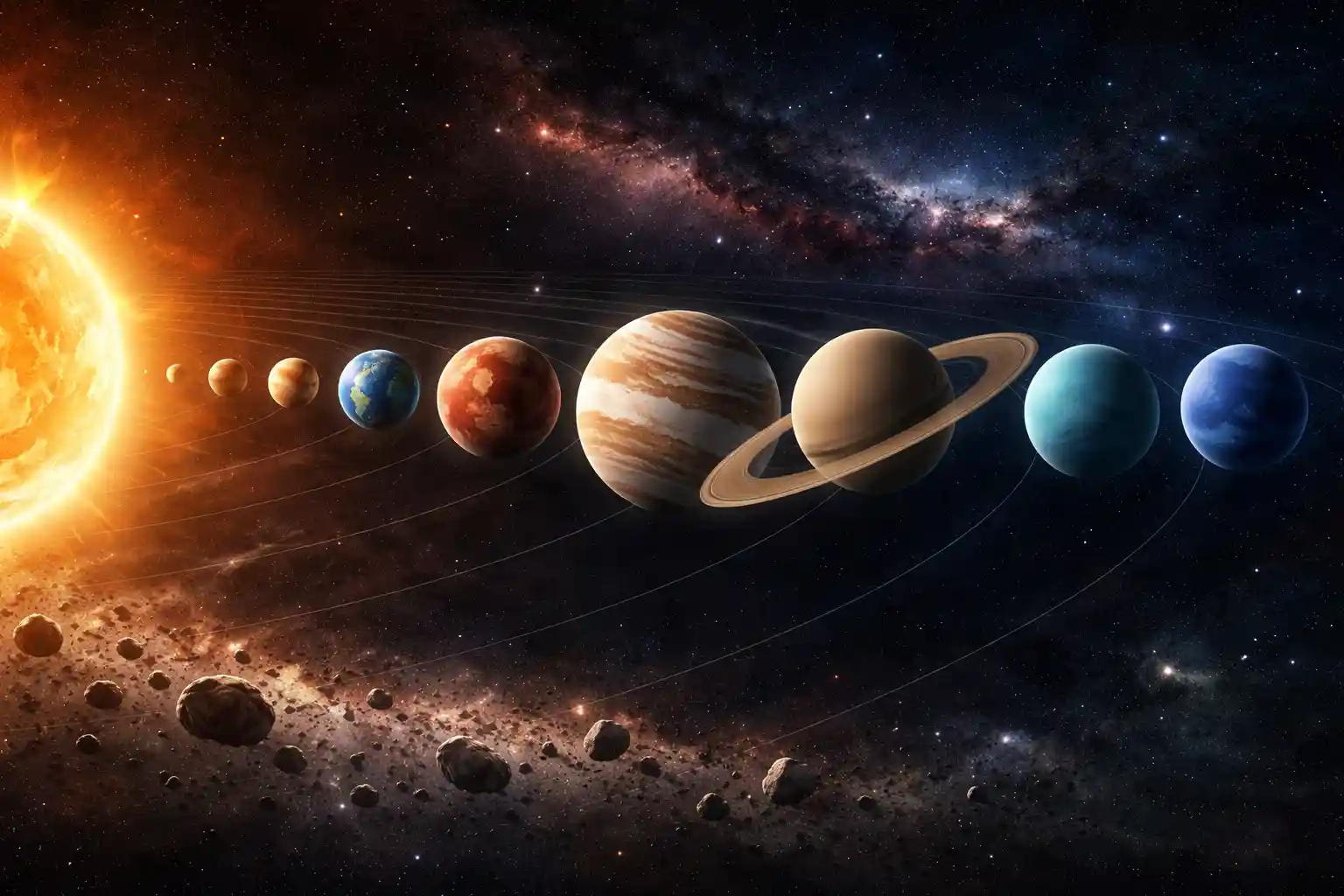
Discover the planets in order from the Sun with an easy chart showing distance, size, moons, and key facts. A quick and complete guide to our solar system.
🪐 PLANETS IN ORDER
Select a planet
Discover the Planets in Order from the Sun: A Complete Guide to Our Solar System
Understanding the planets in order from the Sun is essential for anyone fascinated by astronomy. The solar system consists of eight major planets, each with unique features, orbits, and characteristics. Knowing their sequence helps students, space enthusiasts, and curious minds alike grasp the structure of our cosmic neighborhood.
Starting from the closest to the Sun, the planets are Mercury, Venus, Earth, Mars, Jupiter, Saturn, Uranus, and Neptune. Each planet has distinct traits, such as size, atmosphere, gravity, and distance from the Sun, which makes exploring the solar system a captivating experience.
| Planet | Distance (AU) | Diameter (km) | Moons |
|---|---|---|---|
| Mercury | 0.39 | 4,879 | 0 |
| Venus | 0.72 | 12,104 | 0 |
| Earth | 1.00 | 12,742 | 1 |
| Mars | 1.52 | 6,779 | 2 |
| Jupiter | 5.20 | 139,820 | 101 |
| Saturn | 9.54 | 116,460 | 285 |
| Uranus | 19.22 | 50,724 | 29 |
| Neptune | 30.06 | 49,244 | 16 |
Mercury: The Smallest and Fastest Planet
Mercury is the closest planet to the Sun, at an average distance of approximately 57.9 million kilometers. Despite its proximity, Mercury is not the hottest planet; that title belongs to Venus. Mercury is known for its extremely thin atmosphere and rapid orbit, completing a full revolution around the Sun in just 88 Earth days. Its surface is heavily cratered, resembling Earth’s Moon, making it a point of interest for planetary geologists.
Venus: The Hottest Planet in the Solar System
Venus, the second planet from the Sun, is often called Earth’s twin because of its similar size and structure. However, Venus has a thick, toxic atmosphere composed primarily of carbon dioxide, with clouds of sulfuric acid. This creates an intense greenhouse effect, making Venus the hottest planet in the solar system, with surface temperatures reaching over 460°C. Its slow rotation and retrograde spin add to its unique planetary dynamics.
Earth: Our Life-Sustaining Planet
The third planet from the Sun is Earth, the only known planet that supports life. Earth’s atmosphere is rich in nitrogen and oxygen, providing a stable climate and protecting life from harmful solar radiation. At 149.6 million kilometers from the Sun, Earth sits in the “habitable zone,” where liquid water can exist. Earth’s gravity, magnetic field, and diverse ecosystems make it the cornerstone of life in our solar system.
Mars: The Red Planet
Mars, the fourth planet, is known as the Red Planet due to its reddish appearance caused by iron oxide on its surface. Mars has the largest volcano in the solar system, Olympus Mons, and deep canyons like Valles Marineris. Its thin atmosphere and cold temperatures make it a challenging destination for future human exploration, yet scientific missions continue to uncover evidence of water and potential habitability in the past.
Jupiter: The Giant of the Solar System
Jupiter is the fifth planet and the largest in our solar system. With a diameter of 139,820 kilometers, it is a gas giant primarily composed of hydrogen and helium. Jupiter is famous for its Great Red Spot, a giant storm larger than Earth that has raged for centuries. The planet has 101 moons, including Ganymede, the largest moon in the solar system. Its massive gravity influences the orbits of nearby objects, protecting inner planets from potential comet impacts.
Saturn: The Ringed Beauty
Saturn is the sixth planet from the Sun and is renowned for its spectacular ring system. The rings are made of ice, rock, and dust particles orbiting the planet in complex structures. Saturn is also a gas giant, with a diameter of 116,460 kilometers. It has 285 moons, including Titan, which has a dense atmosphere and liquid methane lakes. Saturn’s low density allows it to float if placed in water, highlighting its unique composition.
Uranus: The Tilted Ice Giant
Uranus is the seventh planet and an ice giant with a distinct blue-green color due to methane in its atmosphere. Unlike other planets, Uranus rotates on its side, with an axial tilt of approximately 98 degrees. This extreme tilt causes unusual seasonal changes and polar phenomena. Uranus has faint rings and 29 known moons, making it a mysterious and intriguing object for astronomers and space enthusiasts.
Neptune: The Windy Blue Giant
Neptune, the eighth and farthest known planet from the Sun, is a deep blue ice giant. Its intense atmosphere features the fastest winds in the solar system, reaching speeds of over 2,000 km/h. Neptune has 16 known moons, with Triton being the largest, notable for its retrograde orbit and geysers. Neptune’s distant orbit and extreme conditions make it one of the least explored planets, but modern telescopes continue to reveal its dynamic weather patterns and composition.
Why Learning the Planetary Order
Knowing the planets in order from the Sun is more than just memorization; it provides context for understanding orbital mechanics, planetary environments, and potential for life beyond Earth. This knowledge is essential for students, educators, and anyone interested in space science. With increasing interest in space travel and exploration, understanding planetary order helps humans appreciate the vastness and complexity of our solar system.
🪐 Fun Facts About the Planets
Mercury has no moons at all — its gravity well is too small to hold onto one.
Venus rotates backward compared to most planets, a quirk called retrograde rotation.
Earth is the densest planet in the solar system, thanks to its iron-rich core.
Mars hosts Olympus Mons, the tallest volcano in the solar system.
Jupiter’s magnetic field is roughly 20,000 times stronger than Earth’s.
Saturn is so low-density it could float in water — and it now leads the solar system with 285 confirmed moons.
Uranus spins on its side, causing extreme, decades-long seasons.
Neptune has the fastest winds of any planet, gusting over 2,000 km/h.
FAQ
The planets in order from the Sun are Mercury, Venus, Earth, Mars, Jupiter, Saturn, Uranus, and Neptune.
Mercury is the closest planet to the Sun, orbiting at about 57.9 million kilometers.
Jupiter is the largest planet in the solar system, with a diameter of 139,820 kilometers.
Mars is known as the Red Planet due to its reddish surface caused by iron oxide.
Jupiter has the strongest gravity in the solar system at 24.8 m/s².
Saturn is famous for its spectacular ring system, composed of ice and rock particles.
Uranus rotates on its side with an axial tilt of 98°, making its rotation unique among the planets.
Venus is the hottest planet in the solar system due to its thick atmosphere and runaway greenhouse effect.
Neptune has the fastest winds in the solar system, reaching up to 2,100 kilometers per hour.
Earth is the only known planet to support life, with the perfect conditions for water, atmosphere, and biodiversity.
In 2006, the International Astronomical Union (IAU) redefined what constitutes a “planet.” Pluto failed to meet one of the three criteria: it has not “cleared its neighborhood” of other debris in its orbit. As a result, Pluto was reclassified as a “dwarf planet.”
While there are several dwarf planets beyond Neptune (like Pluto, Eris, and Haumea), astronomers are currently searching for a hypothetical “Planet Nine,” which is theorized to be a large, hidden planet far beyond Pluto’s orbit. However, as of now, there are only eight officially recognized major planets.