
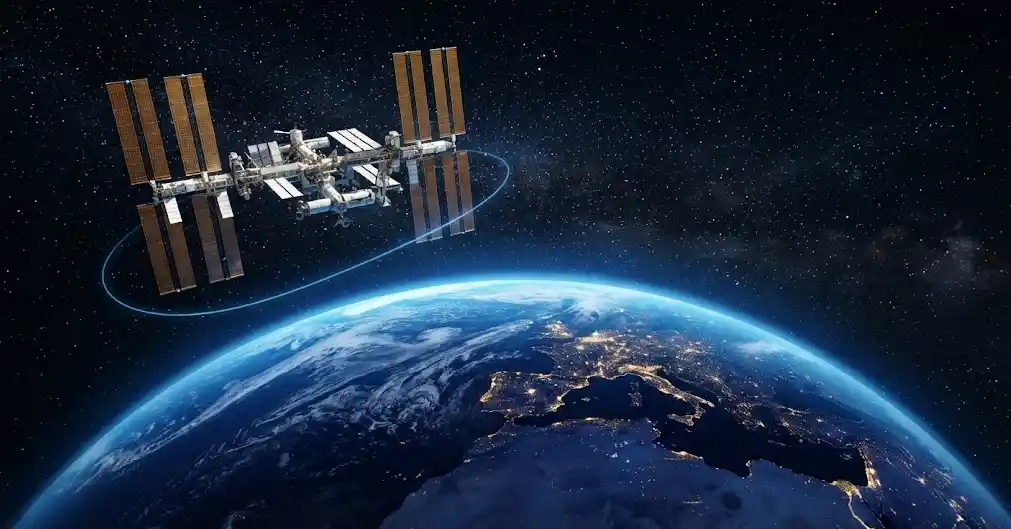
See when the International Space Station flies over your city. Pick a city below to find the next visible passes, with local times, direction and how long the ISS stays in view.
How to Spot the International Space Station
The International Space Station (ISS) is the largest object humans have ever put into orbit, about the size of a football pitch. It circles Earth at roughly 400 km altitude, travelling at around 28,000 km/h. That speed means it completes one orbit in about 90 minutes, so the crew sees around 16 sunrises and sunsets every day.
The station has been continuously crewed since November 2000, and a typical crew is around seven astronauts and cosmonauts. Their work covers everything from medicine and materials science to studying how the human body adapts to weightlessness.
Why Can’t I See It Every Night?
The ISS does not produce its own light. You see it because it reflects sunlight, so you can only spot it when two things happen at once: the sky where you stand is dark, and the station high above is still lit by the Sun. That is why the best viewing windows come shortly after sunset or before sunrise.
The orbit is tilted about 51.6° to the equator, which is why the station can be seen from most populated parts of the world. Some weeks offer several visible passes in a row, and other weeks offer none.
What Does It Look Like?
The ISS looks like a very bright, steady white light moving smoothly across the sky. It can outshine every star and even Venus. It does not blink or change direction like an aircraft, and a typical visible pass lasts between two and six minutes.
Tips for Your First Sighting
- Check the pass time for your city and go outside a few minutes early.
- Note the direction where it appears and where it disappears.
- Choose an open spot with a clear horizon, away from tall buildings and bright lights.
- Cloud cover is the main thing that can spoil a pass, so check the forecast.
Pick your city above to see the next visible passes, or follow the live tracker to see where the ISS is right now.