
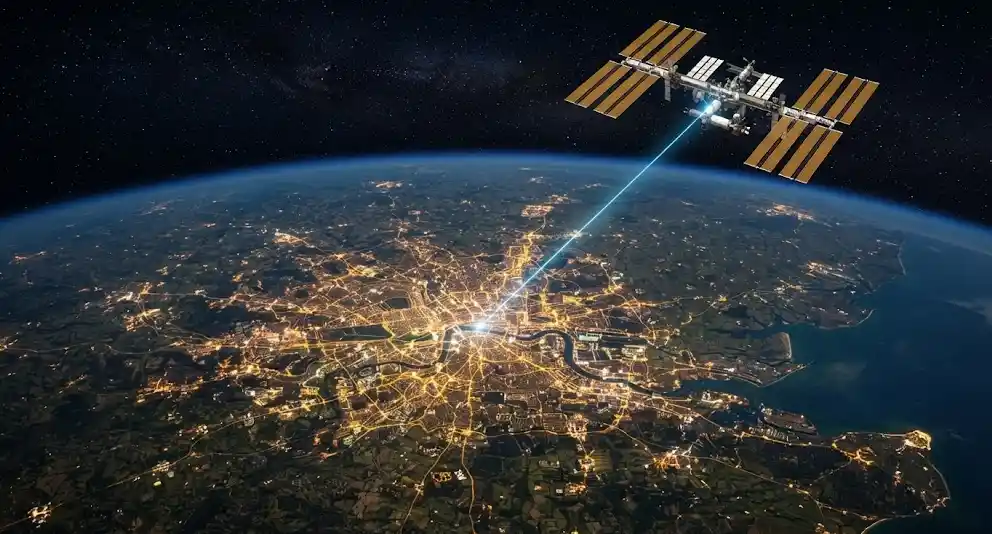
How to see the ISS from London
London is at 51.5°N, almost the same as the 51.6° tilt of the ISS orbit. That puts London right under the northernmost part of the station’s path, so passes here can climb high into the sky. A good pass reaches 60° or more and is visible for several minutes.
The ISS is easy to find. It is brighter than any star, and at its best brighter than Venus. It moves steadily without blinking, and almost always travels from west to east.
When it is visible
The ISS only shows when the sky over London is dark and the station is still in sunlight. That means a window after sunset or before sunrise. Some weeks bring several visible passes, and other weeks bring none. In summer London never gets fully dark, but the ISS is still easy to see in the twilight.
The table above shows only passes that meet these conditions, with local London time (GMT in winter, BST in summer).
Where to watch in London
You do not need a dark site, but you do need an open horizon.
- Primrose Hill: wide view over the city, good to the south and east.
- Hampstead Heath (Parliament Hill): open ground and a long horizon in most directions.
- Greenwich Park: open view towards the east and the river.
- Richmond Park: darker skies and a low horizon, good for low passes.
Streetlights and tall buildings block the low part of the sky, so passes that peak high are easiest to see from the middle of the city.
ISS London FAQ
No. The ISS is visible with the naked eye.
It has moved into Earth’s shadow and is no longer lit by the Sun.
Yes. Check the weather before you go out.
Best within 2-3 days. The ISS adjusts its orbit from time to time, so passes further ahead can shift by a few minutes.
Higher passes are brighter, because the ISS is closer and reflects more light towards you.