
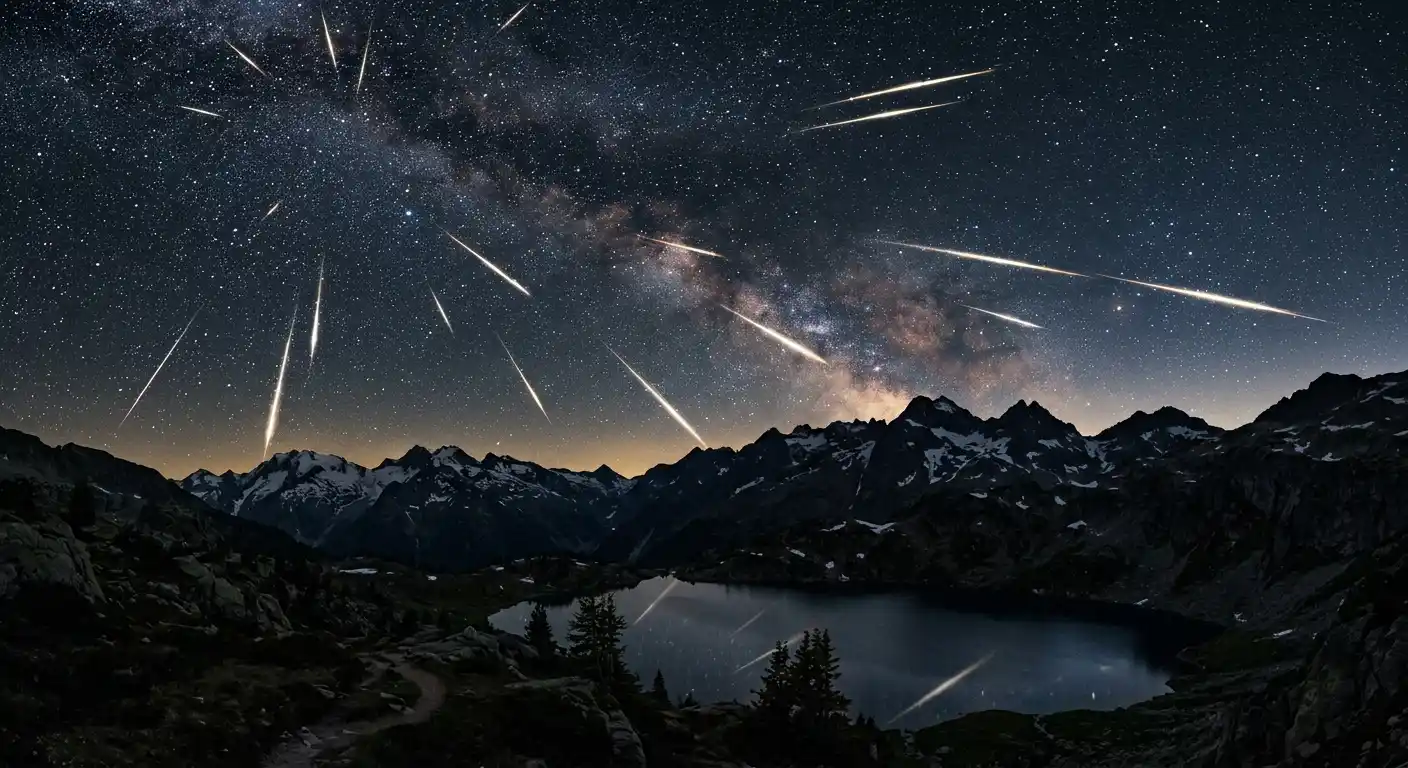
Peak night December 14 · up to 150 meteors per hour · best from midnight to 4 AM
Geminid Meteor Shower Countdown
Geminids peak every year on December 14
Up to 150 meteors per hour. Best viewing from 10 PM to 4 AM local time.
How many Geminids will you see?
Rough estimate for the peak hours with clear weather. The radiant sits lower in the Southern Hemisphere, so rates are lower there.
Night plan
What are the Geminids?
The Geminids are the strongest meteor shower of the year. Under a dark sky you can see up to 150 meteors per hour at the peak. That beats the Perseids (about 100 per hour) and the Quadrantids (about 120). They are also easy to catch, because you can start watching in the evening and don’t have to wait for the early morning.
Most meteor showers come from comets. The Geminids come from an asteroid called 3200 Phaethon, which goes around the Sun every 1.4 years. Each December Earth drives through the dust it leaves behind. The grains hit the atmosphere at about 35 km/s (78,000 mph). That is slower than the Perseids, so the meteors look like they glide across the sky. Many of them are bright. Most look white or yellow, and some show green.
When to watch in 2026
The shower is active from December 4 to 20, with the peak on December 14. The peak is fairly broad, so the nights before and after are still good.
Start looking around 10 PM. The best time is close to 2 AM, when the constellation Gemini is highest in the sky. This is local time, so 2 AM wherever you live.
The Moon is on your side this year
New Moon falls on December 9, 2026. On the peak night the Moon is a thin crescent, roughly 17% lit, and it sets in the evening. That means a dark sky for the best hours. Moonlight can hide half the meteors in other years, so 2026 is a good one.
How many will you see?
The 150 per hour figure is for a perfect dark sky with the radiant high up. Real numbers depend on where you stand:
- City center: about 10 per hour
- Suburb: about 25 per hour
- Rural area: about 60 per hour
- Dark sky site: 100 or more per hour
In the Southern Hemisphere, Gemini stays lower, so expect roughly half of these numbers. Use the estimator above to get a number for your own sky.
Driving one hour out of a city can multiply what you see by five or more. It is the single best thing you can do.
How to watch
Give your eyes time. It takes 20 to 30 minutes in the dark to see faint meteors. One look at your phone resets it. If you need light, use a red one.
Lie back. Use a reclining chair or a blanket and look straight up, or toward the southern part of the sky if you are in the north. You don’t need a telescope or binoculars. They make it worse, because they show a tiny part of the sky.
Don’t stare at Gemini. Meteors near the radiant look short. The long trails show up 40 to 60 degrees away from it, so look at the whole sky.
Dress warmly. December nights are cold, and you will be still for an hour or two. Wear more layers than you think you need, and bring a hot drink.
Check the clouds. A clear sky matters more than anything else. Look at the cloud forecast a day before, and if your area is covered, find a spot within driving distance that is not.
Plan two nights. If the peak night is cloudy, December 13 or 15 will still give you a good show.
Taking photos
You can photograph Geminids with a normal camera. Put it on a tripod with a wide lens (14 to 24 mm), aperture f/2.8 or lower, ISO 1600 to 3200 and 10 to 15 second exposures. Use an interval timer and let it shoot hundreds of frames. Only a few will catch a meteor, so don’t expect every frame to work. Point it at a wide area of sky, away from the Moon and street lights.
FAQ
The shower is active from December 4 to 20, and the peak is on December 14. The nights of December 13 and 15 are also good, so you have a backup if the peak night is cloudy.
Between midnight and 4 AM local time, with the best rates close to 2 AM. You can see some meteors from about 10 PM, because Gemini rises early in the evening.
Up to 150 under a perfect dark sky. In practice you will see about 10 per hour in a city center, 25 in a suburb, 60 in the countryside and 100 or more at a dark sky site.
You don’t need to look at Gemini. Meteors near it look short, and the long ones appear 40 to 60 degrees away. Lie back and take in as much sky as you can, ideally away from street lights.
No. They show only a tiny part of the sky and you will miss most meteors. Your eyes are the best tool here. A reclining chair and warm clothes help more than any equipment.
No. New Moon is on December 9, so on the peak night the Moon is a thin crescent, about 17% lit, and it sets in the evening. The best hours after midnight will be dark.
Yes, but fewer. Gemini stays lower in the sky, so expect about half the rate you would see in the north. The meteors are still bright, and you can see them from Australia, South Africa and South America.