
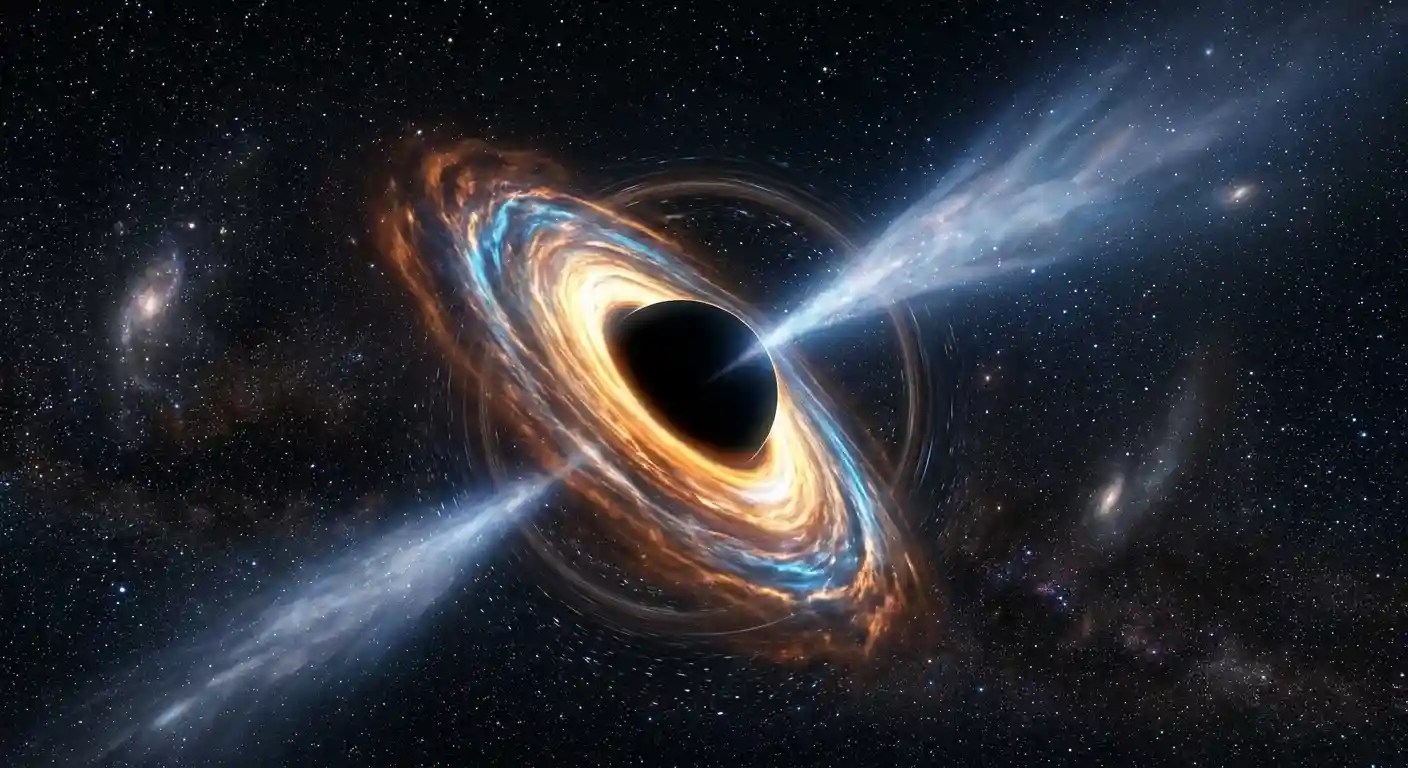
Compare the biggest black holes with our Solar System, and see how small Earth, the Sun or you would become as a black hole.
The biggest black holes next to our Solar System
Width of each black hole’s event horizon (the point of no return), compared with Earth, the Sun and the orbit of Neptune.
How small would it become as a black hole?
Pick an object to see the size it would have if all its mass collapsed into a black hole.
Calculated with r = 2GM/c². Nothing in nature could squeeze Earth or the Sun this small by itself; the numbers show the size they would have. Object radii and black hole masses are rounded estimates.
Black Holes: Size, Mass and Numbers
What a black hole is
A black hole is a region of space where the escape velocity is greater than the speed of light, 299,792 km/s. Its boundary is the event horizon. Nothing that crosses it, including light, can return. For a non-rotating black hole, the horizon radius is the Schwarzschild radius, r = 2GM/c², which is about 2.95 km per solar mass. Compress the Sun and it would be a sphere 5.9 km wide. Earth would be about 1.8 cm wide, roughly a marble.
How they form
Stellar-mass black holes form when a star starting at more than about 20 solar masses runs out of fuel and its core collapses. They usually weigh 5 to 100 solar masses. The Milky Way probably holds around 100 million of them, but only a few dozen have been identified. The nearest known, Gaia BH1, is about 1,560 light-years away.
The Sun will not become one. In roughly 5 billion years it will shed its outer layers and leave a white dwarf.
Intermediate-mass black holes, between about 100 and 100,000 solar masses, are rarer and harder to find. Candidates exist, but few are confirmed.
Supermassive black holes sit in the centres of most large galaxies and weigh millions to billions of solar masses. How they grew so fast is still debated. Quasars with up to 2 billion solar masses are seen when the universe was under 800 million years old, compared with its current age of 13.8 billion years.
The biggest known black holes
Horizon widths are calculated from estimated masses.
- Cygnus X-1: 21 solar masses, 7,200 light-years away, horizon about 124 km wide
- Gaia BH3: 33 solar masses, 1,926 light-years away, about 195 km wide
- Sagittarius A*: 4.15 million solar masses, 26,700 light-years away, about 24.5 million km wide, roughly 18 Suns side by side
- M87*: 6.5 billion solar masses, 55 million light-years away, about 257 AU wide, 4.3 times the width of Neptune’s orbit
- TON 618: about 66 billion solar masses, 10.4 billion light-years away, about 2,600 AU wide, 43 times the width of Neptune’s orbit
Phoenix A may be larger, with an upper mass estimate near 100 billion solar masses, but that figure is uncertain.
Matter falling toward a supermassive black hole heats up in a disc and can outshine its host galaxy. TON 618 is such a quasar, with an estimated luminosity of 140 trillion Suns.
How we know they exist
In 2015, the LIGO detectors recorded gravitational waves from two black holes of about 36 and 29 solar masses merging 1.3 billion light-years away. The result weighed about 62 solar masses, and the missing 3 were radiated away as gravitational waves. Well over 100 more mergers have been detected since.
The Event Horizon Telescope imaged M87* in 2019 and Sagittarius A* in 2022. Before that, astronomers tracked the star S2 around Sagittarius A*. It completes an orbit in about 16 years and reaches roughly 2.5% of the speed of light. That work earned Reinhard Genzel and Andrea Ghez a share of the 2020 Nobel Prize in Physics.
What happens when you fall in
Near a stellar-mass black hole, the difference in gravity between your head and feet would stretch you apart before you reached the horizon. At a supermassive black hole, the tidal force at the horizon is weak enough that you would cross it intact.
Do black holes last forever?
Almost. Through Hawking radiation, a black hole slowly loses mass. A solar-mass black hole has a temperature near 60 billionths of a kelvin, far colder than the 2.7 K cosmic microwave background, so today it absorbs more than it emits. Only once the background cools below that temperature does it begin to shrink, and a solar-mass black hole would then need about 10⁶⁷ years to evaporate. The universe is 1.4 × 10¹⁰ years old.
Black Hole FAQs
TON 618 is one of the largest well-measured black holes, with an estimated mass of about 66 billion Suns. Its event horizon is roughly 43 times wider than the orbit of Neptune. Phoenix A may be larger, but its mass is a rough upper estimate.
Sagittarius A* has about 4.15 million times the mass of the Sun. Its event horizon is around 24 million km wide, about 18 times the width of the Sun.
Earth would shrink to a black hole with a radius of about 9 mm, roughly the size of a marble. Nothing in nature can compress Earth that far, but that is the size its mass would have.
The event horizon is the boundary around a black hole beyond which nothing, not even light, can escape. Its radius for a non-spinning black hole is called the Schwarzschild radius, calculated as 2GM/c².
No. The Sun does not have enough mass to collapse into a black hole. It will end its life as a white dwarf.