
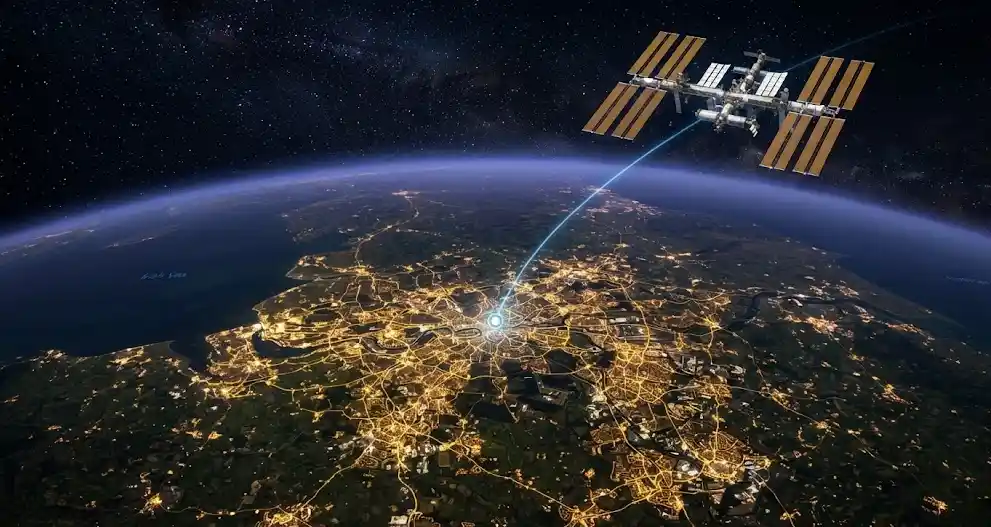
How to see the ISS from Manchester
Manchester sits at 53.5°N, about two degrees north of the highest point of the ISS orbit (51.6°). The station therefore never passes directly overhead here. The best passes climb to around 60° and stay in the southern half of the sky, so face south when one is due.
The ISS is easy to recognise. It is brighter than any star, shines a steady white and crosses the sky in two to six minutes without blinking. It always moves from west to east.
When it is visible
The ISS is only visible when the sky over Manchester is dark and the station is still lit by the Sun. That gives two windows: after sunset and before sunrise. Passes come in clusters of a few days, followed by a gap of one to two weeks, so an empty table is normal.
In midsummer the sky never gets fully dark at this latitude, but the ISS is still easy to see in the twilight. Times in the table above are local Manchester time (GMT in winter, BST in summer).
How to use the table
Each row shows when the ISS becomes visible, its maximum height, how long it stays visible and the direction. Height is measured from the horizon (0°) to straight up (90°). A pass above 30° clears most buildings and trees. A direction like SW → SE means the ISS rises in the south-west and sets in the south-east.
Where to watch around Manchester
An open view to the south and a low horizon matter more than total darkness.
- Heaton Park: high ground in north Manchester with a wide view south over the city.
- Daisy Nook Country Park: open land between Failsworth and Oldham, away from the brightest lights.
- Lyme Park (Disley): on the edge of the Peak District, with darker skies and a long horizon.
- Marple and the Peak District edge: darker still, good for low passes.
Greater Manchester is bright, but the ISS is bright enough to see from a street or back garden if buildings do not block the south. Low passes (10-20°) are easiest from higher ground.
Weather
Cloud is the most common reason to miss a pass here. Check the cloud forecast before you go out, and give it a few minutes, because gaps in cloud can open quickly.
ISS FAQ Manchester
Check the table above. It lists only passes that are visible from Manchester: the ISS is above 10°, the sky is dark and the station is lit by the Sun.
The ISS orbit shifts relative to the Sun, so visible passes come in clusters of a few days, followed by one to two weeks with none. Check back when the window opens again.
Mostly south. Manchester is north of the orbit’s highest point, so the ISS stays in the southern half of the sky. The table gives the exact direction for each pass.
No. The ISS is easily visible with the naked eye.
Up to about 60° at best. It never passes directly overhead, because Manchester (53.5°N) is north of the ISS orbit’s maximum latitude (51.6°).
Best within 2-3 days. The ISS adjusts its orbit from time to time, so passes further ahead can shift by a few minutes. The page uses the latest orbital data each time you open it.
The ISS has no flashing lights, moves silently at a steady pace and fades out when it enters Earth’s shadow. Aircraft blink, usually have coloured lights and fly more slowly across the sky.