
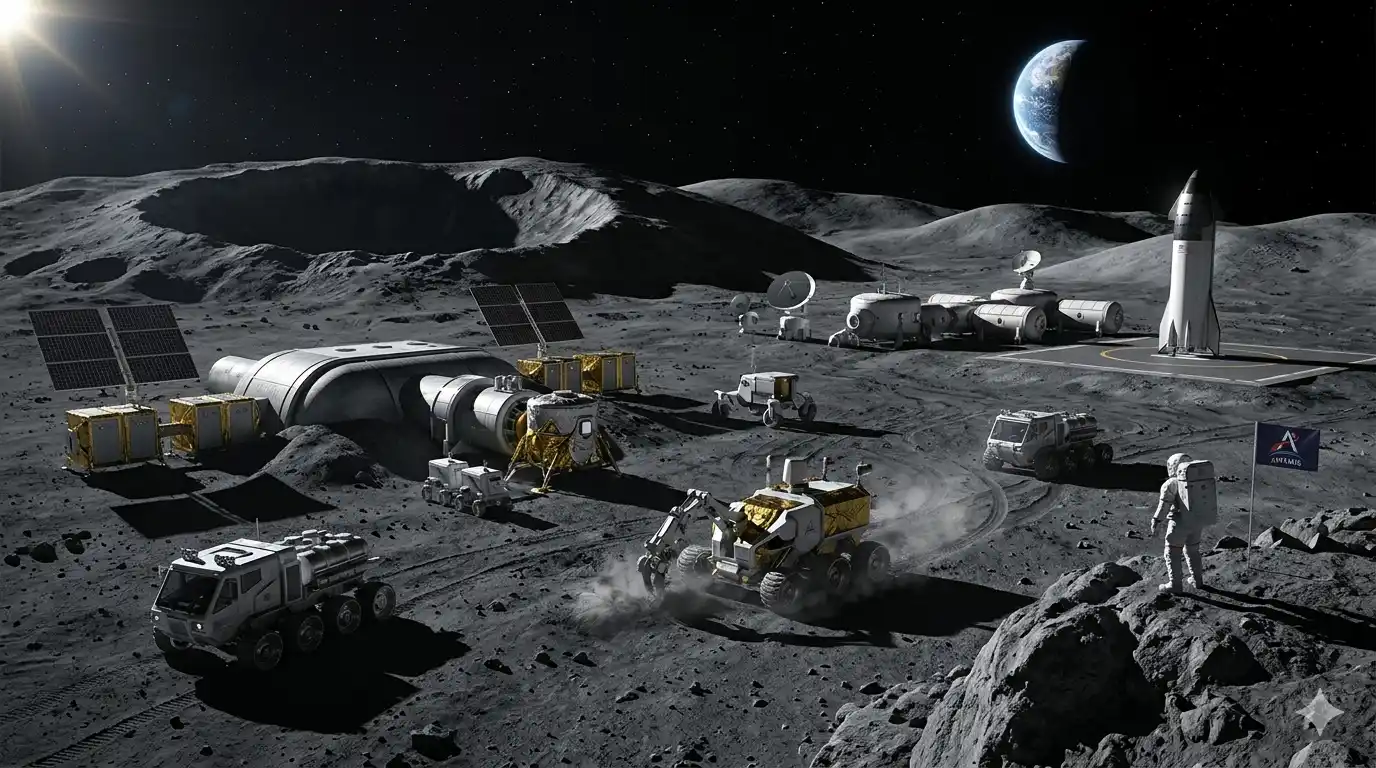
As the Artemis missions establish a permanent human presence, the Moon is transforming from a celestial body into the next global economic frontier. Discover the companies leading lunar infrastructure, the potential of Helium-3 mining, and how to position your portfolio for the multi-billion dollar space economy.
Why the Moon is the Next Economic Frontier
The Moon is no longer just a destination for exploration; it is the cornerstone of a new multi-trillion dollar space economy. As Earth-based resources become more difficult to extract, the lunar surface offers a pristine repository of critical materials. From Helium-3, a potential fuel for future clean fusion energy, to Lunar Water Ice, which can be converted into liquid hydrogen and oxygen to create ‘gas stations’ in orbit, the Moon is the essential jumping-off point for deep space commerce. In 2026, the race for lunar infrastructure is not just about prestige—it is about securing the supply chains of the future.
Top Lunar & Space Infrastructure Stocks Table
| Company | Ticker | Key Role | 2026 Status |
|---|---|---|---|
| Intuitive Machines | $LUNR | Lunar Landers & Comms | Active Missions |
| Lockheed Martin | $LMT | Orion Spacecraft & Habitats | Tier 1 NASA Partner |
| Rocket Lab | $RKLB | Small Sat Launch & Tech | Expanding Capacity |
| Northrop Grumman | $NOC | Lunar Gateway Modules | Mission Critical |
Recommended Gear for Lunar Observation
Ready to see the lunar frontier for yourself? These high-performance telescopes are perfect for tracking lunar craters and missions from your own backyard.


As an Amazon Associate, SpaceInformer earn from qualifying purchases.
How to Invest in Space Exploration (ETFs)
For investors looking to diversify without picking individual ‘moon stocks,’ Space ETFs (Exchange-Traded Funds) offer a safer entry point. These funds bundle aerospace giants, satellite operators, and lunar tech startups into a single asset. Key players include the ARK Space Exploration & Innovation ETF (ARKX), which focuses on orbital and terrestrial technologies, and the Procure Space ETF (UFO), the first pure-play global space fund. Investing in these ETFs allows you to capture the growth of the entire sector as the Artemis missions move from lunar orbits to permanent surface bases.
Lunar Resource Value Estimator
Lunar Resource Value Estimator
Estimate the market value of materials on the Moon (2026 Prices).
The Artemis Accords and Private Property on the Moon
The legal framework for the lunar economy is governed by the Artemis Accords, a series of international agreements led by the United States. While the 1967 Outer Space Treaty prevents nations from claiming sovereignty over the Moon, the Artemis Accords clarify that private companies can indeed extract and utilize space resources. This legal certainty is the catalyst for private investment, allowing corporations to build habitats, mine materials, and trade assets under a recognized ‘safety zone’ framework. However, with China and Russia pursuing their own International Lunar Research Station (ILRS), the geopolitical competition for the best ‘real estate’—specifically the water-rich South Pole—is intensifying.
Recommended Reading: The Lunar Economy
Deepen your understanding of the space frontier with these essential titles for investors and visionaries.


As an Amazon Associate, SpaceInformer earn from qualifying purchases.
The Role of AI and Robotics in Lunar Mining
The harsh environment of the lunar South Pole makes human labor both dangerous and expensive. Consequently, the lunar economy will be the world’s first ‘AI-first’ industry. Autonomous robotic swarms are currently being developed to map craters, extract regolith, and process raw materials without direct human intervention. For investors, this means the real value often lies in the software and AI-driven robotics companies that provide the ‘brains’ for these lunar machines. From machine learning algorithms that navigate the moon’s treacherous terrain to remote-operated mining rigs, Silicon Valley’s role in the lunar economy is just as vital as the aerospace giants themselves.
Oxygen and Water Ice: The Moon as a “Gas Station” in Space
One of the most valuable commodities on the Moon isn’t gold or Helium-3—it is water. Recent missions have confirmed billions of tons of water ice trapped in permanently shadowed craters. This ice is more than just a life-support resource; it is the key to deep space exploration. By splitting water ($H_2O$) into Hydrogen and Oxygen, the Moon can serve as a strategic refueling station for Starship and other reusable rockets. This ‘In-Situ Resource Utilization’ (ISRU) significantly reduces the cost of space travel, as rockets no longer need to haul all their return-trip fuel from Earth’s deep gravity well. This creates a massive B2B market for orbital fuel depots and propellant storage.
The Strategic Rivalry: Artemis vs. China’s ILRS
The lunar economy is being shaped by two competing visions for the future. On one side is the NASA-led Artemis Program, supported by the Western-aligned Artemis Accords. On the other is the International Lunar Research Station (ILRS), a joint project between China and Russia. This geopolitical competition is driving rapid innovation and massive government spending in the US, Germany, and Australia. For the private sector, this ‘New Space Race’ provides a dual-income stream: government contracts and commercial mining rights. Understanding the tension between these two blocs is crucial for anyone looking to invest in long-term lunar infrastructure and telecommunications.
FAQ
Yes, several publicly traded companies are already active in the lunar economy. Key players include Intuitive Machines ($LUNR), which provides lunar landing services, and aerospace giants like Lockheed Martin ($LMT) and Northrop Grumman ($NOC), which hold major NASA contracts for lunar infrastructure and habitats.
While Helium-3 is often cited for its potential in clean fusion energy, water ice is currently the most strategic resource. Lunar water can be converted into liquid hydrogen and oxygen, serving as rocket fuel. This allows the Moon to function as a “gas station in space,” drastically reducing the cost of deep space missions.
Under the 1967 Outer Space Treaty, no nation can claim sovereignty over the Moon. However, the Artemis Accords—signed by over 40 nations including the US, Germany, and Australia—provide a legal framework that allows private companies to extract and utilize lunar resources for commercial purposes.
Helium-3 is estimated to have a potential market value of approximately $4 billion per ton. Because it is rare on Earth but abundant in the lunar regolith, it is considered a “holy grail” for future carbon-free nuclear fusion power plants, though large-scale extraction technology is still in development.
For diversified exposure to the lunar and space economy, investors often look at the ARK Space Exploration & Innovation ETF (ARKX) and the Procure Space ETF (UFO). These funds include a mix of satellite communications, rocket manufacturers, and lunar technology providers.
Yes, lunar samples and orbital mapping indicate the presence of rare earth metals, gold, silver, and platinum-group metals. These materials are essential for high-tech electronics and green energy solutions on Earth, making lunar mining a long-term solution to terrestrial resource depletion.
The Artemis Economy refers to the ecosystem of private and public companies supported by NASA’s Artemis program. It covers everything from lunar telecommunications and 3D-printed habitats to autonomous mining rovers and orbital logistics, creating a sustainable business model for permanent human lunar presence.