
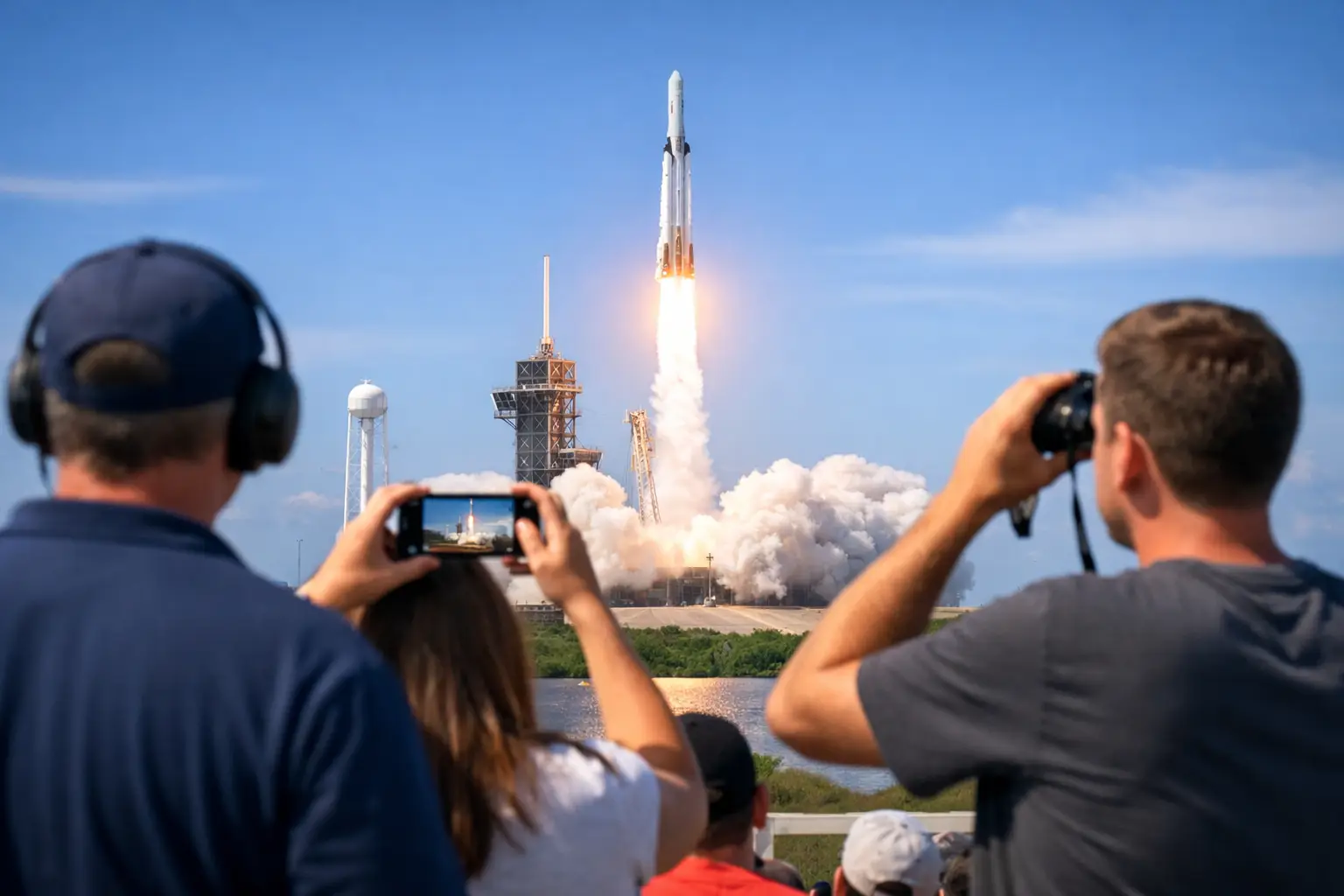
A SpaceX liftoff is not just a countdown clock. It is a fast-moving, location-specific event: a Falcon 9 can clear the tower in seconds, its first stage can return about 8.5 minutes later, and viewers hundreds of miles away may see a bright plume spread across twilight. If you want to know how to watch SpaceX launch coverage without missing a scrub, start with the mission clock, your local time zone, and the launch site.
| Viewing data point | Typical value | Why it matters |
|---|---|---|
| Falcon 9 height | 70 m | A useful scale for understanding why a close launch view feels so dramatic. |
| First-stage landing burn | About T+8.5 minutes | Stay watching after ascent for a possible return and sonic booms. |
| Typical Starlink deployment orbit | About 530 km altitude | Explains why the satellites are not visible immediately after launch from most locations. |
| Example time conversion | 02:30 UTC, July 16, 2026 = 10:30 p.m. EDT, July 15 | UTC dates can place a nighttime US launch on the previous local calendar day. |
Start with the live mission status
The launch time on a calendar is a planning signal, not a guarantee. SpaceX missions can shift by minutes, hours, or days because of weather, upper-level winds, range availability, payload readiness, or a technical hold. A launch marked for a 90-minute window may lift off at the opening second, near the end of the window, or not at all.
Use a live launch tracker on the day of flight and check it again 60 minutes before the opening of the window. Confirm four details: the launch site, the opening time in local time, the length of the window, and whether the mission is still targeting liftoff. SpaceInformer’s launch monitoring tools are designed for this exact moment: follow the countdown, then refresh your plan when the status changes.
UTC is the clock to respect when comparing sources. Eastern Daylight Time is UTC minus 4 hours, while Eastern Standard Time is UTC minus 5 hours. For example, a target of 02:30 UTC on July 16, 2026 converts to 10:30 p.m. EDT on July 15 in Florida and 7:30 p.m. PDT on July 15 in California. Check daylight-saving status rather than assuming the same offset all year.
How to watch a SpaceX launch online
For most people, the definitive experience begins with the official live webcast. Coverage commonly starts 10 to 20 minutes before liftoff, although a mission with complex operations or a crew may begin earlier. Watch on a reliable Wi-Fi connection or wired connection if possible, and open the stream at least 15 minutes before the stated launch time.
Keep a second screen available for a live tracker. The webcast tells the story, while the tracker helps with the operational details: whether the clock is counting down, whether a hold has been announced, and where the vehicle is in flight. This is especially helpful during a narrow instantaneous window, when a delay can mean the next attempt is on another date.
Do not leave when the rocket disappears from the camera. A typical Falcon 9 webcast continues through main engine cutoff, stage separation, fairing deployment, second-stage ignition, and, when planned, booster recovery. Main engine cutoff generally occurs roughly 2 minutes and 30 seconds after liftoff. The first-stage landing sequence is often the emotional second act.
A webcast can also clarify what you are seeing. A bright expanding cloud shortly after sunset is often sunlit exhaust at high altitude, not a failure. In twilight, the plume may become visible when the rocket is more than 100 km above Earth even though observers on the ground are already in darkness.
Watch from the ground near Florida or California
In-person viewing adds scale, sound, and the strange delay between them. Kennedy Space Center and Cape Canaveral Space Force Station in Florida host many SpaceX flights, while Vandenberg Space Force Base on California’s Central Coast supports frequent polar-orbit launches. Each location has different public access rules, road closures, and sightlines.
Distance changes the experience quickly. At about 5 km from a pad, the rocket’s sound arrives roughly 15 seconds after the light. At 30 km, expect about 90 seconds. That lag is normal, and it is one reason a launch can look silent in a phone video before the roar finally reaches the crowd.
For Florida launches, public beaches and causeways can offer broad views, but a clear line toward the pad matters more than simply being close. For Vandenberg launches, coastal viewpoints may provide excellent ascent views, though marine layers and low clouds are frequent variables. Arrive early, bring water, and expect traffic to increase sharply after a successful launch or scrub.
Do not plan around access to restricted facilities unless you have confirmed a public viewing program for that particular mission. Security zones can change, and launch-day restrictions can close routes with little notice. A public shoreline or designated viewing area is usually the more dependable choice.
Pick the right launch for skywatching
Not every mission looks the same from the ground. A daytime launch is easiest to follow close to the spaceport because the rocket itself and its white contrail are visible against a bright sky. At greater distances, it can be difficult to spot.
Twilight launches are often the visual standouts. If the ground is dark but the rocket is still illuminated by the Sun, the exhaust plume can fan into a luminous, jellyfish-like shape. The best geometry often occurs around 30 to 90 minutes before sunrise or after sunset, but cloud cover and the precise trajectory decide the result.
Night launches are spectacular near the pad, where the flame is visible immediately. Farther away, look for a moving point of intense light rising from the horizon. Give your eyes a few minutes to adapt, avoid staring at bright phone screens, and keep your view toward the expected direction of ascent.
A southbound Florida launch and a polar launch from California can follow dramatically different ground tracks. That is why a generic “look east” instruction is unreliable. Use a trajectory map or local viewing forecast for the individual mission, then choose an unobstructed horizon in that direction.
Bring a plan, not just a camera
A phone is enough to record the memory, but it may not capture what your eyes see. For a handheld clip, use the widest camera lens, lock focus before the count reaches zero, and resist zooming during ascent. The rocket will cross your frame faster than expected.
For still photography, a tripod and a wide lens are useful for twilight plume shots, while a longer lens can work for close pad views. There is a trade-off: long focal lengths make the rocket larger but are much harder to track. For a first launch, prioritize watching over managing equipment.
Bring ear protection for young children near close viewing areas, especially if you are within roughly 15 km of the pad. Bring a portable battery, water, insect protection in Florida, warm layers for coastal California nights, and an offline copy of your route. Cellular networks can slow down when thousands of people refresh the same countdown.
Know what happens after a scrub
A scrub is part of launch operations, not a failed event. If the countdown stops, listen for whether the team is holding, recycling, or standing down. A hold can last a few minutes. A scrub usually means the attempt has ended, though the next opportunity may come later that day or several days later depending on the mission.
Keep your viewing setup flexible. If you are traveling, schedule an extra day when possible rather than treating one launch window as certain. Weather is the most familiar variable, but upper-atmosphere conditions and range constraints can be just as decisive.
When the countdown reaches zero, put the screen down for a few seconds and look up. Track the light, wait for the sound, and stay through the landing attempt. Spaceflight moves on a precise clock, but the best part is still remarkably human: sharing the moment when a vehicle leaves Earth and becomes a moving star.