
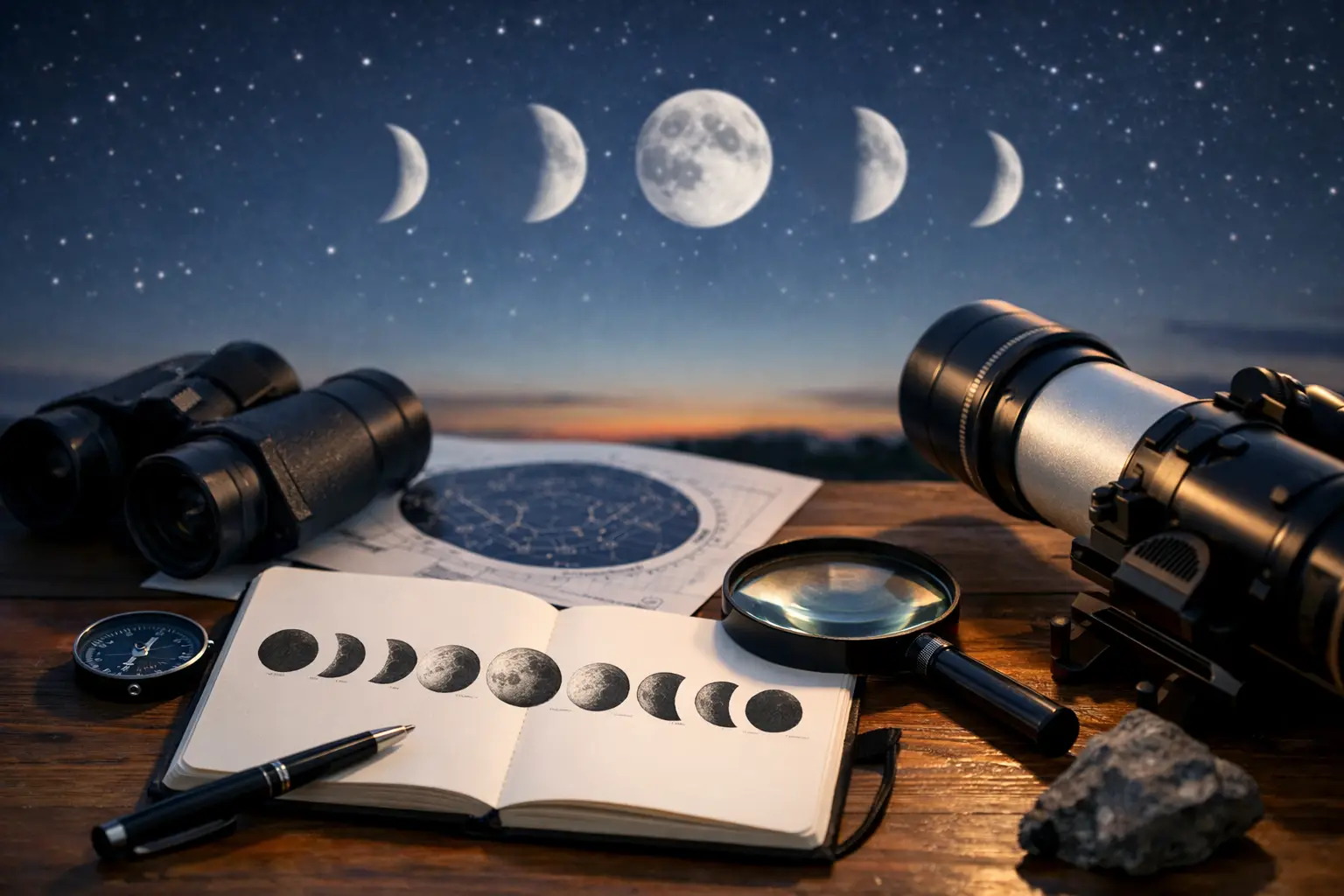
The Moon can look like a different object from one night to the next, but its schedule is remarkably precise. Learning how to read moon phases means connecting three live clues: the bright side you see, where the Moon sits in the sky, and the time of night. Once those line up, you can identify the phase without an app – then use a moon tracker to confirm the exact illumination percentage and local rise time.
| Phase | Illumination range | Approx. rise time, local | Best sky window |
|---|---|---|---|
| New Moon | 0% | Near sunrise | Usually hidden in solar glare |
| Waxing crescent | 1%-49% | Morning to late morning | Western sky after sunset |
| First quarter | About 50% | Near noon | High in the south near sunset |
| Waxing gibbous | 51%-99% | Afternoon | Evening sky |
| Full Moon | About 100% | Near sunset | Visible most of the night |
| Waning gibbous | 99%-51% | Evening | Late night to dawn |
| Third quarter | About 50% | Near midnight | High in the south near sunrise |
| Waning crescent | 49%-1% | Pre-dawn | Eastern sky before sunrise |
How to Read Moon Phases by Watching the Light
Moon phases are not caused by Earth’s shadow. Except during a lunar eclipse, which is a separate event, half of the Moon is always lit by the Sun. What changes is our viewing angle from Earth. As the Moon travels around Earth, we see different portions of its sunlit half.
The full cycle from one New Moon to the next is 29.53059 days, called a synodic month. The Moon moves eastward against the background stars by about 13.2 degrees per day. That movement is why it rises roughly 50 minutes later each day, although local terrain, latitude, and the Moon’s changing orbital speed can shift the exact result.
Start with the boundary between light and dark, called the terminator. A slim crescent has less than half of its visible disk illuminated. A gibbous Moon has more than half illuminated, but it is not full. At first quarter and third quarter, the Moon is half lit from our perspective. The word “quarter” refers to the Moon being about one-quarter of the way through its orbit, not to seeing one-quarter of the disk lit.
For observers in the continental United States and much of the Northern Hemisphere, the quick visual rule is simple: a Moon lit on the right side is waxing, meaning its illuminated portion is growing; a Moon lit on the left side is waning, meaning it is shrinking. This is a useful field rule, not a universal one. South of the equator, the apparent orientation reverses, and near the equator the crescent can appear more like a tilted bowl.
Use the Clock and Horizon as Your Backup System
If cloud, haze, or a building blocks part of the lunar disk, timing can identify the phase faster than shape alone. The Moon’s position relative to the Sun sets the schedule.
A New Moon is near the Sun in the sky. It rises and sets close to the Sun, making it difficult and unsafe to search for in daylight. Never sweep the sky with binoculars or a telescope near the Sun. The first visible waxing crescent generally appears low in the western twilight sky one to three evenings after New Moon, depending on the Moon’s angular separation from the Sun, your horizon, and atmospheric clarity.
At first quarter, the Moon is about 90 degrees east of the Sun. It rises near noon, reaches its highest point around sunset, and sets around midnight. This is one of the best phases for family observing because it is already well placed in the evening sky and its surface features show dramatic contrast.
A Full Moon lies roughly 180 degrees opposite the Sun. It rises near sunset, peaks near local midnight, and sets near sunrise. “Near” matters: the exact time can differ by tens of minutes because the Moon’s orbit is tilted and its daily motion is not uniform. A full Moon rising over a flat eastern horizon can be spectacular, but it is not the best time for a telescope. Its face-on lighting flattens many crater shadows.
After full, the Moon becomes a waning gibbous and increasingly takes over the late-night and pre-dawn sky. Third quarter is around 90 degrees west of the Sun, rising near midnight and standing high near sunrise. The waning crescent is the final pre-dawn phase, low in the east shortly before sunrise.
A 10-second field test
When you spot the Moon, ask two questions. First: is it west of you after sunset, or east of you before sunrise? A western evening crescent is waxing; an eastern morning crescent is waning. Second: is it visible near midnight? If it is nearly round and bright then, it is likely full or gibbous. If it is half lit around midnight, it is likely near third quarter.
This method works because the phase and the viewing time are linked by geometry, not guesswork.
Read the Moon’s Shape More Precisely
A crescent has less than 50% illumination, while a gibbous Moon has more than 50%. That distinction is useful when the phase name in an app feels too broad. A 12% illuminated Moon and a 42% illuminated Moon are both waxing crescents, but they behave differently in twilight. The 12% Moon is usually low and brief after sunset; the 42% Moon stays up longer and is easier to locate before nightfall.
The same applies on the waning side. A 78% waning gibbous can remain visible well into the morning. A 7% waning crescent may only have a narrow viewing window between moonrise and brightening dawn.
For surface observing, avoid treating a full Moon as the automatic target. The terminator is where sunlight arrives at a low angle, making crater rims, mountain ranges, and lava plains stand out. Around first quarter and third quarter, a small telescope or even 7×50 binoculars can reveal far more texture than at full phase. Always steady binoculars and never point any optical device toward the Sun.
Why the Moon Looks Bigger or Smaller
The phase tells you how much of the visible Moon is lit. It does not tell you the Moon’s distance. Because the lunar orbit is elliptical, the Moon ranges from about 363,300 kilometers at perigee to about 405,500 kilometers at apogee. Its apparent diameter changes from roughly 34.1 arcminutes to 29.3 arcminutes – a real difference of about 14% in width.
That is why a perigee Full Moon can look slightly larger in side-by-side photos. Near the horizon, though, the famous oversized Moon effect is mostly an illusion created by nearby trees, buildings, and ridgelines. The Moon is not physically magnified by the atmosphere when it rises, although atmospheric refraction can distort and redden it close to the horizon.
Turn Phase Reading Into an Observing Plan
Use the phase to choose the right mission. New Moon is prime time for faint targets because moonlight is minimal. Dark-sky observers usually get their best deep-sky conditions during the several nights around New Moon, provided clouds and local light pollution cooperate.
A waxing crescent is excellent for Earthshine – the faint glow on the Moon’s dark portion caused by sunlight reflected from Earth. First quarter is a high-contrast lunar terrain night. A Full Moon is ideal for naked-eye viewing, moonrise photography, and helping newcomers find their way around the sky, but it can wash out faint stars, meteors, and nebulae.
For a reliable local forecast, check the phase percentage alongside moonrise, moonset, altitude, and cloud cover. A Moon at 10 degrees altitude can be obscured by houses, trees, and thicker low atmosphere; at 30 degrees or higher, it is usually a much cleaner target. SpaceInformer’s live moon tools can turn that data into a location-specific window, but your own eyes can still identify the phase first.
The next clear evening, make a prediction before checking a screen. Note the bright side, note the direction, note the time, then test your answer. Within one lunar month, the Moon stops being a changing decoration and becomes a dependable sky clock.