
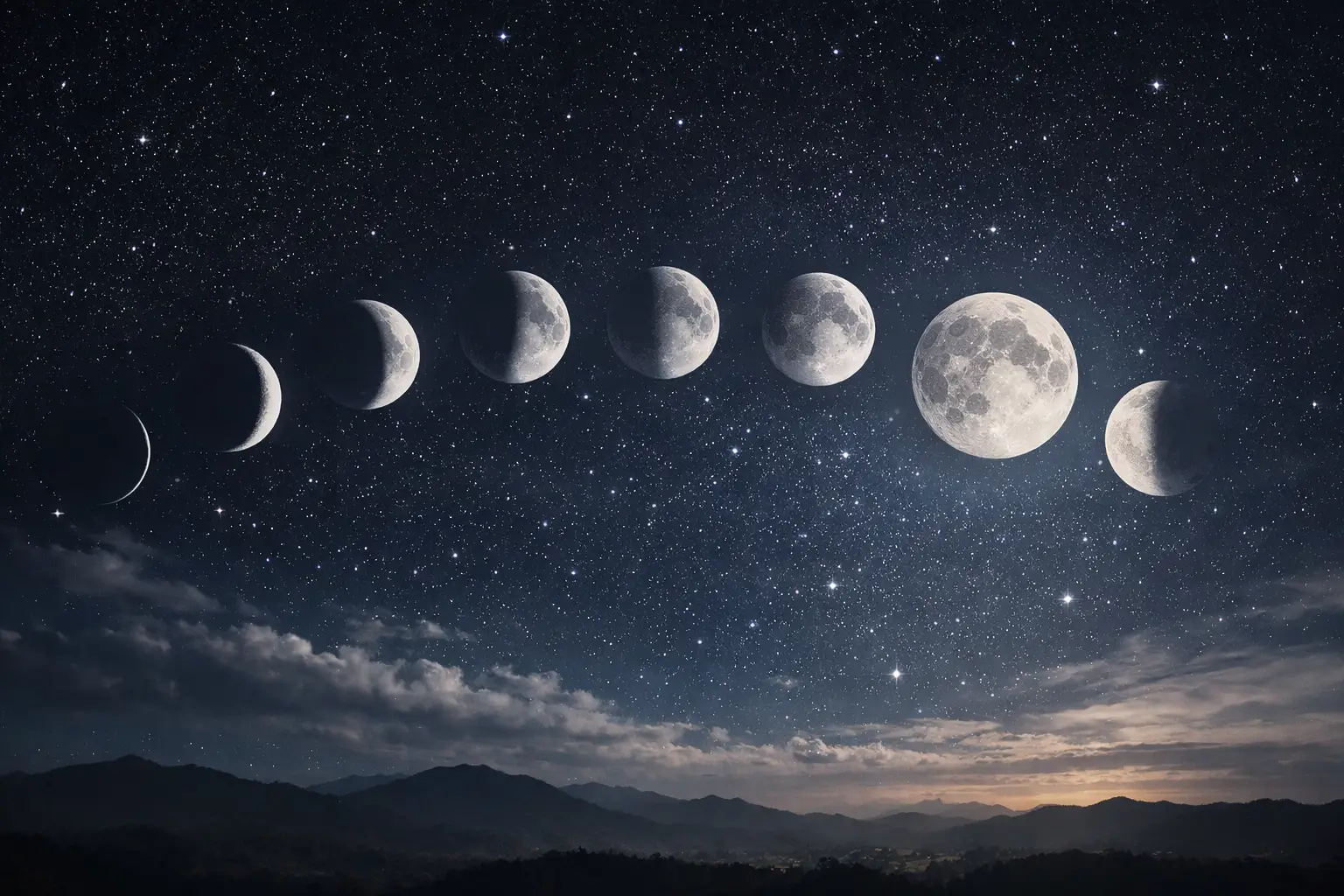
The Moon can turn a backyard observing session into either a high-definition lunar tour or a washed-out search for faint galaxies. Understanding moon phases puts that timing under your control. The complete visible cycle repeats every 29.53059 days, and each phase changes when the Moon rises, how bright the sky becomes, and which targets deserve your telescope time.
| Moon phase | Cycle timing | Visible illumination | Typical rise time, local solar time |
|---|---|---|---|
| New Moon | Day 0.0 | 0% | Around sunrise |
| Waxing Crescent | Days 1-6 | 1%-49% | Morning to late morning |
| First Quarter | Day 7.4 | 50% | Around noon |
| Waxing Gibbous | Days 8-13 | 51%-99% | Afternoon |
| Full Moon | Day 14.8 | 100% | Around sunset |
| Waning Gibbous | Days 16-21 | 99%-51% | Evening |
| Last Quarter | Day 22.1 | 50% | Around midnight |
| Waning Crescent | Days 23-29 | 49%-1% | Late night to pre-dawn |
What Creates Moon Phases?
The Moon does not generate its own light. At every moment, one half of the lunar globe is lit by the Sun. From Earth, we see a changing fraction of that illuminated half as the Moon travels eastward around us at roughly 13.2 degrees per day.
At New Moon, the Moon sits roughly between Earth and the Sun. Its sunlit side faces away from us, so it is effectively absent from the night sky. About 7.4 days later, it reaches First Quarter, when the Moon is one-quarter of the way through its orbit but appears half illuminated. After another 7.4 days, the Moon is opposite the Sun and full.
That wording matters: a “quarter moon” refers to the Moon’s orbital position, not the amount of its disk that is bright. Both First Quarter and Last Quarter show about 50% illumination.
The 29.5-day phase cycle is called a synodic month. The Moon completes one trip around Earth relative to the distant stars in only 27.32166 days, but Earth moves along its path around the Sun during that time. The Moon needs about 2.2 additional days to catch up to the same Sun-Earth geometry.
Moon Phases for Real Sky Planning
For deep-sky observers, New Moon is mission-launch time. The Moon is close to the Sun and generally out of the nighttime sky, leaving the darkest conditions for faint nebulae, galaxies, meteor showers, and Milky Way photography. A practical dark-sky window usually runs from about 3 days before New Moon to 4 days after it, although local light pollution and the Moon’s actual rise and set times still matter.
A thin waxing crescent is a strong early-evening target. Look low in the western sky 30 to 90 minutes after sunset. At this stage, earthshine often becomes obvious: sunlight reflected from Earth softly lights the Moon’s darkened portion. Binoculars reveal the effect well, while a small telescope can show the sharp boundary between lunar day and night.
First Quarter is one of the best phases for lunar detail. The terminator, the moving line between light and darkness, cuts across crater rims, mountain ranges, and mare edges. Long shadows add contrast that the Full Moon lacks. For US observers, First Quarter usually stands highest in the southern sky near sunset and sets near midnight, giving families and students a convenient observing window.
The Full Moon is dramatic, bright, and not always ideal for every target. It rises near sunset, reaches its highest altitude close to local midnight, and sets near sunrise. Its surface appears flatter because sunlight strikes much of the near side nearly head-on, reducing shadows. It is excellent for naked-eye viewing, landscape images, and learning the major lunar maria, but its glare can overwhelm faint star clusters and diffuse deep-sky objects.
After Full Moon, the action shifts into the pre-dawn sky. Last Quarter rises near midnight and is high before sunrise. That makes it a useful phase for early observers, and the terminator again brings strong crater contrast. The waning crescent then retreats closer to the dawn horizon before the cycle resets.
Why the Moon Rises Later Each Day
The Moon does not follow a fixed clock. Because it moves eastward in orbit, Earth must rotate a little farther each day before your location faces it again. On average, moonrise occurs about 50 minutes later from one day to the next.
That average can vary substantially. Depending on your latitude, season, and the angle of the Moon’s path against the horizon, the shift can be closer to 20 minutes or more than 90 minutes. A local forecast is the definitive planning tool, especially if you have a narrow weather break or want the Moon at a specific altitude for a photo.
Altitude changes the quality of the view. Near the horizon, Earth’s atmosphere scatters and distorts more light. A Moon at 30 degrees altitude is viewed through roughly twice as much atmosphere as one near the zenith at 90 degrees. For sharper telescope views and steadier images, target a time when the Moon is at least 30 degrees above the horizon.
The Moon’s Size Is Not Constant
The Moon’s orbit is elliptical, so its distance changes throughout the month. Its average distance is about 384,400 kilometers, but it can be near 363,300 km at perigee and about 405,500 km at apogee. That difference changes its apparent diameter by roughly 14%, enough to matter in carefully matched photographs.
A Full Moon near perigee is commonly called a supermoon. It can appear up to about 14% wider and around 30% brighter than a Full Moon near apogee. The visual effect near the horizon can feel much larger because of the Moon illusion, a perception effect created by foreground objects and the way our brains judge scale. The Moon itself is not physically magnified by the atmosphere.
For imaging, distance is only one variable. A higher Moon in clear, stable air can produce a more detailed result than a slightly larger perigee Moon hanging low in humid or turbulent conditions.
Moon Phases Do Not Cause Eclipses Every Month
New Moon and Full Moon are required for solar and lunar eclipses, respectively, but they are not enough. The Moon’s orbital plane is tilted about 5.1 degrees relative to Earth’s orbital plane around the Sun. Most months, the Moon passes above or below the precise alignment needed to cast a shadow.
An eclipse becomes possible when New or Full Moon occurs near one of the two points where the lunar orbit crosses Earth’s orbital plane, called nodes. A solar eclipse happens at New Moon, when the Moon’s shadow reaches Earth. A lunar eclipse happens at Full Moon, when the Moon passes through Earth’s shadow.
The total lunar eclipse of March 3, 2026, for example, occurred at Full Moon and was visible from much of the Americas. Lunar eclipses are accessible from the entire nighttime side of Earth, while a total solar eclipse is visible only from a narrow path that can be roughly 100 to 200 km wide. Phase tracking tells you when alignment is possible; eclipse forecasts tell you whether your location is in the action.
A Better Way to Use the Lunar Cycle
Treat the lunar month like a recurring observation schedule. Reserve the dark side of the cycle for faint objects and wide-field astrophotography. Use the quarter phases for crater shadows, binocular sessions, and public outreach. Save the bright Moon for lunar close-ups, landscape compositions, or a relaxed naked-eye sky check.
A location-aware moon phase tool can turn that plan into exact rise, set, illumination, and altitude data for your ZIP code. On SpaceInformer, pairing that live lunar information with local weather and event timing gives you a clearer go or no-go decision before you carry gear outside.
The next time the Moon appears, do not just label it full, crescent, or half. Check where it is in its 29.5-day run, note when it will clear your horizon, and let that moving light set the schedule for your next night under the sky.