
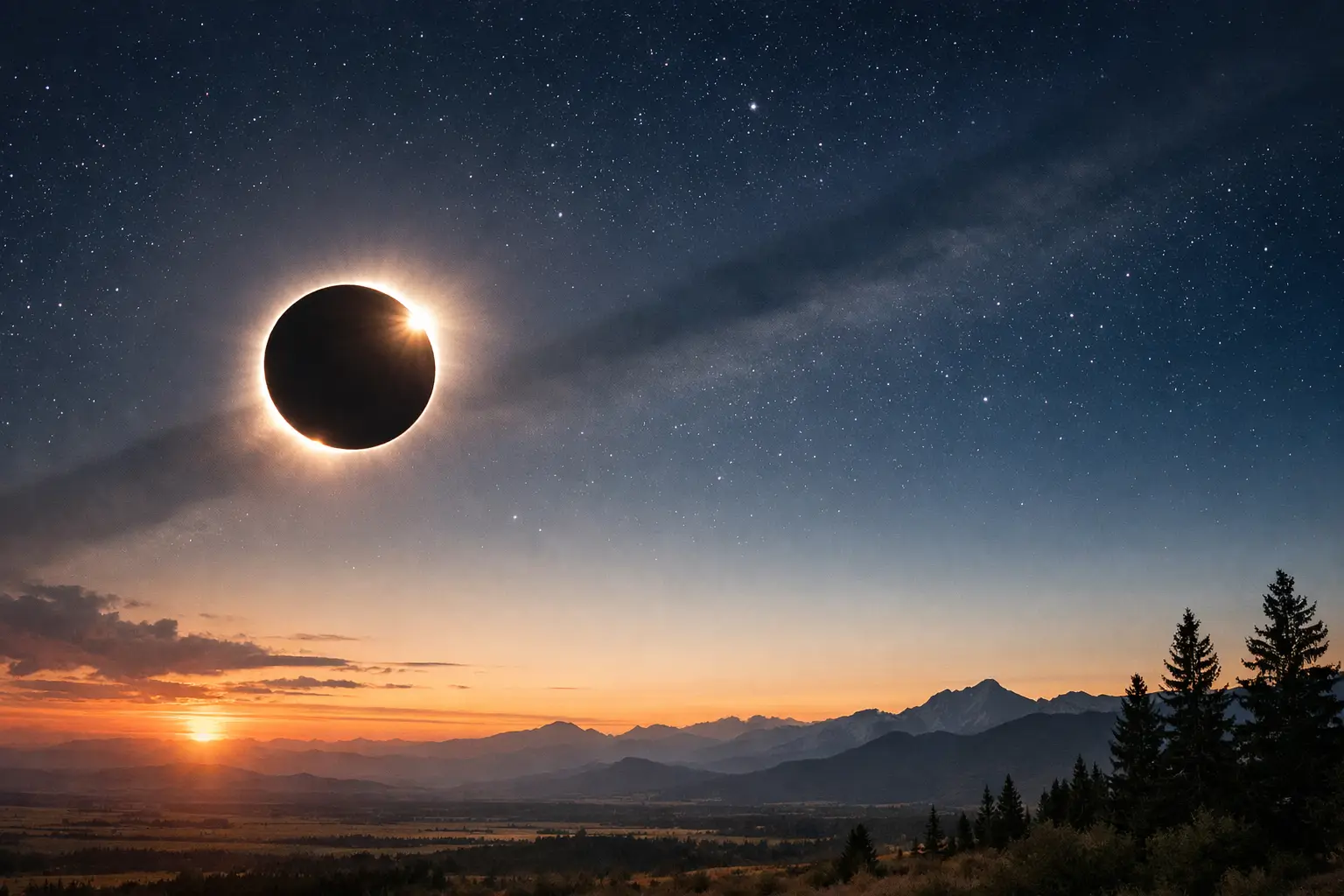
On August 12, 2026, the 2026 solar eclipse path will sweep out of the Arctic, cross Greenland, Iceland, and northern Spain, then finish over the western Mediterranean. For US skywatchers, this is not a coast-to-coast event like April 8, 2024. It is mainly a travel eclipse, and that changes the planning game completely. If you want totality, you will need to be under a narrow corridor a little over 290 km wide at its maximum, not just somewhere in the same country.
| 2026 eclipse data point | Value | Units / notes |
|---|---|---|
| Date | August 12, 2026 | Gregorian calendar |
| Eclipse type | Total solar eclipse | Partial eclipse visible over a wider region |
| Maximum totality | 2m 18s | Near greatest eclipse |
| Path width at maximum | About 294 | km |
| Greatest eclipse time | 17:47 UTC | Approximate central timing |
The big headline is geographic. The path of totality does not cross the continental United States. Instead, the Moon’s umbral shadow begins in the high Arctic, then races southeast across eastern Greenland, clips western Iceland, cuts through northern Spain, and exits across the Balearic region toward North Africa. Large parts of Europe, the North Atlantic, and northwest Africa will still get a partial eclipse, but partial and total are completely different experiences. A 99 percent partial eclipse is still not totality. The sky does not behave the same way, the corona does not appear, and the event feels less like sunset at noon and more like a strange dimming.
2026 solar eclipse path by region
If you are choosing where to go, the path matters more than the country name. A city only 50 km outside totality can miss the main event. The centerline is where totality lasts longest, while the path edges lose precious seconds.
| Region on path | Approx. local eclipse window | Sun altitude | Viewing note |
|---|---|---|---|
| Eastern Greenland | Late afternoon UTC | Low to moderate | Remote access, high weather risk |
| Western Iceland | Around early evening local time | About 25-35 degrees | Better altitude, cloud odds remain a factor |
| Northern Spain | Near sunset local time | Very low, often under 10 degrees | Dramatic horizon eclipse if skies stay clear |
Greenland offers the first landfall under totality, but it is not the easy pick. Infrastructure is limited, weather can be harsh, and moving around on eclipse day is not as simple as driving one county over. Iceland is more accessible for travelers and gives the Sun more altitude in the sky, which helps both naked-eye viewing during totality and photography. Northern Spain is likely to be the magnet for eclipse tourism because of access, roads, lodging, and the spectacle of a low-Sun total eclipse. The trade-off is that low altitude means horizon haze, coastal cloud layers, and terrain obstructions matter a lot more.
Where the best viewing may be
There is no single best answer because eclipse success depends on what you value most: longest totality, easiest travel, highest Sun altitude, or strongest weather odds. Those goals do not always line up.
Spain will probably attract the biggest crowds because it is easy to reach and the eclipse arrives over populated areas. For many travelers, that convenience outweighs the low-Sun geometry. If you secure a site with a clean western horizon, you could get an extraordinary scene with totality just before sunset. But the margin for error is thin. A hill, marine layer, or band of haze near the horizon can spoil the final minutes.
Iceland is the more balanced choice for many serious observers. The Sun sits higher, the path is more manageable than Greenland, and there are solid options for mobility if local clouds threaten one area. Still, Icelandic weather is famously unstable, and cloud cover can change quickly over short distances. If you go there, a rental car and a flexible route are almost part of the eclipse kit.
Greenland is the expedition option. It may appeal to travelers who want a remote, Arctic totality and are comfortable building a trip around logistics first and sightseeing second. The reward is rarity. The risk is that access and weather can box you in.
What US observers should expect
For readers in the United States, the practical question is simple: can you see this one from home? In most of the US, no meaningful eclipse will be visible. The 2026 event is centered across the North Atlantic and parts of Europe, not North America. That makes this a destination eclipse for Americans rather than a backyard event.
If travel is on the table, start early. A total solar eclipse compresses lodging, flights, and ground transport into a narrow corridor on one date. The 2024 US eclipse made that lesson obvious. Prices rise fast, and the best locations get booked first, especially towns near the centerline with open western views.
This is also a case where local sunset times matter almost as much as eclipse times. In northern Spain, the Sun will be very low during totality, so even a perfect forecast is not enough if your hotel balcony faces the wrong direction or a ridge blocks the horizon. For Iceland, the issue is usually cloud mobility rather than horizon geometry, so road access becomes the strategic advantage.
Timing, duration, and why this eclipse is shorter
The longest totality on August 12, 2026 is about 2 minutes 18 seconds. That is a strong eclipse, but it is shorter than some famous long-duration events because the Moon’s apparent size and its distance from Earth vary from eclipse to eclipse. When the Moon appears slightly larger and the geometry lines up more favorably, totality lasts longer. Here, the setup still produces a full total eclipse, just not an especially long one by historical standards.
That shorter duration changes how you observe it. If your plan includes photography, binocular viewing during totality, and simply taking it in, you need a sequence. Two minutes disappear fast. Many experienced observers recommend doing less with equipment and more with your eyes. That advice is even more relevant when the Sun is low and the scene around you may become part of the show.
Planning around weather and mobility
Clouds are the real gatekeeper for the 2026 solar eclipse path. Eclipse maps tell you where totality is possible. Weather decides whether you actually see it.
For Spain, historical August conditions can be favorable in some inland and Mediterranean-adjacent zones, but microclimates matter. Coastal areas can look great on paper and still wake up with low cloud. Inland sites may offer better odds, but you then need to check whether the low western Sun stays clear of hills or city structures.
For Iceland and Greenland, the challenge is broader cloud variability. The upside is that mobility can rescue a marginal forecast if road or air connections allow it. The downside is obvious: everyone else may have the same plan. Eclipse traffic is not just a US problem.
A good strategy is to choose a base with multiple viewing options within 50 to 150 km, then make the final call the night before or morning of the eclipse. SpaceInformer-style planning works best here: live cloud data, sunrise and sunset geometry, and exact centerline position should all be on the same checklist.
Eye safety and equipment for the 2026 solar eclipse path
Outside totality, certified solar viewing is mandatory. That means eclipse glasses or solar filters designed for direct solar observation. During totality only, when the Sun is completely covered, it is safe to remove eclipse glasses briefly and view the corona with unaided eyes. The instant the first bright bead of sunlight returns, eye protection goes back on.
If you are photographing the event, the low-Sun locations create a trade-off. You may get more dramatic landscape compositions, but you also deal with thicker atmosphere, more color shift, and less stable seeing. A wide-angle setup can be more rewarding than a long focal length if the horizon and crowd reaction are part of the story.
This eclipse is built for planners. The path is narrow, the best locations are overseas for US travelers, and local conditions will decide everything. If you treat August 12, 2026 like a mission window instead of a casual outing, you give yourself the best shot at seeing one of the sky’s most precise and unforgettable events.