
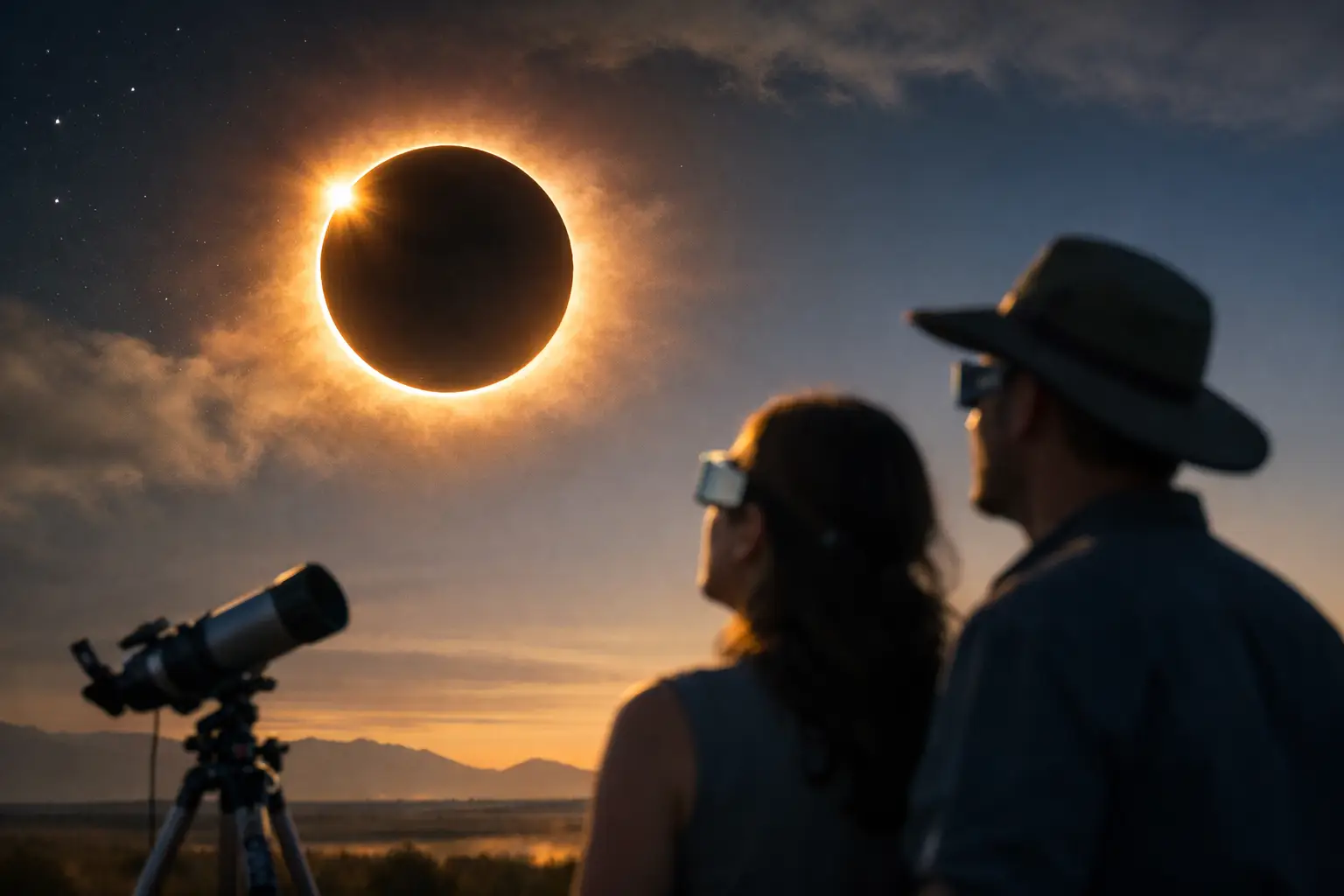
The countdown is already on. On August 12, 2026, one of the decade’s biggest sky events will sweep across the North Atlantic, Greenland, Iceland, and northern Spain, delivering a total solar eclipse to a narrow corridor and a partial eclipse to a much wider region. If you want a practical guide to 2026 solar eclipse planning, the big question is simple: are you chasing totality, or settling for partial coverage closer to home?
| Event detail | Data | Units |
|---|---|---|
| Eclipse date | August 12, 2026 | UTC calendar date |
| Greatest eclipse time | 17:46 UTC | UTC |
| Maximum totality duration | About 2 min 18 sec | minutes, seconds |
| Approximate umbral path width | About 294 | km |
| Moon shadow speed near greatest eclipse | Roughly 2,700 | km/h |
This eclipse matters because it offers true totality over accessible land, but not for most US observers. From the continental United States, you should expect no meaningful view. That means this event is less about stepping outside for ten minutes and more about travel, timing, and weather strategy.
Guide to 2026 solar eclipse path and visibility
The path of totality begins over the Arctic, crosses Greenland, runs through Iceland, and then reaches Spain in the late afternoon local time. Northern Spain is likely to attract the biggest crowds because it combines road access, tourism infrastructure, and a realistic shot at seeing the event without chartering a ship or heading deep into the Arctic.
Iceland is a headline location, but it comes with a trade-off. The landscape is spectacular and the eclipse will be dramatic, yet cloud risk is serious in August. Spain usually gives travelers a better transportation network and, in many northern and northeastern areas, a stronger late-summer weather profile than Iceland.
For partial-eclipse viewers, much of Europe, northwestern Africa, and parts of the North Atlantic region will get at least some solar coverage. The farther you are from the centerline, the less dramatic the event becomes. That difference is not subtle. A 90 percent partial eclipse is still not totality. The sky dims, but you do not get the corona, the sudden twilight effect, or the sharp temperature drop that makes total eclipses unforgettable.
| Location | Eclipse type | Typical sun altitude | Notes |
|---|---|---|---|
| Greenland path | Total | Low to moderate | Remote access, logistics are the main challenge |
| Iceland | Total in parts | Low to moderate | Excellent scenery, variable cloud risk |
| Northern Spain | Total in path | Low, near horizon in many areas | Best mix of access and tourism support |
| Most of mainland US | Not visible | 0 | Travel required for observation |
What makes the 2026 eclipse tricky
The biggest challenge is sun altitude. In Spain especially, the eclipse occurs late in the day, with the Sun sitting low above the western horizon. Low altitude can make the view beautiful, but it also raises the odds that terrain, buildings, haze, or marine clouds ruin the moment. A mountain ridge in the wrong place can matter just as much as the weather forecast.
That means your site selection should not stop at picking a city. You need an actual viewing line with a clear western horizon. Beaches, elevated lookouts, open farmland, and ridge-top roads can all work. Dense urban streets and valley locations are riskier.
The second challenge is mobility. A lot of travelers will book one hotel and hope for the best. Better strategy: build a movable plan with a rental car, two or three candidate observing areas, and a willingness to relocate within a 100 to 250 km radius if cloud forecasts tighten 24 to 48 hours before eclipse day.
Best viewing strategy for US travelers
For a US audience, Spain is the practical favorite. Flights are easier, road networks are better, and there are more fallback viewing zones within a day’s drive. Iceland is appealing if you also want a destination trip built around dramatic landscapes, but you are buying higher weather uncertainty.
If your goal is maximum odds instead of maximum adventure, target the totality corridor in Spain and arrive at least two full days early. That buffer matters if flights slip, rental inventory gets thin, or local traffic builds around the event. Eclipse tourism compresses quickly around major cities and obvious viewpoints.
If your goal is photography, low solar altitude changes your gear decisions. Wide landscapes can be stunning because the eclipsed Sun sits close to the horizon, but atmospheric distortion can soften close-up telescopic shots. Long lenses still work, just expect seeing conditions to be less stable than when the Sun is high overhead.
Guide to 2026 solar eclipse timing and planning
Precise local contact times depend on your observing coordinates, sometimes by seconds and often by minutes. That is why real-time location tools matter. Still, broad timing is useful for planning your day. Greatest eclipse occurs at 17:46 UTC, which places the main European viewing window in the late afternoon to early evening.
For Spain, many observers will experience totality with the Sun only around 5 to 15 degrees above the horizon, depending on location. That is a narrow visual corridor. You should physically test your horizon the day before at the same local time as the eclipse. If the Sun disappears behind hills or structures during your test, that site is not good enough.
| Planning factor | Recommended target | Units |
|---|---|---|
| Arrival before eclipse | 2-3 | days |
| Flexible relocation range | 100-250 | km |
| Minimum pre-event site check | 24 | hours |
| Horizon test lead time | Same local time on prior day | schedule check |
Eclipse safety is simple, but non-negotiable
You must use certified solar viewing glasses or properly rated solar filters during every partial phase. The only time it is safe to look with the naked eye is during totality itself, and only if you are inside the path of totality and the Sun is fully covered.
That distinction trips people up. If you are outside the total path, there is no safe naked-eye phase at all. Not at 95 percent. Not at 99 percent. Never. If even a tiny sliver of the Sun remains visible, eye protection stays on.
The same rule applies to cameras, binoculars, and telescopes. They need front-mounted solar filters designed for solar observation. Eclipse glasses do not protect optics, and looking through unfiltered magnified equipment can cause instant eye injury.
What to bring and what to skip
You do not need a truck full of gear to have a strong eclipse day. You need certified glasses, water, extra power, offline maps, weather updates, and a viewing location with a tested horizon. If you are photographing, decide in advance whether you want images or the experience. Trying to improvise both usually means missing the best 120 seconds.
A tripod helps, but a giant telescope is not essential for a low-altitude eclipse. In many cases, binoculars with solar filters, or a moderate camera lens in the 200 to 400 mm range, are more realistic than hauling heavy equipment through crowded travel routes.
One smart move is to rehearse your full sequence. Practice removing the solar filter only during simulated totality, then replacing it immediately. Muscle memory matters when the sky suddenly changes and everyone around you starts shouting.
For live planning, this is exactly the kind of event where a real-time tracker earns its keep. SpaceInformer-style planning works best when you combine eclipse maps, local timing, cloud forecasts, and horizon awareness into one decision, not five separate tabs and a guess.
If you can make the trip, chase totality. Partial eclipses are interesting. Total eclipses reorder the sky in real time, and August 12, 2026 is one of those dates worth building a plan around now.