
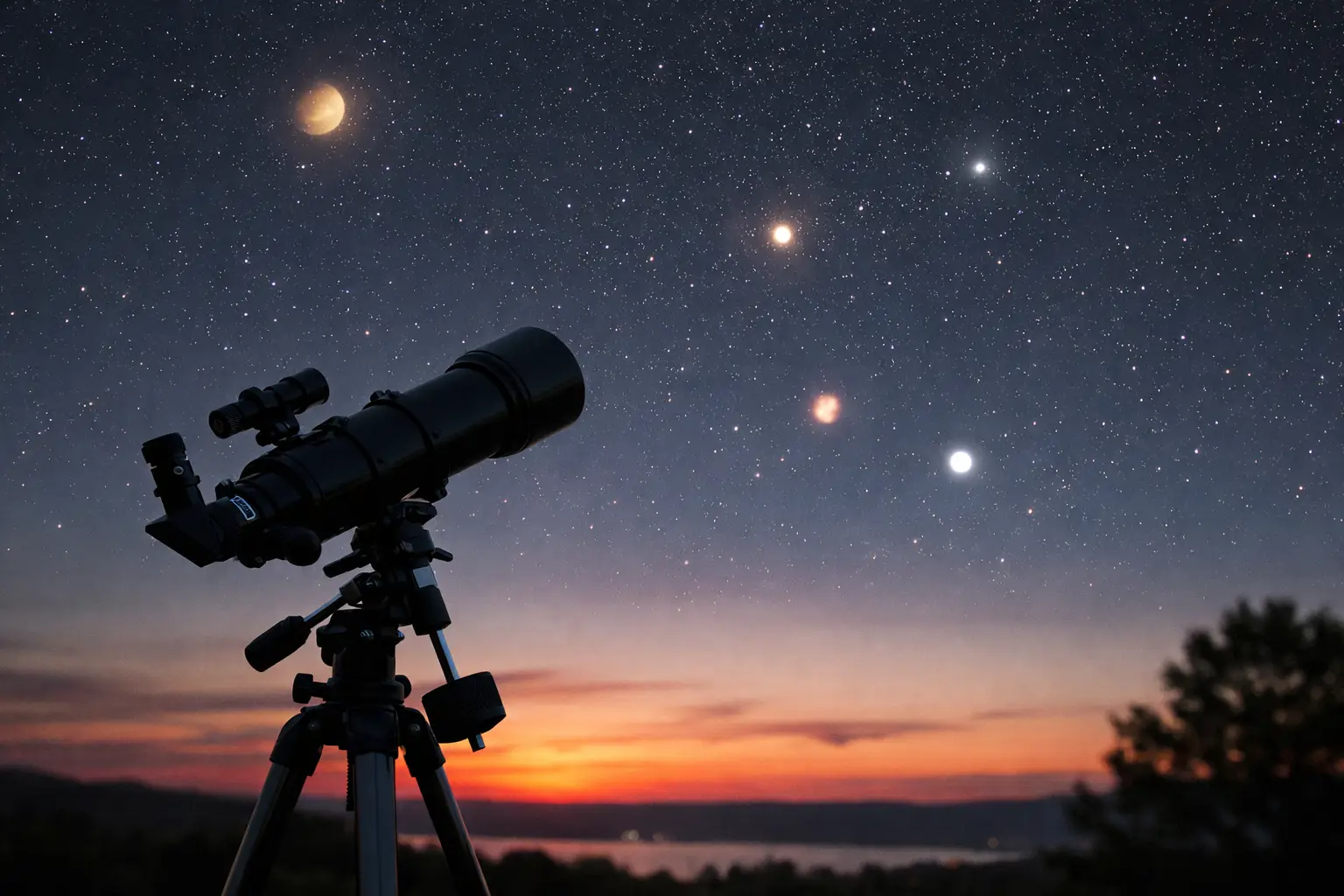
If you step outside tonight and want a fast answer to which planets are visible tonight, the real question is not just what is up there – it is when each planet rises, how bright it is, and whether it will clear your local horizon before dawn or fade into twilight after sunset. Planet visibility changes week to week, so the best approach is to use this as a live planning guide for late June 2026 in the US, then match it to your location and sky conditions.
| Planet | Best Viewing Window | Direction | Approx. Brightness | Typical Altitude | Distance from Earth |
|---|---|---|---|---|---|
| Mercury | 30-45 min after sunset | West-northwest | -0.3 to +0.5 mag | 5-12 degrees | 120-170 million km |
| Venus | 60-30 min before sunrise | East | about -3.9 mag | 10-20 degrees | 200-240 million km |
| Mars | Early evening | West | about +1.5 mag | 10-25 degrees | 300-350 million km |
| Jupiter | Pre-dawn | East-northeast | about -1.9 mag | 8-18 degrees | 900-930 million km |
| Saturn | After midnight to dawn | Southeast to south | about +0.9 mag | 20-35 degrees | 1.33-1.38 billion km |
These numbers are practical planning ranges for observers across the continental US around June 30, 2026. Your exact rise and set times can shift by more than an hour depending on whether you are in Miami, Dallas, Denver, Seattle, or Boston, and low-altitude planets are especially sensitive to local hills, trees, haze, and light pollution.
Which planets are visible tonight in the US
For most US observers tonight, the easiest planets to catch are Venus before sunrise and Saturn in the late-night to pre-dawn sky. Jupiter is returning to visibility low in the east before dawn, Mercury is a low western target just after sunset, and Mars is fading into the evening twilight and becoming less impressive by the week.
That means there is no single nationwide answer that works down to the minute. There is, however, a strong general pattern. The evening sky is slim on bright planets right now, while the morning sky is much better stocked. If you only have one viewing session to choose from, set the alarm rather than waiting until after dinner.
Best planet viewing windows tonight
After sunset: Mercury and a fading Mars
Mercury is the classic quick-strike target. Around late June 2026, it lingers low in the west-northwest roughly 30 to 45 minutes after sunset. In many mid-US locations, civil sunset falls between about 8:15 p.m. and 8:45 p.m. local time, putting Mercury’s best window near 8:45 p.m. to 9:20 p.m. local time. It usually sits just 5 to 12 degrees above the horizon, so you need a flat western view.
Mars is also in the evening sky, but this is not peak Mars season. It appears modestly bright at around magnitude +1.5 and drops toward the western horizon during evening twilight. In practical terms, Mars is visible for a short stretch after sunset, often around 10 to 25 degrees high at the start of darkness, then slipping lower fast. If you are expecting a huge orange beacon, this is one of those it-depends moments. Under dark skies it is easy enough, but from suburban areas it can blend into the background more than people expect.
Before dawn: Venus, Jupiter, and Saturn take over
Venus is the headline act right now. It rises before the Sun and shines at about magnitude -3.9, bright enough to punch through dawn glow and urban sky brightness. For many US locations, a strong viewing window opens about 60 to 30 minutes before sunrise. If sunrise is near 5:45 a.m. to 6:15 a.m. local time, Venus is often best around 4:50 a.m. to 5:40 a.m. local time.
Jupiter is back in the morning lineup, but it is still low and benefits from a clean eastern horizon. Expect it to sit around 8 to 18 degrees high in the east-northeast during the brighter stages of dawn. It is bright at about magnitude -1.9, so the issue is not whether it is luminous enough. The issue is whether your horizon and morning haze let you catch it before sunrise washes out the view.
Saturn is the steadiest planet in tonight’s pre-dawn setup. It rises well before sunrise and reaches a more comfortable altitude than Jupiter in the same time span. By the start of morning twilight, Saturn can be around 20 to 35 degrees above the southeast or southern horizon, depending on latitude and time. That extra height matters. It is why Saturn is often the best telescope target of the three even if Venus is much brighter.
| Time Block | Planet Targets | Typical Local Time | Viewing Notes |
|---|---|---|---|
| Just after sunset | Mercury, Mars | 8:45 p.m. to 9:20 p.m. | Need a low, clear western horizon |
| Late night | Saturn | 1:00 a.m. to 4:00 a.m. | Higher altitude improves telescope views |
| Pre-dawn | Venus, Jupiter, Saturn | 4:30 a.m. to sunrise | Best overall multi-planet window |
How to find the planets fast
Brightness is your shortcut. Venus is by far the brightest object in the morning sky other than the Moon. Jupiter is also very bright, but lower and usually farther left or right depending on the morning geometry for your location. Saturn looks steadier and dimmer, with a pale golden tone rather than the sharp white brilliance of Venus.
Mercury and Mars are the harder catches because both live closer to the twilight glow right now. Mercury often looks like a bright star hovering just above the sunset line. Mars appears noticeably less bright than Venus or Jupiter and can show a faint orange-red tint if the air is clear.
If you are scanning manually, use this sequence. Start with the brightest low object in the east before sunrise for Venus. Then sweep lower or farther along the horizon for Jupiter. Look higher and farther toward the south or southeast for Saturn. After sunset, look first for Mercury and only then try for Mars while the sky darkens a bit more.
What binoculars or a telescope will show tonight
With the naked eye, all five visible planets are just points of light, but their brightness and color differences make the sky feel active. Binoculars help most with Mercury and Saturn because they improve contrast in bright twilight and can cut through some haze.
A small telescope changes the game for three planets in particular. Venus may show a distinct phase. Saturn can reveal its ring system, especially once it climbs above about 25 degrees altitude. Jupiter, even when still low, can show its four Galilean moons, though atmospheric turbulence near the horizon may soften the view.
Mars is the least rewarding telescope target tonight unless you have excellent seeing conditions and enough aperture. Its apparent disk is small at this stage, so there is a trade-off: it is visible, but not at its most detailed.
Conditions that can ruin an otherwise good planet night
Low horizon clouds are the biggest spoiler this week because four of the five visible planets spend part of their viewing window near the horizon. Even thin haze can erase Mercury completely and make Jupiter much harder than its brightness suggests. Heat shimmer after sunset and before dawn can also blur telescopic detail.
Moonlight is less of a problem than many beginners think. Bright planets handle moonlit skies well. Light pollution is also not a deal-breaker for Venus, Jupiter, or Saturn. It matters more for Mercury and for star-hopping around the planet field.
This is where a live sky tool becomes more useful than a static chart. A planet might technically be above the horizon, but if it is only 6 degrees up behind neighborhood trees, that does not help much. SpaceInformer-style real-time visibility planning works best when it combines rise time, azimuth, altitude, and local forecast instead of relying on a generic national sky map.
Which planets are visible tonight if you only have 10 minutes
Go before sunrise. That is the highest-probability move tonight.
If you have a clear eastern view, Venus is your guaranteed hit and Jupiter is your likely second target. Add Saturn if you can scan a little higher toward the southeast. If your schedule only allows evening viewing, Mercury is the better challenge target, while Mars is more of a bonus object than a must-see event.
A good rule for tonight is simple: evening for quick horizon hunting, morning for the definitive planet session. Step outside with realistic timing, face the right horizon, and give your eyes a few minutes to settle. The planets are not just visible – they are on schedule, and the best ones are waiting before sunrise.