
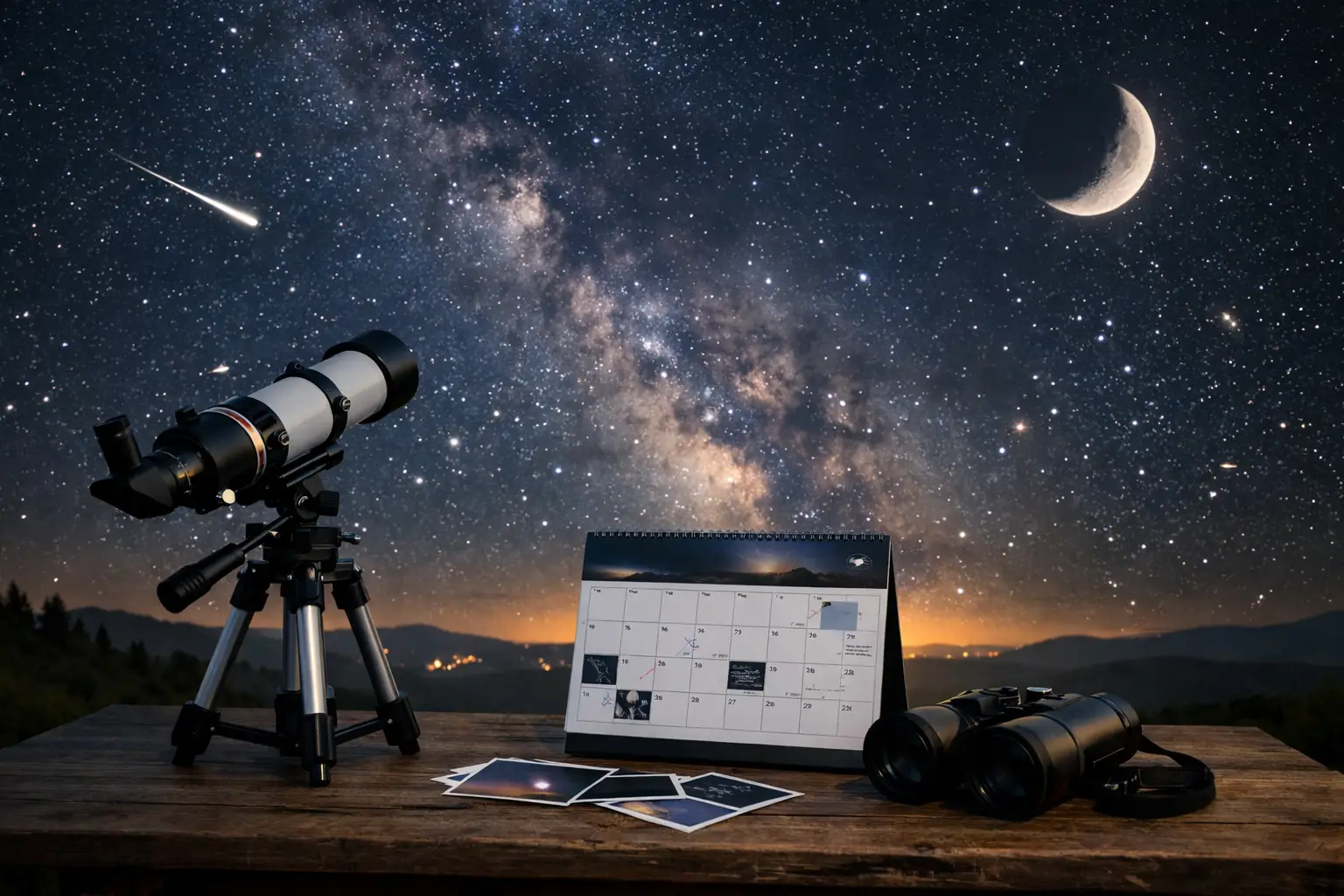
The best observing nights are rarely accidents. A useful night sky calendar tells you when the Moon will wash out faint targets, when a meteor shower has real potential, and when a 5-minute ISS pass is worth stepping outside for. It turns scattered space news into a live plan for your backyard, school event, camping trip, or telescope session.
For 2026, these major dates provide strong anchors for a US-focused calendar. All eclipse times below are listed in Coordinated Universal Time (UTC), so convert them to your local time zone before heading out.
| Date | Sky event | Key time or measurement | Planning value for US observers |
|---|---|---|---|
| March 3, 2026 | Total lunar eclipse | Greatest eclipse near 11:33 UTC | Visible from parts of North America, especially western regions, depending on local moonset. |
| August 12, 2026 | Total solar eclipse | Maximum totality about 2 minutes 18 seconds | A major travel event for Greenland, Iceland, and Spain; not visible as totality from the continental US. |
| August 12-13, 2026 | Perseid meteor shower peak | Potentially 50-100 meteors per hour under ideal dark skies | The nearly new Moon creates excellent dark-sky conditions if weather cooperates. |
| August 27-28, 2026 | Partial lunar eclipse | Greatest eclipse near 04:12 UTC | Best placed for observers across parts of the Americas, Europe, Africa, and the Pacific. |
What a Night Sky Calendar Should Track
A calendar is more useful when it separates events by how much planning they demand. Eclipses, a bright comet, or a close planetary pairing can justify travel. Meteor showers and Moon-free weekends are ideal for planning ahead. ISS passes, Starlink trains, and bright satellite flyovers are short-notice opportunities that require a location-specific alert rather than a date circled months ago.
Start with the Moon. Its 29.5-day cycle is the control panel for nearly every deep-sky session. Around a new Moon, the sky stays darker for longer, improving views of the Milky Way, nebulae, galaxies, and all but the brightest meteors. Around a full Moon, lunar observing becomes the main event, while faint objects lose contrast in the moonlit sky.
For practical planning, mark a roughly 10-night dark-sky window centered on each new Moon. The exact number depends on your target and local light pollution. A bright open cluster can still look good with a waxing crescent present. A faint galaxy from a suburban backyard may need the Moon below the horizon and a transparent night.
Use UTC First, Then Convert Locally
Astronomy calendars often publish a single universal time. That avoids confusion across states and countries, but it can move an event to a different local date. At 04:12 UTC on August 28, for example, observers in the Eastern time zone are still on the evening of August 27 during daylight saving time.
Add both entries to your personal calendar: the official UTC event time and your local viewing window. For a meteor shower, the peak is only a guide. The best observing may occur several hours before or after the listed maximum, especially when the radiant is higher in your sky.
Build Your Calendar in Four Working Layers
Think of your calendar as mission control, not a static poster. The long-range layer identifies annual opportunities. The monthly layer checks lunar conditions. The weekly layer watches planet positions and weather. The nightly layer confirms cloud cover, satellite passes, and darkness times.
1. Lock in annual headline events
Put eclipses and major meteor showers on the calendar first. The Perseids peak on the night of August 12-13, 2026, and the Geminids are expected near December 13-14. The Perseids can produce 50 to 100 meteors per hour at a dark site under ideal conditions, while the Geminids are often among the year’s strongest displays. Real-world rates can be much lower under city lights, haze, or a bright Moon.
For lunar eclipses, you do not need a telescope or special filters. The Moon may remain visible during every phase, and binoculars reveal changing color and shadow detail. Solar eclipses are different: direct solar viewing requires certified eclipse glasses or a correctly filtered solar telescope. Never use ordinary sunglasses, camera filters, or unfiltered binoculars.
2. Add the Moon’s rise, set, and phase
Moon phase alone is not enough. A 70% illuminated Moon that sets at 10:00 p.m. can leave several excellent dark hours afterward. Conversely, a thin crescent that hangs high in the west at twilight is great for a photograph but does little for a 2:00 a.m. meteor watch.
Record three values for every planned session: illumination percentage, moonset time, and the Moon’s altitude in degrees. Altitude matters because objects below about 20 degrees pass through much more atmosphere. They can look dimmer, distorted, and less colorful than the same target at 50 degrees above the horizon.
3. Treat planets as moving targets
Planets do not follow annual dates as neatly as meteor showers. Their visibility changes with elongation from the Sun, opposition dates, conjunctions, and your local horizon. Jupiter near opposition is visible for much of the night and appears at its largest and brightest. Venus can be spectacular near greatest elongation, but it may sit only 10 to 20 degrees above the horizon in bright twilight.
Your calendar should include a planet’s rise time, set time, and highest altitude, not just a label that says “visible.” Saturn at 25 degrees altitude can still be rewarding through a telescope, but atmospheric turbulence may soften the rings. At 45 degrees or higher, the view is often steadier. It depends on local seeing, which can change minute by minute.
4. Keep a live layer for objects that do not wait
ISS passes can cross the sky in less than 6 minutes. A bright pass typically reaches magnitude -3 to -4, brighter than most stars, but the station’s track and maximum altitude differ dramatically by location. A pass topping out at 15 degrees may be blocked by homes or trees. One reaching 70 degrees can fly nearly overhead and become the night’s easiest target.
Use a live tracker on the day of observation. Check the pass start time, maximum altitude, direction of travel, and expected brightness. The same approach applies to Starlink visibility. Satellites are most likely to catch sunlight soon after sunset or before sunrise, while your ground location is already dark.
Match the Event to the Right Gear
A night sky calendar should prevent overpacking as much as it helps you plan. Meteor showers need a reclining chair, warm layers, a wide-open horizon, and at least 30 minutes for your eyes to dark-adapt. A telescope is usually counterproductive because its narrow field of view hides most meteors.
For lunar eclipses and bright planetary conjunctions, 7×50 or 10×50 binoculars are fast, simple, and family-friendly. A smartphone on a tripod can capture the Moon, but expect exposure compromises. The bright lunar disk and a dark sky have a large brightness difference, so test exposures before the main phase begins.
For galaxies, nebulae, and the Milky Way, prioritize darkness over aperture. Moving from a bright suburban sky to a rural site can reveal more than upgrading from a 4-inch telescope to an 8-inch telescope under the same light dome. Use the Bortle scale as a rough guide: Bortle 3 skies are dramatically better for faint targets than Bortle 7 skies, though clouds, smoke, humidity, and nearby lights still matter.
Make Every Entry Location-Ready
A national date becomes useful only when it answers four local questions: Where should I face? How high will it get? What time is best? What could block the view? Add the viewing direction in compass terms, the peak altitude in degrees, and a backup window of at least 30 to 60 minutes when the event allows it.
For example, “Perseids, northeast after 11:00 p.m.” is a starting point, not a finished plan. The shower’s radiant rises in the northeast, but meteors can appear anywhere in the sky. For the best rate, give the sky a broad view, avoid looking directly at the radiant, and stay out through the predawn hours when Earth is moving more directly into the debris stream.
Weather is the final launch criterion. Check cloud cover a few hours before the event, then again near departure. If you are driving, identify an alternate site within 30 to 60 miles, because a narrow band of clear sky can make the difference between a canceled session and a memorable one.
A great calendar does more than remind you that space is happening. It gives you a countdown, a direction, and a reason to look up when the sky is ready.