
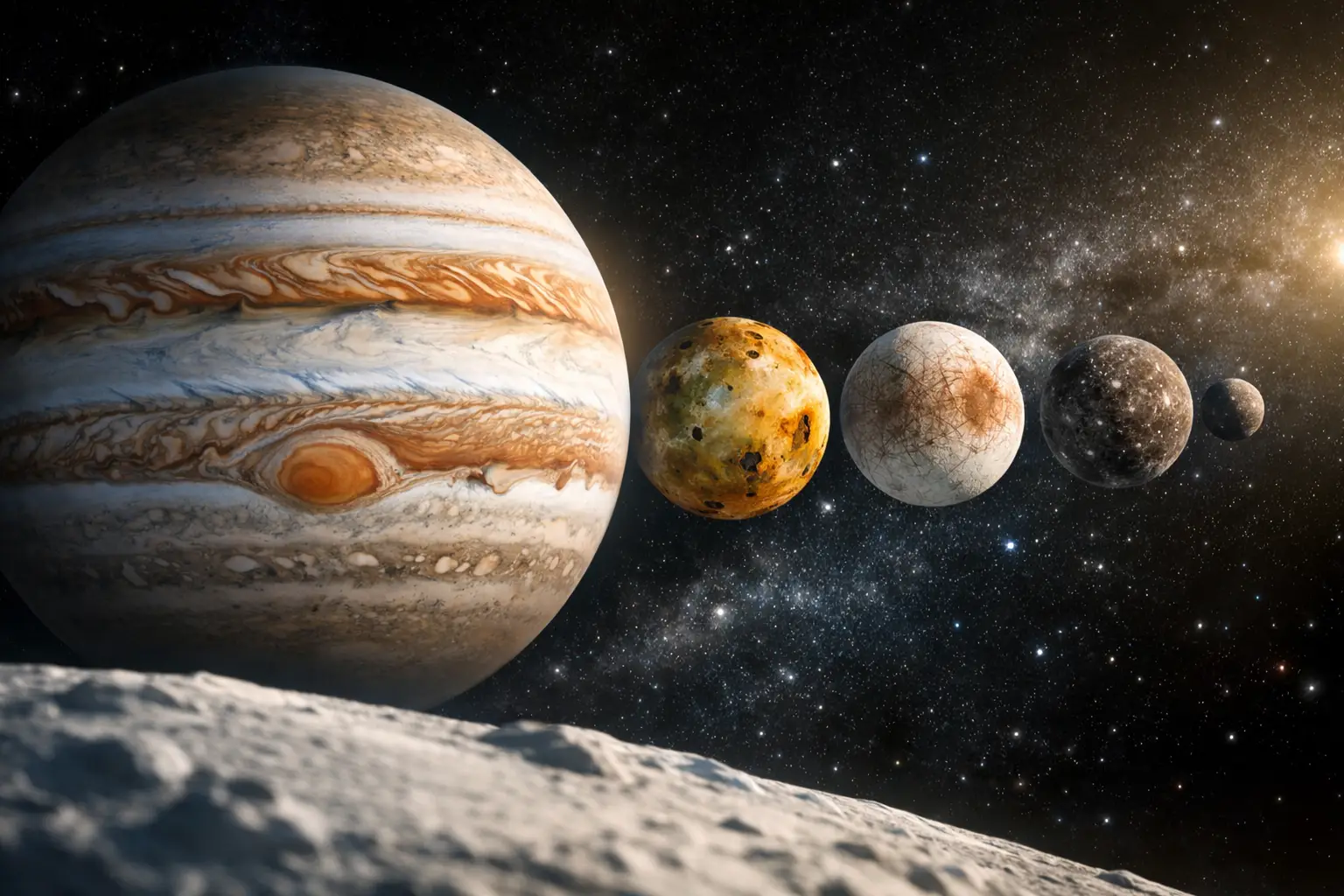
Jupiter looks like a bright point of light to the naked eye, but aim even a small telescope at it and the scene changes fast. Jupiter’s moons are a live, constantly shifting system: four bright worlds slide from side to side, vanish behind the planet, cross its cloud tops, and cast tiny black shadows that move across a world 11 times wider than Earth.
| Moon | Mean radius (km) | Average orbit from Jupiter (km) | Orbital period (Earth days) |
|---|---|---|---|
| Io | 1,821.6 km | 421,700 km | 1.769 days |
| Europa | 1,560.8 km | 671,100 km | 3.551 days |
| Ganymede | 2,634.1 km | 1,070,400 km | 7.155 days |
| Callisto | 2,410.3 km | 1,882,700 km | 16.689 days |
These are the Galilean moons, first recorded by Galileo Galilei in January 1610. They are not just dots arranged around Jupiter. Each is a distinct planetary-scale destination, and their fast orbital motion makes Jupiter the best repeat-viewing target in the solar system. Observe it at 9:00 p.m., then again at 11:00 p.m., and the changing lineup can be obvious.
Why Jupiter’s Moons Matter
Jupiter has 95 recognized moons, but the Galilean four dominate both the view through an eyepiece and the science return from decades of spacecraft exploration. Their discovery provided direct evidence that not everything in the heavens circles Earth. More than 400 years later, they remain central to the search for habitable environments beyond our planet.
Io is the solar system’s volcanic powerhouse. Jupiter’s immense gravity, combined with rhythmic pulls from Europa and Ganymede, flexes Io’s interior so intensely that it drives hundreds of active volcanoes. Some eruptions launch sulfur-rich material hundreds of kilometers above the surface. Io is slightly larger than Earth’s Moon, yet its yellow, red, and black surface is continually resurfaced by lava and volcanic deposits.
Europa is smaller than Earth’s Moon, but it is one of the highest-priority ocean worlds ever identified. Beneath an icy shell estimated to be kilometers thick lies a global salty ocean. The exact thickness of the ice and the ocean’s chemistry are still active research questions, which is why NASA’s Europa Clipper mission is designed to make repeated close flybys after arriving at Jupiter in 2030. The mission launched on October 14, 2024, beginning a long cruise toward this high-value target.
Ganymede is the headline act for scale. At 5,268 km across, it is the largest moon in the solar system, larger than the planet Mercury by diameter. It is also the only moon known to generate its own internal magnetic field. That magnetic environment is embedded inside Jupiter’s much larger and more punishing magnetosphere, making Ganymede an extraordinary natural laboratory.
Callisto, the outermost of the four, is an ancient, heavily cratered archive. Its battered surface has changed far less than Io’s volcanic plains or Europa’s fractured ice. Callisto may also hold a deep subsurface ocean, but it receives less tidal heating than Europa and Ganymede. That distinction matters: liquid water is compelling, but a potentially habitable environment also depends on energy sources and chemistry.
The orbital clockwork behind the action
Io, Europa, and Ganymede are locked in a 1:2:4 orbital resonance. For every one orbit Ganymede completes, Europa completes two and Io completes four. This is not a curiosity. The repeating gravitational nudges maintain the slightly non-circular orbits that generate internal friction and tidal heating, especially on Io and Europa.
Callisto sits outside that resonance. Its more distant orbit takes 16.689 days, compared with Io’s 1.769 days. From Earth, this difference is visible in real time. Io can move a noticeable fraction of Jupiter’s apparent diameter over a single evening, while Callisto takes longer to rearrange itself in the lineup.
How to Track Jupiter’s Moons From Your Backyard
The first mission rule is simple: observe when Jupiter is high. Aim for an altitude of at least 30 degrees above the horizon, and 45 degrees or more is better. Low-altitude views force you to look through thicker, turbulent air, which blurs Jupiter’s cloud belts and makes its moons harder to separate from the planet’s glare.
A 7×50 or 10×50 binocular can reveal the four Galilean moons as pinpoints, provided Jupiter is well placed and the binoculars are held steady or mounted. A small 60 mm refractor or 70 mm to 80 mm telescope makes the view much more reliable. At magnifications around 50x to 100x, the moons become easy to identify as a row of tiny stars near the planet.
Do not expect the moons themselves to look like disks through a beginner telescope. Their angular sizes are tiny. The show is their geometry. Depending on Jupiter’s distance from Earth, Io can reach a maximum separation of roughly 2.4 arcminutes from Jupiter, Europa about 3.8 arcminutes, Ganymede about 6.1 arcminutes, and Callisto about 10.7 arcminutes. Callisto is often easiest to locate when it is far from the planet, while Io can get lost in the glare during close approaches.
For a first successful observation, sketch the pattern from left to right, noting the local date and time to the nearest 15 minutes. Return two hours later. You may see a moon shift position, or find that one has disappeared. It has not gone away. It may be crossing in front of Jupiter, moving behind it, or passing through Jupiter’s shadow.
A live Jupiter moon tracker removes the guesswork by showing which point is Io, Europa, Ganymede, or Callisto at your chosen observation time. Use it before heading outside, then compare the predicted lineup with the actual view. That small verification step turns a bright dot and four companions into a system you can follow with confidence.
The Events Worth Waiting For
The most satisfying targets are transits, occultations, eclipses, and shadow transits. A transit occurs when a moon crosses Jupiter’s face. An occultation happens when Jupiter hides a moon behind its disk. During an eclipse, the moon enters Jupiter’s shadow and fades from view. A shadow transit is the visual favorite: the moon’s shadow appears as a crisp dark spot moving over Jupiter’s bright cloud deck.
Shadow transits are usually easier to see than the moon itself crossing the planet. With a 90 mm to 130 mm telescope at 100x to 180x, steady atmospheric conditions can reveal a black dot against the pale zones and darker belts. Larger apertures help, but poor seeing can erase detail even in a 200 mm instrument. The trade-off is real: a smaller telescope under calm skies can outperform a bigger scope pointed through heat shimmer.
Jupiter rotates once in about 9 hours 56 minutes, so its visible cloud features also change quickly. If a moon’s shadow is approaching the Great Red Spot region or a prominent belt, the contrast can make the event especially dramatic. Track event times in UTC first, then convert carefully to your local time zone. US daylight saving time can shift local clock interpretation by one hour, while UTC does not change.
What the Next Missions Will Reveal
Europa Clipper will investigate Europa with radar, cameras, thermal instruments, and particle measurements during dozens of flybys. It is not a life-detection mission, and it will not land. Its task is more focused and just as essential: determine whether Europa’s ocean environment has the ingredients and conditions that could support life.
The European Space Agency’s JUICE mission, launched on April 14, 2023, is also headed for the Jovian system. It is scheduled to arrive in July 2031 and will study Ganymede, Callisto, and Europa, with special attention to Ganymede’s ocean, ice shell, and magnetic environment. Together, these missions will turn familiar telescope targets into mapped worlds with increasingly precise answers.
The next clear night, give Jupiter more than a quick look. Log the time, identify all four moons, and check again before you pack up. In just a couple of hours, the solar system will have visibly moved – and you will have watched it happen.