
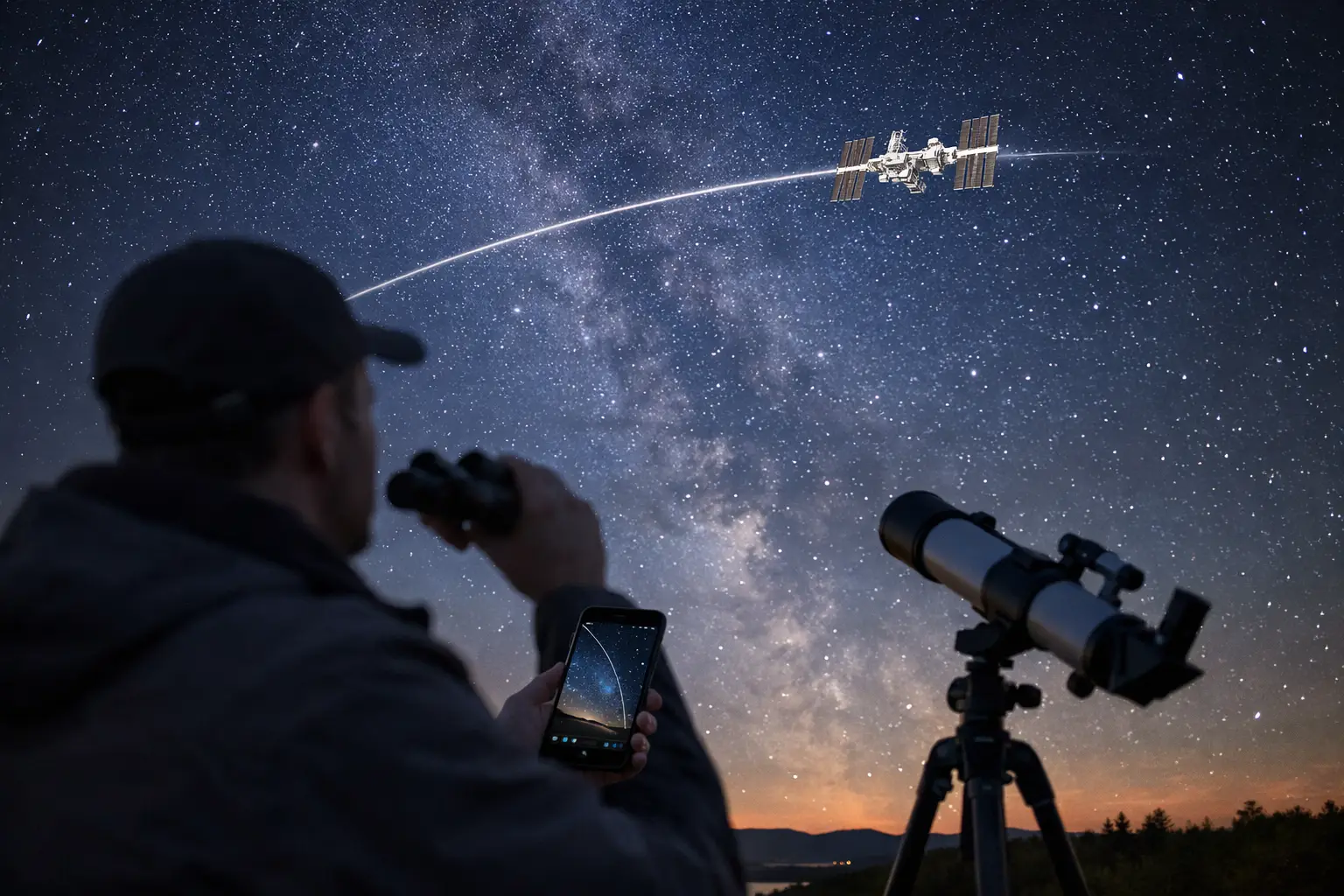
A forecast that says the ISS appears at 8:42 p.m. does not mean it will be directly above your house at 8:42. When people ask what time is ISS overhead, they usually want the moment to step outside – but the best pass also depends on your exact location, the station’s peak altitude, and whether sunlight is still hitting the spacecraft.
| ISS pass data | Typical value | Why it matters |
|---|---|---|
| Orbital altitude | About 370-420 km | The altitude changes gradually with station operations and atmospheric drag. |
| Orbital speed | About 27,600 km/h | It can cross a large section of sky in only a few minutes. |
| One orbit | About 90 minutes | The ISS circles Earth roughly 16 times each day, but not every orbit is visible from your location. |
| Useful viewing duration | 1-6 minutes | A high pass lasts longer and is easier to spot than a low horizon skim. |
The exact time the ISS is overhead depends on you
There is no single national ISS schedule. A pass predicted for Chicago at 9:16 p.m. CDT can be invisible from Detroit, even though the cities are only about 380 km apart. The station follows a ground track that shifts westward from orbit to orbit as Earth rotates below it, so a small change in location can change the appearance time, direction, and maximum height.
For an accurate answer, enter your observing location in a live pass tracker and look for four fields: start time, peak time, maximum elevation, and direction. The start time tells you when to begin watching. Peak time is when the station reaches its highest point. Maximum elevation, measured in degrees above the horizon, tells you whether the pass is worth planning around.
A 10-degree pass is low, often blocked by trees or buildings. A 30-degree pass is solid from an open yard. A pass at 60 degrees or more is a headline event, and 90 degrees means the ISS passes directly overhead. In practice, begin watching two minutes before the listed start time. The station is quick, and a bright pass can be over before a late observer gets oriented.
Why the ISS is not visible on every pass
The ISS can fly over your region during daylight, darkness, or twilight. You see it only when two conditions line up: your sky is dark enough and the station is still illuminated by the Sun. That is why the best sightings cluster after sunset or before sunrise, often while the Sun is between 6 and 18 degrees below your horizon.
At local midnight, the ISS may be moving through Earth’s shadow and will not reflect enough sunlight to appear. During full daylight, it is sunlit but washed out by the blue sky. Near dusk and dawn, the geometry is ideal: you stand in darkness while the station, roughly 400 km up, remains in direct sunlight.
A visible pass can look like a steady, brilliant white star traveling much faster than an airplane. It does not flash red and green. Aircraft lights blink; the ISS normally does not. Depending on the pass geometry, it may brighten as it climbs, then fade abruptly when it enters Earth’s shadow. That sudden disappearance is real orbital physics, not a cloud or a tracking error.
What “overhead” means on an ISS tracker
Strictly speaking, overhead means 90 degrees elevation, at the zenith. But casual forecasts sometimes use “overhead” to mean any pass above your area. Check the actual elevation number before you make plans.
A 75-degree pass can be nearly as spectacular as a 90-degree one, particularly if you have a clear view toward the direction where it begins. For a lower pass, the first and last minute may be lost behind homes, hills, or trees. City observers should prioritize passes above 40 degrees; rural observers with a wide horizon can enjoy lower ones.
How to read an ISS pass prediction
A useful pass prediction might read: visible at 8:42 p.m., rises WNW, reaches 67 degrees at 8:45 p.m., and disappears ESE at 8:48 p.m. That is a three-part flight across your sky, not a single point-and-look moment.
WNW means west-northwest, around 293 degrees on a compass. ESE means east-southeast, around 113 degrees. You do not need a compass app if you know your landmarks, but it helps to face the correct side of the sky before the countdown starts. If the listing shows UTC rather than local time, convert it carefully. During daylight saving time, Eastern Daylight Time is UTC-4, Central Daylight Time is UTC-5, Mountain Daylight Time is UTC-6, and Pacific Daylight Time is UTC-7.
The predicted brightness is often expressed as magnitude. Lower and more negative values are brighter. A magnitude of -3 can rival Venus and is hard to miss; magnitude 0 is still bright, roughly comparable to Vega. Brightness predictions are useful, but elevation and local clouds usually matter more to whether you see the station.
Set up for a high-confidence sighting
You do not need a telescope, binoculars, or a dark-sky site. In fact, binoculars make finding a fast-moving target harder. Your eyes and a clear slice of sky are the primary equipment.
Check the pass within a few hours of viewing rather than relying on a screenshot from last week. ISS predictions use orbital element data that must be updated as the station’s orbit changes. Occasional reboosts, debris-avoidance maneuvers, and normal atmospheric drag can shift future pass times. A reliable live tracker accounts for current orbital data; a stale prediction may be off by enough to cause frustration during a short event.
Then check the cloud forecast. Thin clouds may still allow the ISS through, especially on a bright pass, but an opaque deck ends the attempt. Give yourself an unobstructed view in the listed rise direction, turn down bright porch lights if possible, and keep your phone screen dim so your eyes remain adapted to the sky.
SpaceInformer’s live tracking tools are designed for this exact job: turning orbital data into a location-specific launch window for your backyard, school field, or evening walk.
A practical family viewing plan
For a pass above 45 degrees, gather everyone outside five minutes early and identify the rise direction together. Tell first-time viewers to look for a moving point of light, not a hovering spacecraft or a blinking aircraft. If children are using a phone, have one person monitor the countdown while everyone else watches the sky.
If the pass is only 15 to 25 degrees high, pick an open location and lower expectations. It may be visible for less than two minutes, and haze near the horizon can erase it. The trade-off is that low passes can still be memorable when the ISS travels behind a skyline, mountain ridge, or line of twilight clouds.
When to check again
Missed tonight’s pass? Do not assume the next visible opportunity is exactly 90 minutes later. The ISS may pass nearby without being sunlit or may be too low to see. Visible opportunities commonly arrive in clusters across several mornings or evenings, followed by gaps as the orbit-Sun geometry changes.
Check your local predictions each day, favor a pass above 40 degrees with a brightness near magnitude 0 or better, and be outside early. When that bright, unblinking point rises on schedule, you are watching a working space station carrying people around Earth at nearly 28,000 km/h – a real-time sky event that rewards simply looking up.