
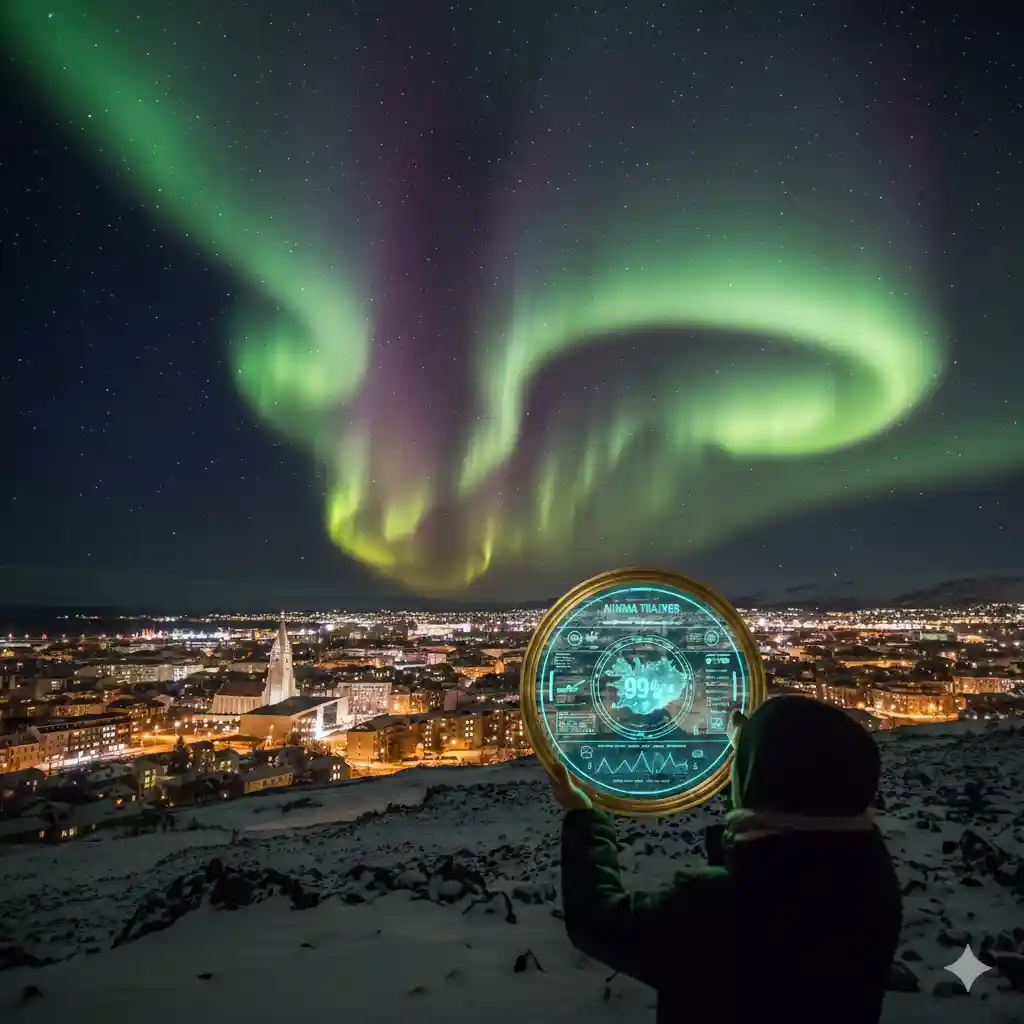
Hunting the Aurora Borealis in Iceland? Use our live tracker to see if the Northern Lights are active over Reykjavik and Southwest Iceland right now.
🌌 Reykjavik Aurora Live Tracker
Real-time Northern Lights Forecast for Reykjavik, Iceland
Loading…
Connecting to NOAA space weather satellites…
Aurora Visibility Guide
✨ Data updates frequently. Refresh for the latest solar activity.
Current Aurora Oval (Satellite View)
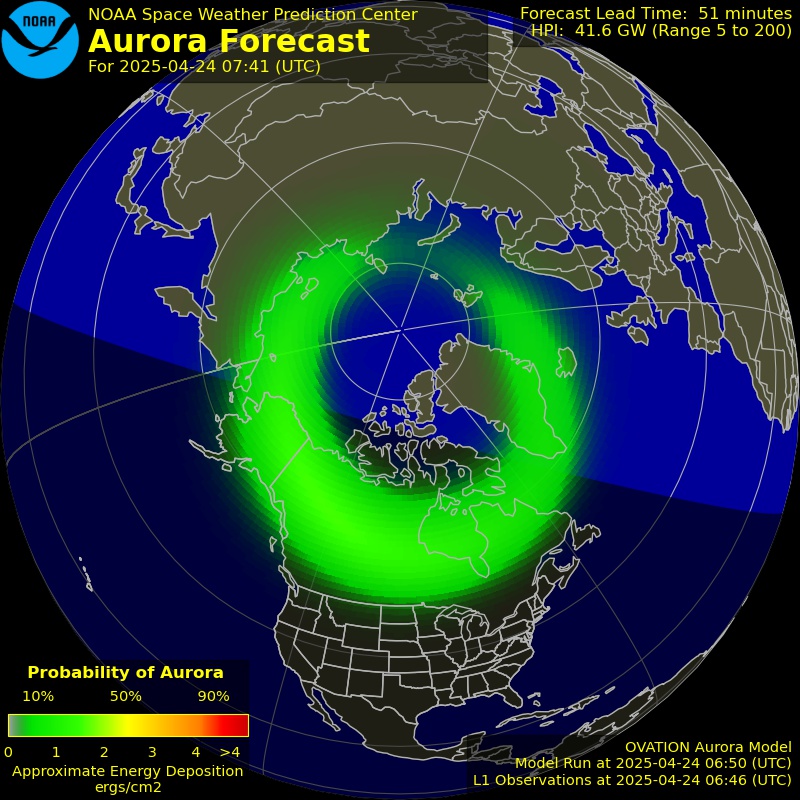
Data provided by NOAA / Space Weather Prediction Center
Check Other Northern Lights Hubs
Why Icelanders Check Two Maps, Not One
Ask a local how they plan an aurora night and you’ll rarely hear “I checked the Kp-index.” Iceland’s Met Office (vedur.is) publishes a cloud cover forecast laid directly over an aurora probability map, and that combination — not the Kp number alone — is what actually drives decisions here. The reason is Iceland’s weather: sitting where the Gulf Stream meets Arctic air, conditions can flip from clear to overcast in under an hour. A night can have excellent geomagnetic activity and still produce nothing if the cloud layer over Reykjavik doesn’t cooperate — which is why the local habit is to treat the aurora forecast as only half the picture, and the cloud map as the half that actually decides your evening.
Getting Out of the City Fast
Reykjavik is a compact capital, not a sprawling metro area, which works in your favor: real darkness is closer than in most capital cities. The core problem is direct light spill from downtown and the harbor. Grótta, a lighthouse and nature reserve at the tip of the Seltjarnarnes peninsula, sits barely fifteen minutes from downtown and already clears most of the city glow, backed by a wide, flat shoreline with no obstruction to the north. For a bigger jump in sky darkness, most visitors — and most locals — head onto the Ring Road itself rather than to a single fixed viewpoint, since Iceland’s self-drive tourism infrastructure means well-lit, well-maintained roads reach genuinely dark countryside within thirty to forty minutes in almost any direction from the city.
Þingvellir and the Rift Valley Effect
Þingvellir National Park, about 45 minutes east of Reykjavik, is where most serious aurora photographers end up, and not by accident. It’s a UNESCO site sitting directly in the rift valley where the North American and Eurasian tectonic plates are pulling apart, which gives the landscape a genuinely unusual foreground — fissures, cliffs, and Þingvallavatn, Iceland’s largest natural lake, all in one frame. It’s also official dark-sky-adjacent territory: no town lighting for kilometers, and enough elevation change that photographers can put real depth between the aurora and the horizon rather than shooting over flat ground.
The Blue Lagoon Question
Visitors often ask whether it’s possible to watch the aurora while soaking in a geothermal lagoon, and the honest answer is: sometimes, but don’t plan a trip around it. The Blue Lagoon itself sits close to Reykjavik’s airport lighting and Grindavík’s town glow, which works against a strong sighting. Some of the smaller, less-lit geothermal pools further from town — the Secret Lagoon near Flúðir, for instance — offer a genuinely better combination of darkness and warm water, but the core lesson is the same as everywhere else in Iceland: pick the location for its sky first, and treat any bonus (thermal water, waterfalls, glacier lagoons) as exactly that — a bonus.
How Reykjavik’s Season Differs from the High Arctic
At 64.1°N, Reykjavik sits noticeably further from the pole than Tromsø or Yellowknife, so it typically needs a somewhat stronger geomagnetic push before the aurora becomes visible overhead rather than as a low green band. What it doesn’t get is a true polar night — Reykjavik keeps a few hours of daylight even at the December solstice, and the viewing season runs roughly late August through mid-April, tightening around a workable window each night rather than the near-continuous darkness further north. In practice, that means fewer “any hour will do” nights, and more value in checking the cloud map before you commit to driving out.
Not in Reykjavik? Go back to our Northern Light Live Tracker!