
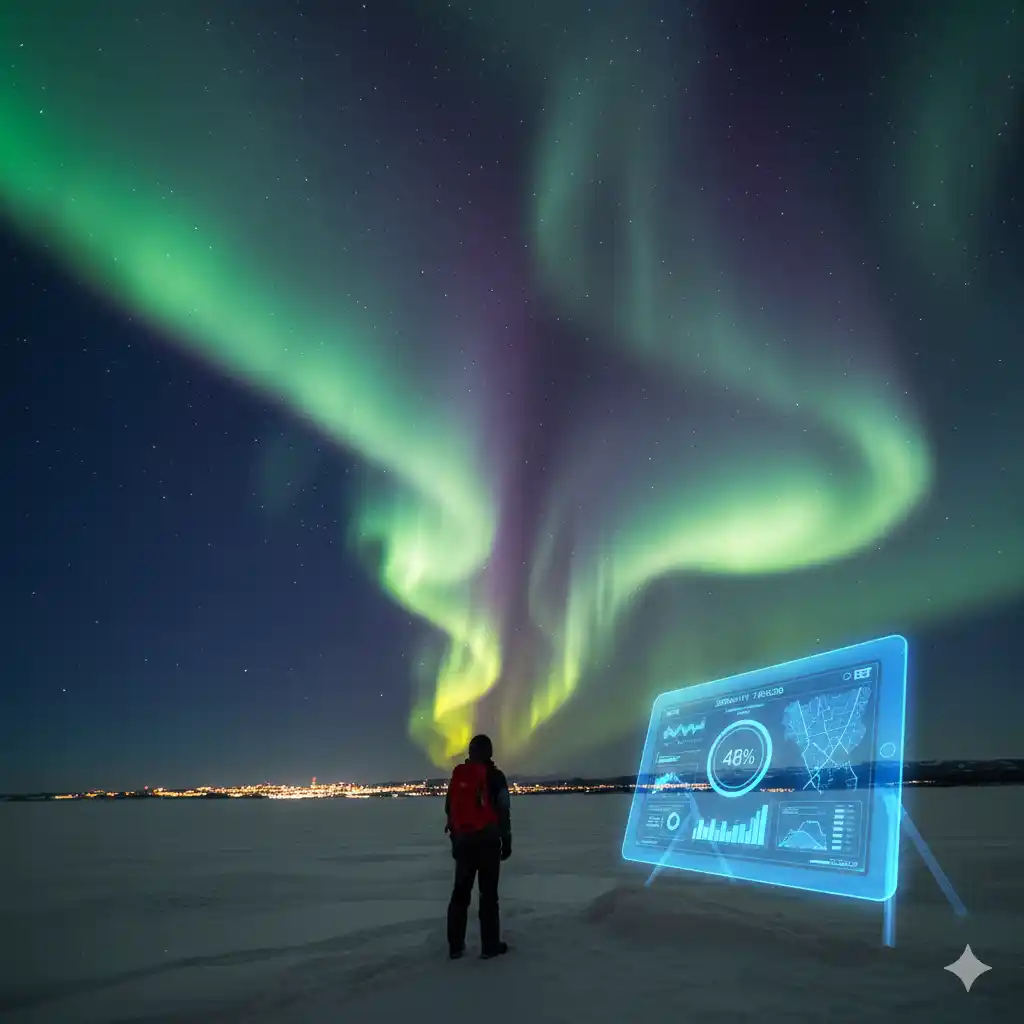
🌌 Yellowknife Aurora Live Tracker
Real-time Northern Lights Forecast for Yellowknife, Canada
Loading…
Connecting to NOAA space weather satellites…
Aurora Visibility Guide
✨ Data updates frequently. Refresh for the latest solar activity.
Current Aurora Oval (Satellite View)
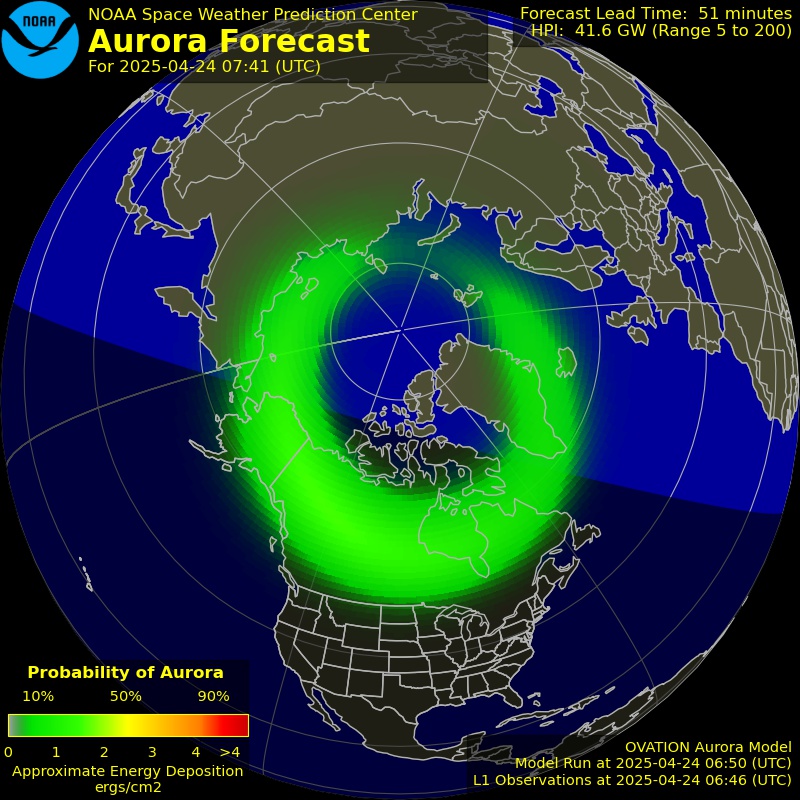
Data provided by NOAA / Space Weather Prediction Center
Check Other Northern Lights Hubs
Why Yellowknife Sits in the Aurora’s Favorite Spot
Most aurora hotspots earn their reputation from clear skies alone. Yellowknife earns it from geometry. The city sits almost directly beneath the auroral oval — the ring-shaped zone around the magnetic pole where charged particles from the sun collide with the atmosphere most often — and it does so over land, not ocean. That combination is rare. Coastal aurora destinations fight moisture and cloud cover rolling in off the water; Yellowknife’s continental, sub-arctic climate means the air stays dry and the winter sky stays open far more nights than not. Locals will tell you the joke isn’t “will the lights show up” but “will the clouds get out of the way” — and in Yellowknife, they usually do.
Reading the Kp-Index Here vs. Everywhere Else
The Kp-index measures global geomagnetic disturbance on a 0–9 scale, but what it means for your night depends entirely on where you’re standing. In most of the continental US, you need a Kp of 6 or 7 before anything is visible. In Yellowknife, that same show is already happening at Kp 1. At Kp 0 — technically “quiet” — a faint green band can still be visible low on the northern horizon on a clear night, because the city sits close enough to the pole that it doesn’t need much push from solar activity. When the index climbs past 5, the display stops behaving like a horizon glow and starts moving overhead: curtains, pillars, and rapid color shifts from green into red and violet as higher-altitude oxygen gets excited.
Where Locals Actually Go
The Aurora Village concept — heated teepees, guided viewing, hot chocolate — is a real industry here and worth it if you want comfort over a multi-hour wait. But plenty of residents skip the packages entirely. Vee Lake, a short drive northwest of downtown, opens onto a frozen, treeless expanse with a 360-degree view — no need to guess which direction the lights will appear. Prelude Lake, further out along the Ingraham Trail, trades that openness for a forested shoreline that makes for a stronger foreground in photos. Closer to town, the Pilot’s Monument in Old Town costs nothing but a short climb and gives you the lights reflected over Great Slave Lake’s ice, with the city skyline as a secondary subject rather than a source of light pollution.
Shooting in Extreme Cold
Yellowknife’s aurora season runs alongside genuinely severe cold — nights of -25°C to -35°C aren’t unusual between December and February. That changes how you shoot. Batteries lose charge dramatically faster; carry a spare in an inside pocket, not your camera bag. Condensation forms when you bring a cold camera into a warm car or hotel room, so seal it in a bag before the temperature swing to let it warm up gradually. Tripods with metal legs will burn bare skin — wrap the joints, or use a model with foam grips. None of this is aurora-specific advice you’ll find on a generic tracker page, but it’s the difference between a usable photo and a fogged lens thirty minutes in.
When to Plan Around It
Late August through early April is the viewing window — the sky needs to be dark enough, which rules out the near-24-hour daylight of summer. Late winter (February–March) pairs the aurora with more stable, colder, clearer air, while shoulder-season trips in September and early April trade a bit of visibility for milder temperatures. Whatever week you choose, plan for at least three consecutive nights: a single cloudy evening can shut out an otherwise strong geomagnetic night, and Yellowknife’s odds are built on giving the sky more than one chance to cooperate.
Not in Yellowknife? Go back to our Northern Light Live Tracker!