
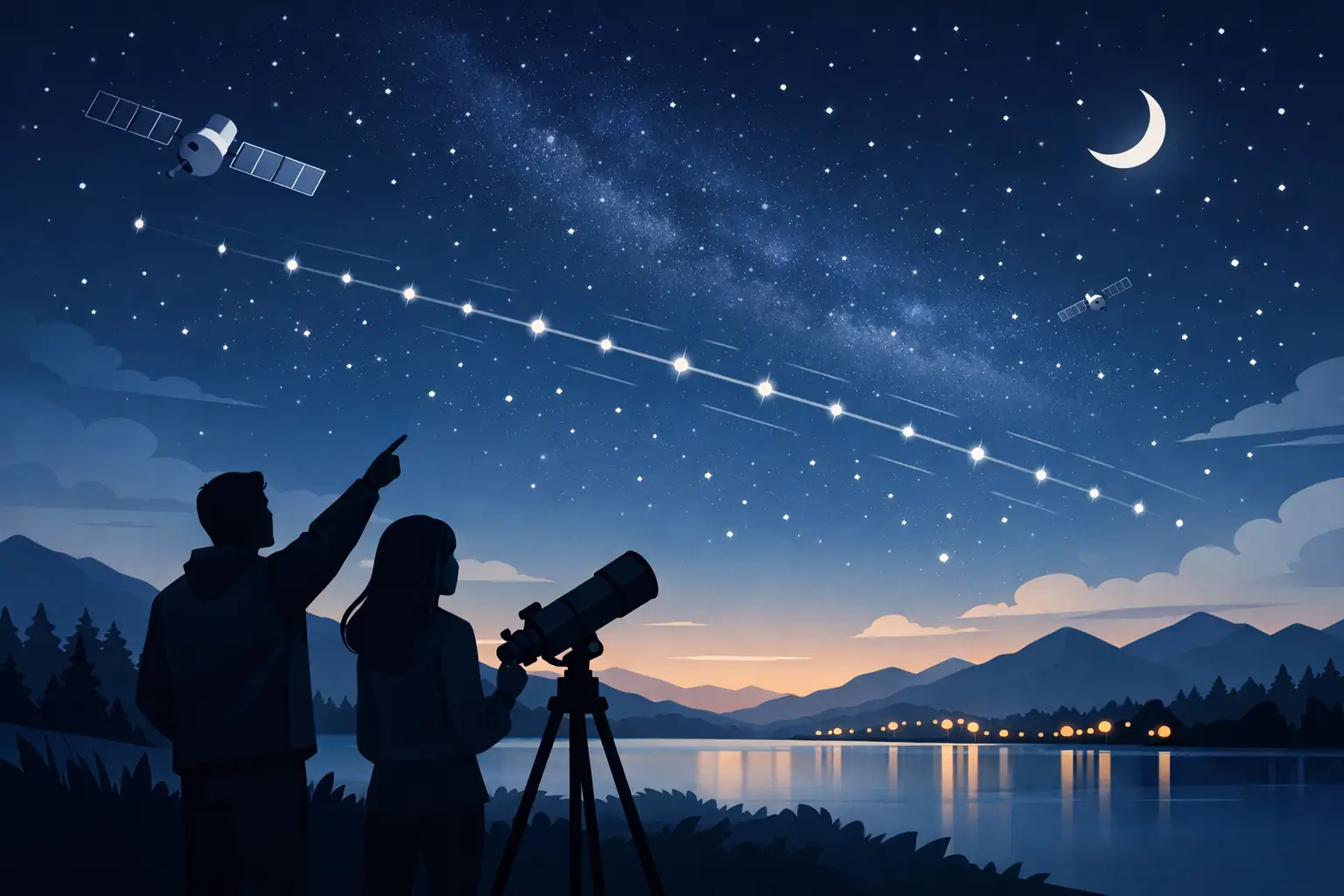
If you’re asking whether starlink satellites visible tonight in your area, you’re usually only a few details away from the answer: your location, the time after sunset or before sunrise, and whether the satellites are still catching sunlight. That is what turns a routine pass into a bright moving train of lights – or nothing at all.
Starlink sightings are one of the most searched sky events for a reason. They can look dramatic, they move fast, and they reward timing more than expensive gear. But they are also inconsistent. Some nights deliver a clean, bright pass that even kids can spot from a backyard. Other nights, the same sky watchers step outside and see absolutely nothing.
How to tell if Starlink satellites are visible tonight
The short version is simple: Starlink satellites are most likely to be visible shortly after sunset or shortly before sunrise, when the ground is dark but the satellites are still high enough to reflect sunlight. If the sky is fully dark and the satellites have entered Earth’s shadow, they disappear even though they are still overhead.
That is why visibility is so location-sensitive. A pass that looks excellent in one US city may be too dim or too low on the horizon somewhere else. Cloud cover matters, of course, but orbital geometry matters more. You are not just looking for a satellite overhead. You are looking for the right combination of timing, altitude, brightness, and direction.
If you want the best odds tonight, check for a predicted pass within roughly 60 to 90 minutes after sunset or before sunrise. Then pay attention to maximum elevation. A pass peaking high in the sky is generally easier to follow than one skimming the horizon, especially in suburbs where trees, buildings, and light pollution block low-angle views.
Why Starlink looks spectacular some nights and invisible on others
This is where expectations make or break the experience. Many people picture the classic Starlink train – a string of satellites following one another closely. That does happen, but it is usually most noticeable after a fresh launch, when the satellites are still grouped tightly before spreading into their operational orbits.
Once that spacing increases, you are more likely to see one or a few moving points of light rather than a dramatic parade. They can still be bright. They just may not look like the viral videos.
Satellite brightness also changes because Starlink’s orientation changes. The angle of reflection, the altitude above your horizon, and the phase of deployment all affect what you see. Some passes are obvious to the naked eye. Others are binocular-only events unless you have unusually dark skies.
There is also a real trade-off between excitement and accuracy here. Social media often overpromises. A forecast may technically show a pass overhead, but that does not guarantee a bright visual sighting. A low-magnitude pass in hazy conditions can be a miss even when the timing is correct.
Best time windows for starlink satellites visible tonight
If you are planning your evening around a possible sighting, timing matters more than anything else. The best windows usually happen soon after sunset or just before dawn because the satellites remain sunlit while your local sky is dark enough for contrast.
Midnight passes are far less dependable for casual viewing. By then, many low Earth orbit satellites have moved into Earth’s shadow during much of their path. They are still there, but they are not reflecting sunlight toward you.
For most viewers in the US, the strongest opportunities tend to fall into three categories. The first is a bright evening pass in twilight. The second is a pre-dawn pass with a darker sky and strong contrast. The third is a recently launched group, which can briefly create the train effect people specifically hope to catch.
If you miss the first minute, do not assume the pass is over. Start watching the predicted direction early and keep scanning. A satellite can begin very dim, brighten rapidly near its highest point, then fade again within seconds.
Where to look in the sky tonight
A good Starlink pass forecast should tell you where the satellites will appear, where they will peak, and where they will disappear. Those three direction points matter more than many beginners realize. If the pass starts in the northwest and climbs toward the south, but you are staring straight overhead, you can lose the first half of the show.
For the clearest view, give yourself a wide patch of open sky. Backyards work if you can avoid rooflines and trees. Parks, school fields, beaches, and parking lots with broad horizons are often better. If the predicted elevation is low, horizon visibility becomes the deciding factor.
You do not need a telescope. In fact, telescopes usually make Starlink harder to track because the field of view is too narrow. Naked-eye viewing is ideal for bright passes, and binoculars help if the forecast suggests a dimmer event.
How Starlink differs from planes, planets, and the ISS
A lot of first-time observers wonder whether they are actually seeing Starlink or just an airplane. The easiest tell is motion and flashing. Airplanes blink. Starlink satellites do not. They move with a smooth, steady glide and usually maintain a constant path without colored navigation lights.
They can also be confused with the International Space Station. The ISS is often much brighter and can dominate the sky like a fast-moving beacon. A single Starlink satellite is typically dimmer, though some can still be impressive. When multiple Starlink satellites follow the same track, that pattern becomes the giveaway.
Planets are easier to rule out because they do not move across the sky in real time the way satellites do. If it is drifting noticeably over a minute or two, it is not a planet.
What affects your chances of a good sighting
Even if a pass is predicted, several real-world factors can lower your odds. Weather is the obvious one. High thin clouds are especially annoying because they can leave stars visible while washing out dim satellites.
Light pollution matters, but less than people think for brighter passes. You can spot some Starlink satellites from city neighborhoods if the pass is favorable. Still, darker skies help, especially if you are trying to pick up a faint train rather than one bright object.
Launch timing matters too. Right after deployment, visibility interest spikes because the satellites are closer together and more visually distinct. Later, the spectacle changes. The satellites are still passing, but the viewing experience becomes more subtle.
That is why a utility-first tracker matters more than generic sky-event advice. You want live, location-aware timing instead of broad claims that a sighting is happening “tonight” across the whole country. For an event this dependent on position and sunlight, local accuracy wins.
If Starlink satellites are visible tonight, make the most of it
Treat the sighting like a short launch window. Step outside a few minutes early, let your eyes adjust, and put your phone away unless you are using it for the pass direction. If you are with family or friends, tell them what to expect before the satellites appear. Most people miss the first object because they are waiting for something brighter or slower.
Photography is possible, but it is not the easiest first goal. A simple wide-angle night shot or short tripod exposure can work if the pass is bright. Still, Starlink is one of those sky events that is often better live than through a screen. The motion is the point.
If tonight’s pass turns out to be disappointing, that does not mean the forecast was wrong. It may mean the brightness was marginal, the horizon was blocked, or the satellites hit shadow earlier than expected from your viewing angle. Starlink tracking always has an “it depends” layer, and that is part of what keeps the hunt interesting.
For regular sky watchers, this is also where the experience compounds. Once you learn how timing, direction, and brightness work together, you stop guessing and start planning. That is the difference between stepping outside hoping to get lucky and tracking the sky like mission control.
The best approach tonight is simple: trust the timing, give yourself an open view, and watch the right part of the sky a little earlier than you think you need to. When the pass lines up, Starlink does not feel distant or abstract – it feels immediate, fast, and very real.