
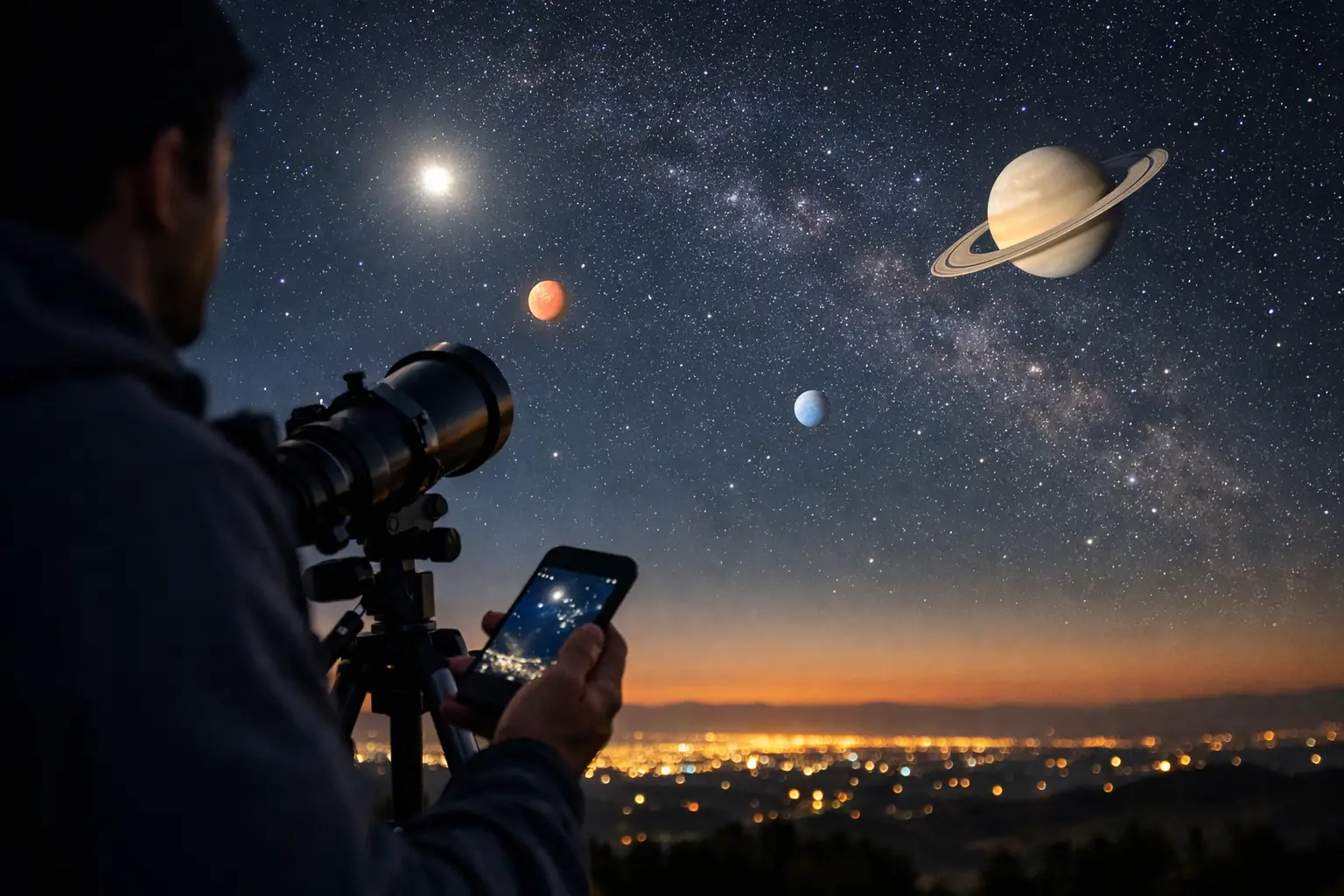
A bright point low in the west can be a planet, an aircraft, or a star on the edge of the atmosphere. The difference comes down to timing, direction, and your exact location. To learn how to find planets tonight, start with a live, location-based sky view, then use the horizon and a few simple checks to turn a possible sighting into a confident one.
| Planet | Mean distance from Sun | Best first search window | Useful viewing altitude |
|---|---|---|---|
| Mercury | 0.39 AU, 57.9 million km | 30-60 minutes before sunrise or after sunset | 5-12 degrees |
| Venus | 0.72 AU, 108.2 million km | 30-90 minutes before sunrise or after sunset | 5-25 degrees |
| Mars | 1.52 AU, 227.9 million km | After twilight, when listed as visible | 20 degrees or higher |
| Jupiter | 5.20 AU, 778.6 million km | After twilight, when listed as visible | 15 degrees or higher |
| Saturn | 9.58 AU, 1.43 billion km | After twilight, when listed as visible | 20 degrees or higher |
The distances above are mean distances from the Sun, not the changing Earth-to-planet distance shown by a live tracker. That distinction matters. A planet can be above your horizon but too close to the Sun, behind trees, or only 4 degrees high, where thick atmosphere can make even a bright target hard to see.
How to find planets tonight with a live sky check
Your first mission-control input is location. Enter your city or allow a sky tool to use your coordinates, then confirm the date and time zone. A chart set to 9:00 PM EDT is four hours behind UTC during daylight saving time, so it corresponds to 01:00 UTC the following calendar day. That one-day rollover can change a Moon-planet conjunction label or make a rising-time prediction look wrong.
Next, look for four data fields: direction, altitude, rise or set time, and apparent magnitude. Direction tells you where to face. Altitude tells you how high the planet is above a flat horizon, where 0 degrees is the horizon, 45 degrees is halfway to overhead, and 90 degrees is directly overhead. Apparent magnitude is a brightness scale in which lower and negative numbers are brighter.
For a first attempt, prioritize a planet at least 15 degrees above the horizon. At 10 degrees, you are looking through roughly 5.6 times as much atmosphere as at the zenith. At 5 degrees, the air path is closer to 10 times thicker than straight overhead. Haze, city glow, rooftops, and trees become major factors there.
A useful field trick is the closed-fist measurement. Hold your arm straight out: one fist spans about 10 degrees, three fingers about 5 degrees, and your little-finger width about 1 degree. If a tracker places Jupiter 22 degrees above the southwest horizon at 10:00 PM, scan about two fist-widths above that horizon rather than searching the entire sky.
Build a 10-minute planet search plan
Do not begin outside with only a planet name. Build a short viewing window before you step out. Check when civil twilight ends, because the Sun is then 6 degrees below the horizon. Bright Venus or Jupiter can sometimes appear before that point, but fainter Mars and Saturn generally benefit from a darker sky.
For example, if civil twilight ends at 9:06 PM local time and your target reaches 18 degrees altitude at 9:35 PM, arrive outside by 9:25 PM. Give your eyes at least 5 to 10 minutes away from bright indoor lights. You do not need full dark adaptation for Venus or Jupiter, but phone screens can still erase the subtle contrast needed to pick out Saturn or a low Mars.
Use this sequence:
- Face the compass direction supplied by your sky tool. Compass directions can be magnetic rather than true north, but the difference is usually small enough for a naked-eye planet search.
- Find a clear horizontal reference point, such as a roofline gap or distant tree break. Avoid judging altitude from a nearby building that blocks your real horizon.
- Sweep upward slowly to the reported altitude. Start with the brightest point in the correct part of the sky.
- Recheck the display after 15 minutes. Planets move slowly against the stars, but their altitude changes continuously as Earth rotates, often by several degrees per hour near rising or setting.
If the display says a planet sets at 10:18 PM, do not plan a 10:15 PM observation. Its listed setting time assumes a level horizon and atmospheric refraction. A hill, apartment block, or line of mature trees can remove your view 10 to 30 minutes earlier.
Know what each visible planet looks like
Venus is usually the easiest planet to identify. Near favorable appearances it can shine around magnitude -4, brighter than every star and visible even in strong twilight. It stays close to the Sun in the sky, however, so it is a morning or evening target, never a midnight object. Never scan near the Sun with binoculars or a telescope.
Jupiter is another standout, often brighter than magnitude -2 around favorable periods. Through 7×50 or 10×50 binoculars held steadily, its four largest moons can appear as tiny points lined up near the planet. A small telescope at 50x to 100x can reveal cloud belts when the atmosphere is steady.
Mars is more variable. It can be unmistakably orange-red near an opposition, when Earth passes between Mars and the Sun, but much dimmer and less dramatic at other points in its roughly 780-day synodic cycle. Color helps, but do not use it as proof by itself. Low altitude can make any star look orange.
Saturn normally looks like a calm, pale yellow point to the naked eye. Its rings need magnification. A small telescope around 50x can begin to separate the ring system from the disk under good conditions, while binoculars are better used to confirm its position first.
Mercury is the precision target. It never strays far from the Sun, and its best evening or morning appearances happen near greatest elongation. Even then, a low, unobstructed horizon is non-negotiable. If Mercury is only 7 degrees high 40 minutes after sunset, a view from a beach, hilltop, or open field may work while a suburban backyard will not.
Separate planets from stars, planes, and satellites
A planet usually shines with a steadier light than a star, especially when it is high in the sky. Stars twinkle because turbulent air bends their light. Planets present tiny disks rather than true point sources, which reduces the visible flicker. But this is a clue, not a guarantee: a planet at 6 degrees altitude can twinkle strongly.
Aircraft move noticeably within seconds and often show blinking red, green, or white lights. Satellites glide steadily across the sky and can cross a constellation in a few minutes, while a planet will remain fixed relative to nearby stars during a 10-minute observation. The International Space Station, for instance, can cross the sky in roughly 3 to 6 minutes during a bright pass, so it is not a planet despite its brilliance.
When a target is uncertain, hold binoculars steady against a wall, car roof, or tripod. A planet will remain in the same star pattern when you compare it with your live chart. This is also where a SpaceInformer-style live sky view earns its keep: it connects the object in front of you to a time-stamped position instead of asking you to guess from a generic monthly map.
When conditions beat a perfect forecast
Clear sky icons do not guarantee good planetary viewing. Transparency measures how clear the air is, while seeing describes how stable it is. For naked-eye identification, transparency matters more. For Jupiter’s bands or Saturn’s rings, stable seeing matters more.
A humid evening can be clear overhead yet poor near the horizon. If your target is below 15 degrees, wait until it climbs if its setting time allows. If it is an evening-only Mercury or Venus opportunity, move to a clearer horizon instead. A change of just 2 miles can make the difference between a blocked target and a clean line of sight.
Tonight’s sky is not a static poster. Run the live check, take the altitude seriously, and give yourself a precise 10-minute window. The moment a bright world locks into the right patch of sky, the search becomes something better than a checklist: a real-time connection with the solar system overhead.