
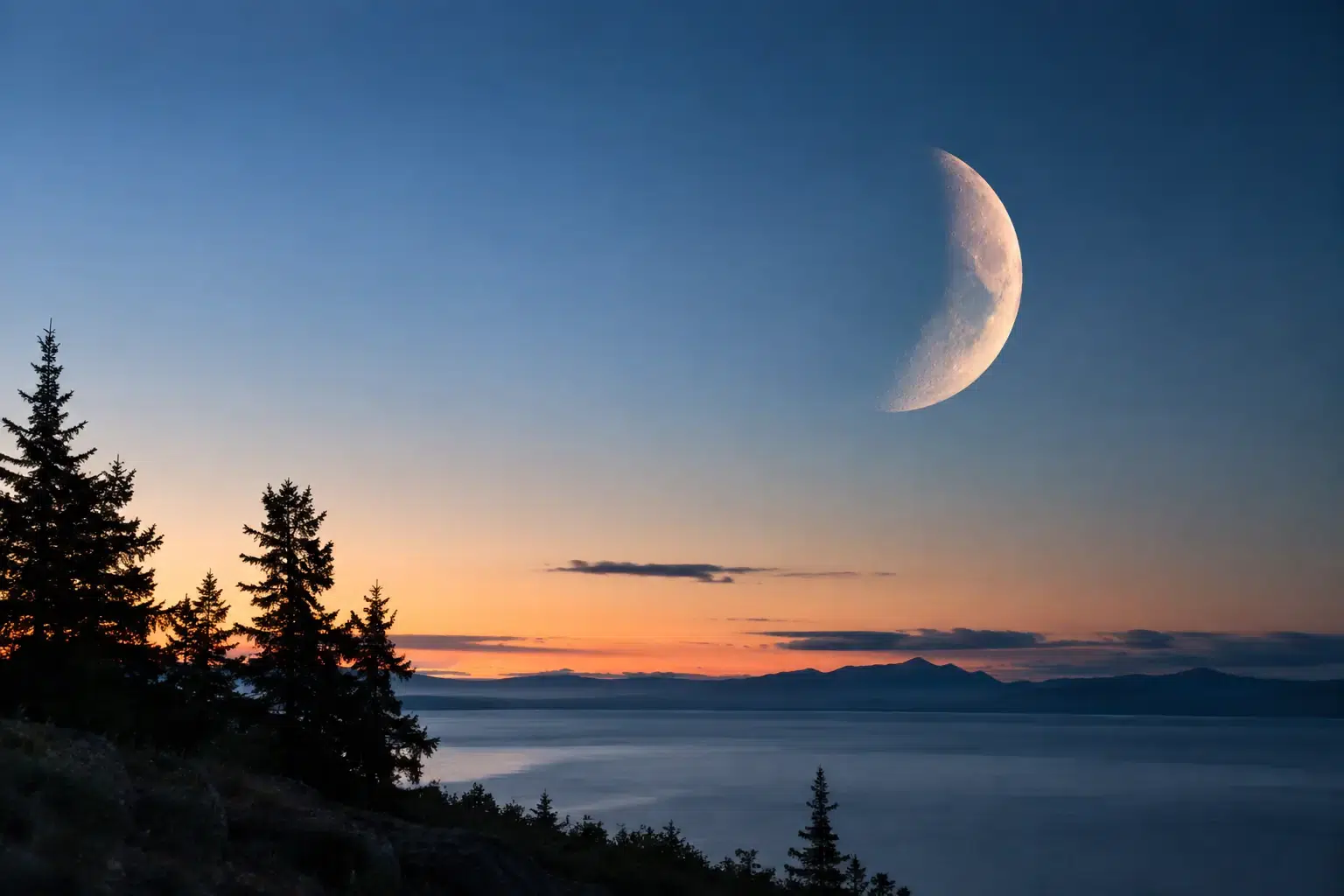
Moonset is a deadline you can see. When the Moon slips below your local horizon, its glare leaves the sky, faint stars return, and a planned telescope session can shift into high gear. This beginner guide to moonset data turns a simple time on a sky dashboard into a practical observation plan – whether you are catching a bright Moon over a city skyline or waiting for darker skies at a campsite.
| Moonset data point | Typical value or unit | What it tells you |
|---|---|---|
| Moonset time | Local clock time, often accurate to 1 minute | When the Moon reaches the apparent horizon at your location |
| Set azimuth | Degrees, 0° to 360° | Where on the horizon to look: 270° is due west |
| Lunar distance | About 363,300 to 405,500 km | Why the Moon’s apparent size and timing shift slightly |
| Daily timing shift | About 50 minutes later per day, on average | Why yesterday’s moonset time cannot plan tonight’s session |
What moonset data actually measures
Moonset occurs when the Moon’s upper edge appears to disappear below a level horizon. That wording matters. Your app is not predicting when the Moon’s center reaches a perfectly flat, airless horizon. Standard astronomical calculations account for Earth’s curvature, the Moon’s visible radius, and atmospheric refraction near the horizon.
Refraction alone can lift the apparent position of an object by roughly 34 arcminutes near the horizon. The Moon’s visible radius is about 15 to 16 arcminutes. As a result, the Moon can still be visibly above the horizon when its geometric center is already below it. This is why a published moonset time is a reliable planning marker, not a promise that the last sliver will vanish at that exact second behind your local trees or apartment buildings.
For most observers, a good moonset display includes three essentials: the local time, the direction of the set, and the lunar phase or illumination. Treat them as one forecast. A time tells you when to be ready; azimuth tells you where to aim; illumination tells you how much moonlight will affect the rest of the sky.
Read time, date, and time zone before you head out
The most common beginner mistake is reading moonset as a universal event. It is local. A moonset at 5:42 a.m. in Denver will not occur at 5:42 a.m. in Boston, Phoenix, or Seattle. Longitude shifts the timing, latitude changes the Moon’s path angle, and elevation can also make a modest difference.
Start by confirming that your location setting is correct to at least the nearest city or ZIP code. Then confirm whether the displayed time is local time or UTC. UTC is the global time standard used in many astronomy tools. For example, 06:00 UTC is 2:00 a.m. EDT during daylight saving time, but 1:00 a.m. EST after the seasonal clock change. A dashboard that labels its times clearly prevents an easy one-hour planning error.
Also check the date attached to the event. Moonset frequently happens after midnight. If a tool shows moonset at 1:18 a.m., it may belong to the early morning of the next calendar day, even though you began your observing session the previous evening. For an overnight meteor shower, eclipse watch, or Milky Way session, that distinction is mission-critical.
Why the time moves from night to night
The Moon orbits eastward around Earth at about 13.2° per day. Earth must rotate a little farther each day before the Moon reaches the same position in your sky. That is why moonrise and moonset typically occur around 50 minutes later on the following day.
“Typically” is the key word. The shift can be noticeably smaller or larger because the Moon’s orbital speed and sky path vary. Do not build a schedule around a fixed 50-minute rule. Use it only as a quick expectation, then check live location-based data for the actual night.
Use moonset direction to choose the right horizon
Azimuth is the compass direction measured clockwise from true north. The core reference points are straightforward: 0° or 360° is north, 90° is east, 180° is south, and 270° is west. A moonset azimuth of 281° means the Moon will set 11° north of due west. At arm’s length, a clenched fist spans about 10°, so that is roughly one fist-width to the right of west when you face west.
This number becomes especially useful around the full Moon. A low Moon can look spectacular near a recognizable foreground – a mountain ridge, bridge, ocean horizon, or city tower – but only if your sightline matches its actual set direction. A generic “look west” instruction is often not enough. A set at 245° is southwest; a set at 300° is northwest. Those are very different views when buildings or terrain block part of the horizon.
Use a phone compass carefully. Magnetic north can differ from true north by several degrees depending on where you are in the United States, and nearby cars, railings, or speakers can interfere with the sensor. Your sky tool’s azimuth is normally referenced to true north. Give yourself a 5° to 10° buffer and scout the view before the event.
Pair moonset with phase and illumination
Moonset data matters most when you connect it to the lunar cycle. A full Moon rises near sunset and sets near sunrise, so it stays present for most of the night. Its bright surface can wash out dim objects, including the Milky Way, many meteor trails, and faint deep-sky targets.
Near new Moon, the situation flips. The Moon is close to the Sun in the sky and usually sets not long after sunset or rises not long before sunrise. The middle of the night is much darker. A lunar cycle, measured new Moon to new Moon, lasts about 29.53059 days, so this pattern repeats on a predictable rhythm without landing on the same calendar dates each month.
A waxing crescent can be useful for evening observers because it sets early, leaving darker hours later at night. A waning crescent is often better for pre-dawn observers because it rises late. For casual viewing, even a 70% illuminated Moon can still be beautiful. For photographing the Milky Way or locating faint galaxies, the difference between 70% illumination and a Moon below the horizon is dramatic.
Account for your real horizon, not the mathematical one
Published moonset times assume a relatively clear horizon. Your horizon is rarely clear. A ridge, tree line, apartment block, or coastal haze can hide the Moon several minutes before official moonset. A 10° hill is not a small obstruction – it can erase the final, most photogenic portion of a low Moon entirely.
Check the Moon’s altitude 30 to 60 minutes before set. Altitude is measured above the horizon: 90° is overhead, 45° is halfway up the sky, and 0° is the astronomical horizon. If a ridge blocks the Moon below 6°, do not wait for the listed 0° moonset. Plan your shot or observation while it is still between 8° and 12° high.
Atmospheric conditions create another trade-off. Near-horizon Moon views can appear warmer, larger, and more dramatic because of perspective and atmospheric filtering. They are also more distorted by turbulence, haze, smoke, and low clouds. For sharp lunar detail through binoculars or a telescope, the Moon is usually better when it is at least 20° above the horizon. For a landscape image, the final 5° may be exactly what you want.
A fast moonset planning routine
Launch your plan with the local moonset time, then work backward. For a photo, arrive 20 to 30 minutes early so you can frame the scene while the Moon is still several degrees high. For dark-sky observing, begin serious faint-object work 30 to 45 minutes after moonset, allowing residual twilight, local sky glow, and your eyes time to settle.
Next, check the set azimuth against your horizon. If the Moon is setting at 292° and your best western opening is centered at 270°, you may need a new location rather than better timing. Finally, read the weather at low altitude. Cloud forecasts for the general sky are useful, but a clear overhead forecast does not guarantee a clear western horizon.
Moonset data is not just a number to glance at before bed. It is a live decision tool. Track the time, direction, phase, and altitude together, then let your local horizon make the final call. The next clear night, pick one moonset, give yourself a 30-minute runway, and watch the sky change gears in real time.