
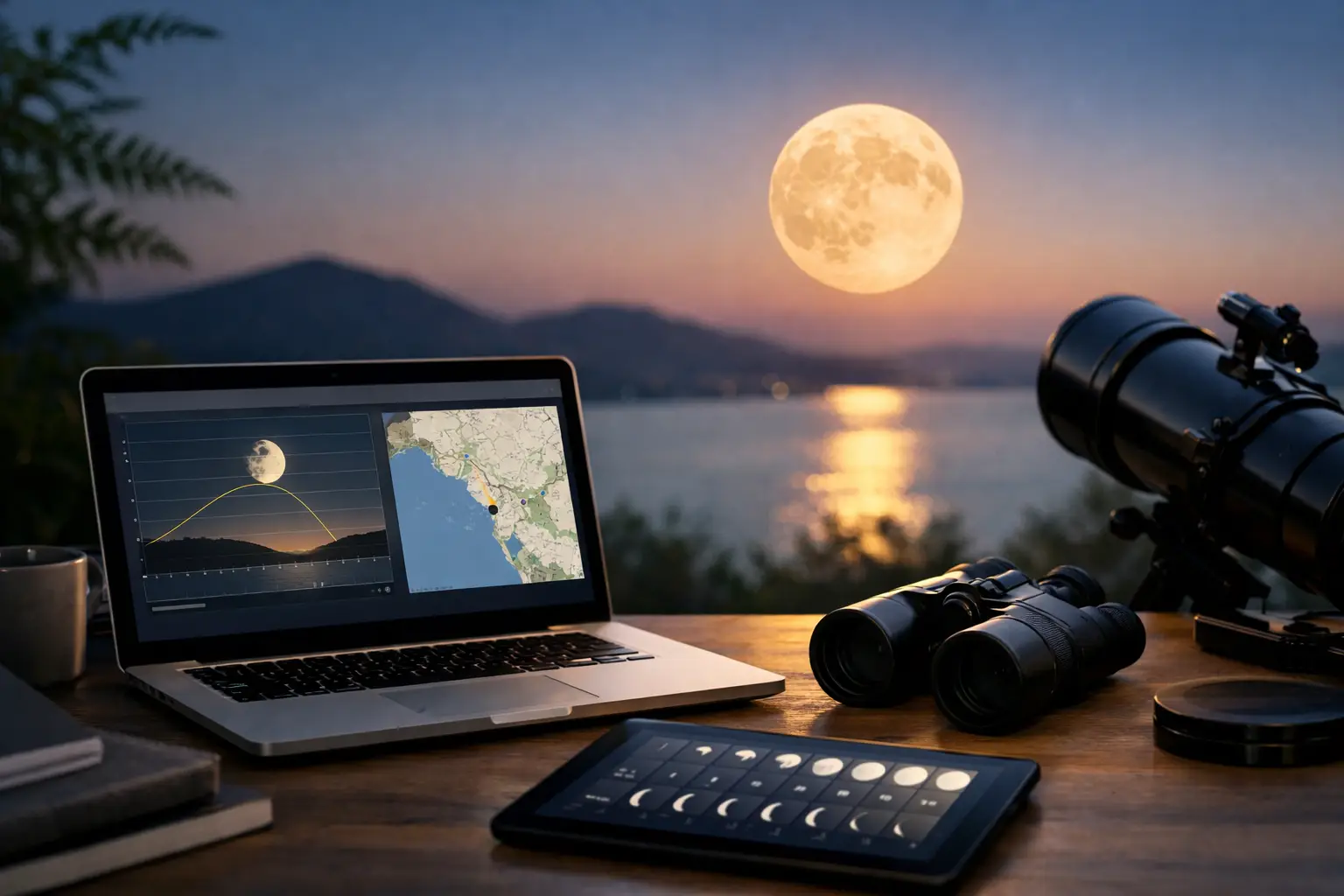
The Moon can be technically above your horizon and still be hidden behind a roofline, tree line, or apartment tower. That is why a moonrise calculator is more useful than a simple calendar listing. It turns your location, date, and local time zone into a live observing plan: when the lunar disk first clears the horizon, where to face, how high it will climb, and whether the phase fits what you want to see.
| Moonrise data | Useful value or range | What it changes |
|---|---|---|
| Daily shift in rise time | About 50 minutes later per day | Yesterday’s viewing time is rarely right for tonight. |
| Lunar orbital distance | About 356,500 to 406,700 km | Apparent size and exact rise calculations change across the month. |
| Clear-horizon target altitude | 5° to 10° above horizon | Gives the Moon a better chance to clear local obstructions and haze. |
| Full phase cycle | 29.53059 days | Explains why lunar rise and set times keep moving through the clock. |
What a Moonrise Calculator Actually Tells You
A good result starts with a precise observing location. Entering just “Denver” can be close enough for casual viewing, but a calculator using your device location or coordinates is better. Moonrise can differ by several minutes across a large metro area, and a hilltop, coastline, or distant horizon can change what you see even when the astronomical time is identical.
The key output is local moonrise time. This is the calculated moment the Moon’s upper edge appears at a level astronomical horizon, after accounting for Earth’s rotation and standard atmospheric refraction. It is not a promise that the Moon will be visible from your backyard at that minute. A building that reaches 8° above your horizon can delay your personal first sighting by 30 minutes or more, depending on the Moon’s path.
Direction matters just as much. Moonrise may occur broadly east, northeast, or southeast rather than at due east. The azimuth is measured clockwise from north: 90° is east, 180° is south, and 270° is west. If a calculator shows a rise azimuth of 112°, face east-southeast, not straight east. That single number can save a lot of standing in the wrong part of the yard.
Altitude is the next mission-critical figure. At 0°, the Moon is on the ideal horizon. At 5°, it is still low, often distorted by haze and local turbulence, but it may be clear of nearby obstacles. At 20°, the view is usually much sharper. For photos featuring a skyline, bridge, or landscape, low altitude is the feature. For crater detail through binoculars or a telescope, wait until the Moon climbs higher.
How to Use a Moonrise Calculator Tonight
Start by setting your exact location and confirming the calculator is displaying local time, including daylight saving time when applicable. A one-hour time-zone error is enough to miss a moonrise completely. Then select the date. Do not assume the Moon rises at the same time as it did the night before: its eastward movement in orbit means Earth must rotate farther before the Moon returns to your horizon.
Next, check four readings together: rise time, azimuth, altitude at your intended viewing time, and illumination. The rise time tells you when to be ready. Azimuth tells you where to look. Altitude tells you whether the Moon has cleared your real-world horizon. Illumination tells you how much of the lunar disk is sunlit, but it does not by itself reveal whether the Moon will be easy to see in twilight.
For a practical launch window, arrive 15 to 20 minutes before the listed moonrise. If your eastern horizon is blocked, plan for the Moon to reach at least 7° altitude before expecting a clean view. A phone compass can help with direction, though nearby metal, cars, and electronics can affect it. Use a landmark aligned with the displayed azimuth whenever possible.
If moonrise is at 8:30 PM local time and the calculator shows an azimuth of 104°, your viewing zone is just south of east. If the Moon reaches 8° altitude at 9:05 PM, that later time may be the realistic target for a neighborhood with trees or homes along the horizon. This is the difference between an astronomical prediction and an observation plan.
Match the phase to the experience
A thin waxing crescent is often visible low in the western sky shortly after sunset, so it is not the phase for a classic evening moonrise in the east. Near first quarter, the Moon tends to rise around midday and is high in the southern sky around sunset. A full Moon rises roughly near sunset and sets roughly near sunrise, making it the headline event for horizon photography and family viewing.
After full Moon, the waning gibbous rises later each evening. By last quarter, it commonly rises around midnight and dominates the predawn sky. Exact times vary with season, latitude, and the Moon’s changing orbital position, which is precisely why live local calculations beat memorized rules.
Why Your Result May Differ From What You See
Moonrise calculations use a standard horizon. Your actual horizon is almost never standard. A mountain ridge can sit 3°, 8°, or far more above the geometric horizon. On a flat beach or open prairie, you may see the Moon close to the published time. In a city, the first visible appearance can come much later.
Atmospheric conditions add another variable. Refraction bends light near the horizon, making the Moon appear slightly higher than its geometric position. The effect is greatest low in the sky and changes with temperature and air pressure. Humidity does not directly control refraction as much as people often assume, but haze, smoke, and cloud absolutely control visibility. A calculated moonrise at 0° altitude is no help through an opaque bank of clouds.
The Moon’s apparent diameter also changes. At perigee, it can be near 356,500 km from Earth; near apogee, it can be around 406,700 km away. That distance swing makes the lunar disk appear roughly 14% wider at perigee than at apogee. It is noticeable in side-by-side images, though the dramatic “huge Moon” effect near the horizon is mostly a human visual illusion, not a giant physical expansion.
Turn Moonrise Into a Better Photo Plan
For a close-up lunar image, use the calculator to avoid the lowest part of the sky. Waiting until 15° to 25° altitude usually reduces distortion and gives the Moon more contrast. A tripod, a shutter delay, and a telephoto lens help, but timing matters more than expensive gear when cloud gaps are brief.
For a landscape composition, do the opposite. Find a safe foreground location before sunset, identify the rise azimuth, and frame the scene in advance. The Moon moves about its own apparent diameter every two minutes, so the best alignment with a tower, ridgeline, or distant structure can be over quickly. Check the calculator again shortly before heading out, especially if you are planning around a narrow gap between buildings.
Moonrise is only one part of the sky forecast
A moonrise calculator is strongest when used with cloud cover, visibility, and phase information. A bright Moon can wash out faint meteors and Milky Way detail, but it can transform an ordinary landscape into a dramatic night scene. For eclipses, conjunctions, and major lunar events, the rise direction and altitude can be as decisive as the event’s peak time.
SpaceInformer’s live sky tools are built for this kind of decision-making: less guesswork, more time looking up. Run the local numbers, give yourself a buffer above the horizon, and let tonight’s Moon become an event you can actually catch.