
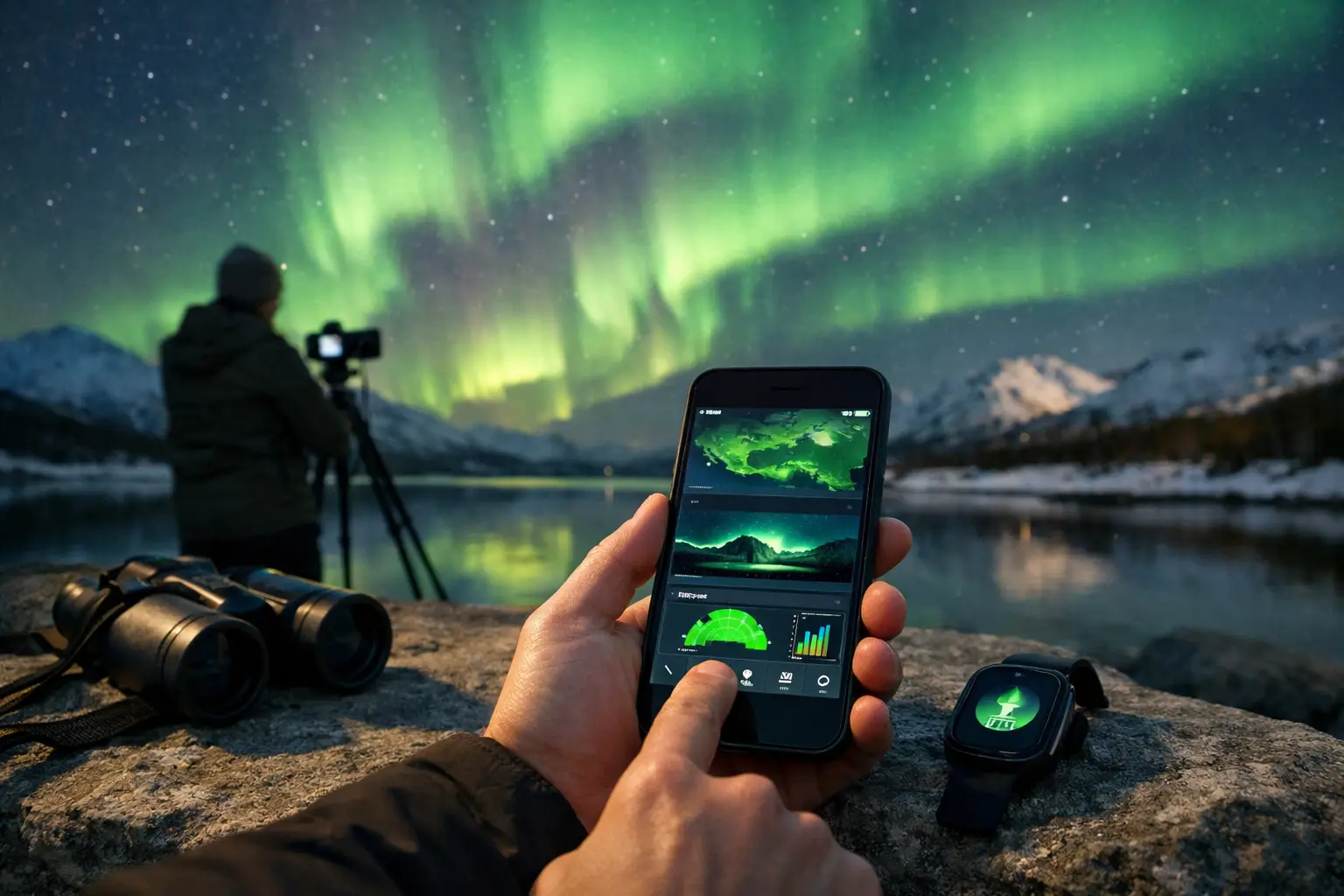
The northern lights do not wait for a convenient bedtime. During the G5 geomagnetic storm of May 10-11, 2024, aurora reached far beyond its usual zone and became visible as far south as Florida and Texas. The best aurora alert apps turn that kind of fast-moving space-weather event into an actionable signal: your phone tells you when solar activity, local visibility, and darkness line up.
| App or service | Key live signal | Best alert use | Platform |
|---|---|---|---|
| My Aurora Forecast & Alerts | KP index (0-9), oval maps | Location-based threshold alerts | iOS, Android |
| SpaceWeatherLive | Solar wind speed (km/s), IMF data | Reading the cause behind a forecast | iOS, Android |
| Hello Aurora | Aurora probability, cloud cover | Simple trip-ready notifications | iOS, Android |
| Aurora Alerts | Local forecast and KP level (0-9) | Low-friction nightly monitoring | Availability varies by device |
| NOAA Space Weather alerts | Geomagnetic storm scale G1-G5 | Official storm context and watches | Mobile web, notifications |
What makes an aurora alert worth acting on?
A high KP number alone is not a launch command. KP is a three-hour planetary index running from 0 to 9, built from magnetic observations around the world. It is useful for measuring broad geomagnetic disturbance, but it can lag the sharp changes that make an aurora suddenly brighten overhead.
For the continental United States, a KP of 5 can put aurora within reach near the northern tier under dark, clear skies. Viewers in northern Minnesota, North Dakota, Montana, and much of Maine may have a realistic horizon glow at that level. In more southerly locations, the required activity rises quickly. A KP of 7 or 8 may be needed before observers near the latitude of Chicago, Des Moines, or Portland, Oregon have a serious chance – and even then, the light may remain low in the northern sky.
The stronger apps combine the longer forecast with near-real-time solar-wind measurements. Watch three figures: solar-wind speed in kilometers per second, density in particles per cubic centimeter, and the interplanetary magnetic field, especially its north-south Bz component in nanoteslas. A sustained negative Bz, often below -10 nT, allows energy from the solar wind to couple more efficiently into Earth’s magnetic field. If speed is above roughly 600 km/s and Bz is strongly southward, conditions can improve far faster than a basic daily forecast suggests.
Cloud cover is the final gatekeeper. A 90% aurora probability above a solid cloud deck produces exactly zero photons at your camera. That is why the most useful alert is not simply “KP 6 expected.” It is “conditions are active, it is dark at your coordinates, and there is a break in the clouds worth using.”
The best aurora alert apps for different observers
My Aurora Forecast & Alerts: the all-around choice
For most first-time aurora chasers, My Aurora Forecast & Alerts is the best starting point. It puts the KP forecast, auroral oval, solar-wind conditions, and location-based notification settings in one consumer-friendly dashboard. The oval map is especially helpful because it shifts the question from “Is the KP high?” to “How close is the visible aurora zone to me?”
Set alerts conservatively at first. Someone in Fairbanks, Alaska, can reasonably want a lower alert threshold than an observer in Minneapolis. If your alerts fire every night and nothing appears, notification fatigue wins. Start with a threshold that matches your latitude, then adjust after a few sessions.
Its trade-off is that a dashboard with many indices can make a beginner feel as if every color change is urgent. It is not. Treat it as a mission display, then check darkness and clouds before driving 30 miles out of town.
SpaceWeatherLive: the best control room for data-minded users
SpaceWeatherLive is built for observers who want to see the live physics behind an alert. Solar-wind speed, density, magnetic-field direction, and geomagnetic indices give you a clearer view of whether an incoming disturbance is strengthening or fading.
This is particularly useful during a coronal mass ejection arrival. Forecast models can estimate an arrival window, but the actual impact at Earth may vary by hours. Once spacecraft upstream from Earth detect changing solar-wind conditions, the practical warning window can be only about 15 to 60 minutes. That is not much time to decide whether to grab a tripod, so a live-data display has real value.
The trade-off is interpretation. A red chart is not a promise of visible aurora at your house. Pair the data with an auroral oval and a local cloud forecast, especially if you are outside the high-latitude zone.
Hello Aurora: the best choice for a simple field decision
Hello Aurora is designed around a question observers ask repeatedly: should I go outside now? Its emphasis on local probability, cloud conditions, and notifications makes it practical for travelers, families, and anyone who would rather photograph the sky than parse magnetometer charts.
That simplicity matters on a cold night. From a city, even a minor drive of 10 to 20 miles can produce a substantial improvement if it takes you away from direct lighting and toward an open northern horizon. An app that brings cloud and location information forward helps you make that call without switching between multiple screens.
Use its probability display as a planning tool, not a certainty meter. Aurora can appear in short substorm bursts, and a forecast based on regional conditions cannot account for every local obstruction, hill, or bright parking lot.
Aurora Alerts: the focused notification option
Aurora Alerts is a useful pick for people who primarily want an alarm rather than a space-weather lesson. A focused app can be ideal if your goal is to receive a prompt at a chosen KP level and then make a quick decision from there.
Before relying on any notification-only option, confirm that it supports your device and that its alert location is set precisely. A 100-mile difference in assumed location matters near the southern edge of visibility. Also check whether alerts use a forecast KP value, current observed KP, or a modeled local aurora probability. Those are different signals with different timing.
NOAA space-weather alerts: the official reality check
NOAA’s G-scale puts geomagnetic storm conditions into a standardized frame: G1 is minor, G2 moderate, G3 strong, G4 severe, and G5 extreme. When a G4 or G5 watch is issued, it is a strong reason for US observers well south of the normal aurora belt to prepare, but it still is not a guarantee for any single state or hour.
Official alerts are best used alongside a consumer aurora app, not in place of one. They provide the event context: a coronal hole stream, a solar flare, or a CME could be driving activity. Your alert app handles the personal question of whether your local sky might deliver.
Set your phone up before the next solar storm
Configure alerts at home, not after the sky turns green. Allow location access, choose a meaningful notification threshold, and disable battery restrictions that can delay background alerts. Then test the entire chain on an ordinary night: notification arrives, your weather layer loads, and you know where you would go for an unobstructed northern view.
For a camera-ready setup, aim for a site with a clear horizon and minimal lighting. In much of the Lower 48, the aurora may sit only 5 to 20 degrees above the northern horizon during moderate activity. A tree line, a house, or the glow from a shopping center can erase it. Use a night-mode phone camera or a tripod-mounted camera to reveal faint structure, but keep looking with your eyes too. Stronger displays can expand overhead in minutes.
Read alerts like a skywatcher, not a scoreboard
The winning setup is usually two layers: one app that tells you the chance is rising near your location, and another source that shows whether solar-wind conditions are actually arriving. Add a cloud forecast and you have a compact personal aurora command center.
No app can schedule the northern lights. But when the next geomagnetic surge reaches Earth, the right alert can replace a missed opportunity with a coat, a dark horizon, and a front-row seat to a planet-sized light show.