
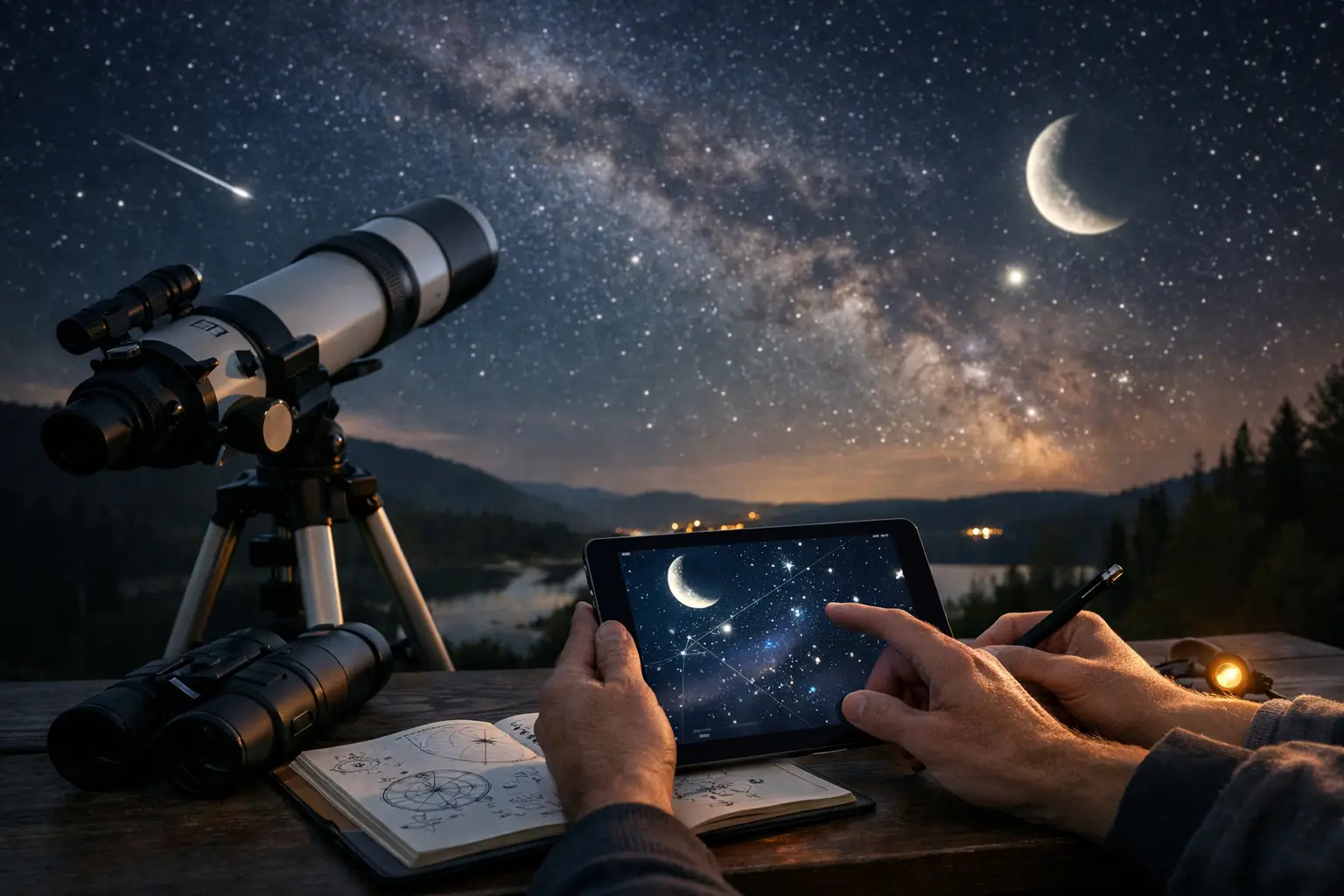
A meteor shower can be active for weeks, yet the best viewing window may last only a few dark hours. An ISS pass can be over in 6 minutes. That is why a night sky event tracker needs to do more than announce that something is happening – it must tell you exactly when to look, where to face, how high the target will climb, and whether the sky at your location gives you a realistic shot.
| 2026 sky event | Peak date (UTC) | Typical peak rate | Best viewing window |
|---|---|---|---|
| Orionid meteor shower | October 21-22 | About 20 meteors/hour (ZHR) | After midnight to dawn |
| Leonid meteor shower | November 17-18 | About 15 meteors/hour (ZHR) | After midnight to dawn |
| Geminid meteor shower | December 13-14 | Up to 120 meteors/hour (ZHR) | 9 p.m. local time to dawn |
The key term in that table is ZHR, or zenithal hourly rate. It assumes a perfectly dark sky, a radiant directly overhead, and an observer watching continuously. Most suburban observers will see far fewer meteors. A tracker that combines the shower peak with moon phase, radiant altitude, and local darkness turns a headline number into a plan you can actually use.
What a night sky event tracker should show
The first job is local timing. Sky events are not just tied to a date. They are tied to your latitude, longitude, elevation, horizon, and time zone. A planetary conjunction may be visible across the United States, but it can sit only 8 degrees above the western horizon in Seattle while appearing 22 degrees high in Miami. Those are very different viewing experiences.
A useful tracker should give every event four immediate answers: local date and time, compass direction, altitude above the horizon, and visibility conditions. Altitude matters more than many first-time observers expect. An object at 10 degrees is low enough to be blocked by houses, trees, hills, and haze. At 30 degrees it is generally clear of most neighborhood obstructions. Above 45 degrees, you are in prime viewing territory.
Direction should be expressed both as a familiar label – northwest, east-southeast, and so on – and as an azimuth in degrees. Azimuth begins at 0 degrees for north, 90 degrees for east, 180 degrees for south, and 270 degrees for west. That number is especially useful when you are planning around a building, mountain ridge, or a narrow gap between trees.
Darkness deserves equal billing. Civil twilight ends when the Sun is 6 degrees below the horizon, nautical twilight at 12 degrees, and astronomical twilight at 18 degrees. Bright planets, the Moon, and the International Space Station can be visible before astronomical darkness. Faint meteors, the Milky Way, and dim deep-sky targets benefit enormously from waiting until the Sun reaches -18 degrees.
Set your location before you trust the countdown
A live sky tracker is only as good as the observing location behind it. Allow location access if you are using it from the field, or enter your city and verify the time zone manually. This is not a cosmetic setting.
For most meteor showers, a location within a few miles is plenty accurate. For satellite passes and eclipse planning, precision matters more. The ISS orbits roughly 370 to 420 km above Earth and travels at about 27,600 km/h. Its ground track shifts quickly, so a pass that reaches 65 degrees above the horizon for one observer may peak below 30 degrees for someone 100 km away.
For solar eclipses, the stakes are higher. The path of totality can be only around 100 to 200 km wide, depending on the eclipse. A tracker should distinguish between partial visibility, totality, and the exact duration of totality at your selected location. A viewing site just outside the path may still see the Moon cover most of the Sun, but it will not experience the sudden darkness and visible solar corona that define totality.
Check your horizon too. A mathematically visible event may not be physically visible from your backyard. If the tracker calls for an object at azimuth 285 degrees and altitude 12 degrees, walk outside before event night. If a roofline fills that section of sky, choose a different site.
Track the event type, not just the object
Different celestial events demand different settings. Treating all of them as a generic notification is how people miss the good part.
Meteor showers
For meteor showers, track the predicted peak, the Moon’s illumination, the radiant altitude, and the start of astronomical darkness. The radiant is the point in the sky from which meteors appear to originate, but do not stare directly at it. Meteors near the radiant have short trails. Look roughly 40 to 60 degrees away for longer, more dramatic streaks.
The Geminids are particularly tracker-friendly because they often produce activity before midnight. The Orionids and Leonids generally improve after midnight as your location rotates into Earth’s direction of travel. Give your eyes 20 to 30 minutes to dark-adapt, keep your phone screen dim and red if possible, and plan for at least 60 minutes outside. A five-minute glance rarely captures the real rhythm of a shower.
ISS and bright satellite passes
For the ISS, prioritize maximum altitude, first visibility time, disappearance time, and direction of travel. A pass that climbs above 40 degrees is usually worth stepping outside for. One peaking above 70 degrees can cross a huge section of the sky and feel spectacular even from a bright city.
The station typically appears as a steady, fast-moving point of light rather than a blinking aircraft. It can cross the sky in roughly 3 to 7 minutes. A tracker should also tell you whether the ISS enters Earth’s shadow before reaching the horizon. That explains the classic moment when a bright moving light simply fades out mid-sky.
Starlink groups require a different expectation. Newly deployed satellites can sometimes appear as a compact train, but the formation changes rapidly as satellites raise orbit and spread apart. Older operational satellites may be visible individually, usually at lower brightness. Track the local pass rather than relying on a viral video or an old prediction.
Planets, conjunctions, and the Moon
Planets reward a tracker that emphasizes altitude and solar separation. Venus may be brilliant, but if it is only 5 degrees above the horizon in bright twilight, you need an open western or eastern view and a precise time. Jupiter and Saturn are easier to locate when they are 20 degrees or more above the horizon, but atmospheric turbulence is still stronger low in the sky.
For a conjunction, the angular separation is the number to watch. A separation of 1 degree is about twice the apparent width of the full Moon, which spans roughly 0.5 degree. At 0.5 degree or less, two bright objects can fit together in the same binocular field. Binoculars should never be used anywhere near the Sun, including during a daytime conjunction.
Use forecasts as a launch criterion
A precise sky prediction cannot beat solid cloud cover. Before committing to a drive, check cloud percentage by hour, not just the daily weather icon. For casual viewing, cloud cover below 30% is a promising starting point. For meteor showers or eclipse photography, 10% or less is far better because even scattered clouds can erase the best moments.
Transparency and humidity matter too. A humid night can make a low planet or satellite pass look weak even under nominally clear skies. Wind can also turn telescope work into a frustrating mission, while it barely affects naked-eye meteor watching. Match the forecast to the event you are chasing.
Build a repeatable observation routine
The best night sky event tracker becomes a personal mission console when you use it before, during, and after an event. Start by saving your primary observing location and one backup site with a clearer horizon. Set alerts early enough to pack gear and get outside – 20 minutes ahead for an ISS pass, 45 minutes for a conjunction at twilight, and at least an hour for a major meteor-shower session.
Then verify the target in the live sky view rather than trusting the notification alone. Conditions change, clocks get misread, and a location pin can be wrong. For family viewing, that final check prevents the familiar scramble of asking everyone to look in the wrong direction.
SpaceInformer is built for that moment when the countdown reaches zero and the sky becomes the screen. Keep your next target saved, check the altitude and weather, and be outside before the event begins. The universe does not wait for a second notification.