
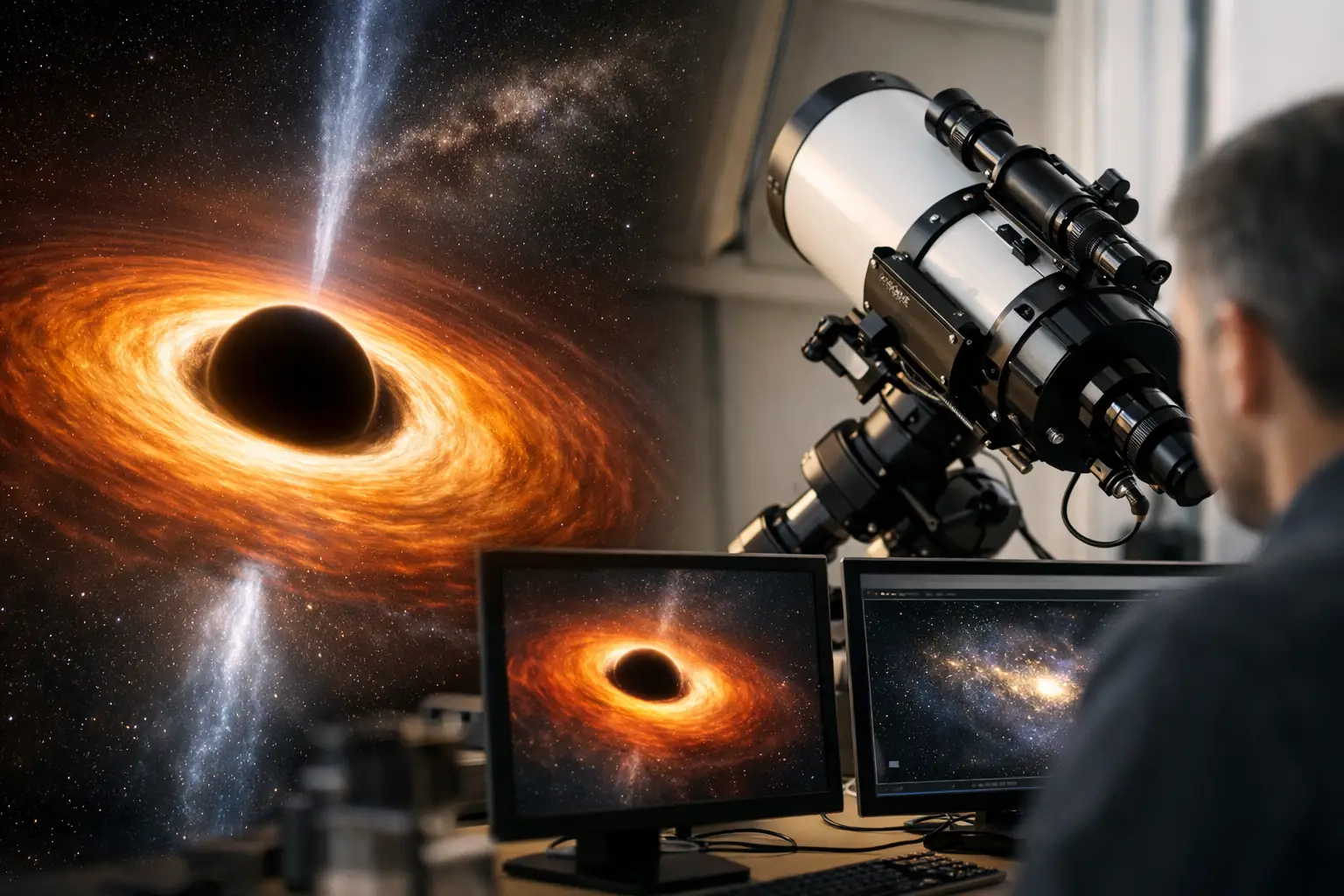
Black holes are not cosmic vacuum cleaners lurking in the dark. They are regions where gravity has compressed matter so intensely that, past a boundary called the event horizon, not even light can return. We cannot photograph a black hole itself, but the universe gives us unmistakable evidence: stars racing around invisible mass, superheated gas blazing in X-rays, and ripples in spacetime arriving at Earth.
| Target | Distance from Earth | Mass | Key observation |
|---|---|---|---|
| Sagittarius A | 26,700 light-years | 4.0 million Suns | First Event Horizon Telescope image released May 12, 2022 |
| M87 | 55 million light-years | 6.5 billion Suns | First black hole image released April 10, 2019 |
| GW150914 merger | About 1.4 billion light-years | 36 and 29 Suns before merger | First detected gravitational-wave signal, September 14, 2015 |
What Black Holes Actually Are
A black hole forms when enough mass occupies a small enough volume for its escape velocity to exceed the speed of light, 299,792 kilometers per second. The event horizon is the point of no return around it. For a non-spinning black hole with the mass of the Sun, that horizon would be only about 3 kilometers in radius. Replace the Sun with a black hole of the same mass and Earth would continue orbiting at roughly 29.8 km/s. The danger comes from getting very close, not from gravity magically reaching farther than normal.
Most known black holes fall into two useful categories. Stellar-mass black holes form after massive stars collapse and typically range from a few to tens of solar masses. Supermassive black holes, found in the centers of large galaxies, contain millions to billions of solar masses. Sagittarius A, the black hole at the Milky Way’s center, has a mass near 4 million Suns. M87, at the center of the Virgo Cluster galaxy M87, is about 1,600 times more massive.
Astronomers also expect intermediate-mass black holes, between roughly 100 and 100,000 solar masses. The evidence is growing, especially from gravitational-wave observations, but this category remains harder to map than its smaller and giant cousins.
The Black Holes We Know Through Motion
The cleanest evidence is orbital motion. At the center of our galaxy, astronomers have tracked stars circling an invisible object for decades. One standout is S2, a star that completes an orbit around Sagittarius A* every 16 years. At its closest approach in 2018, S2 passed within about 120 astronomical units of the galactic center – roughly three times Neptune’s average distance from the Sun – while moving at nearly 7,650 km/s.
That is mission-control-grade evidence. The mass required to drive those speeds, packed into such a tiny region, is about 4 million Suns. Alternative explanations struggle to survive the measurements. The 2020 Nobel Prize in Physics recognized this work on the compact object at the Milky Way’s center.
Black holes in binary systems announce themselves differently. If one partner is a normal star, its gas can spiral toward the black hole. Friction and compression heat that material to millions of degrees before it crosses the event horizon, creating intense X-ray emissions. The black hole stays dark; its feeding zone lights up.
The Image That Changed Public Astronomy
On April 10, 2019, the Event Horizon Telescope released the first image of a black hole’s shadow: M87*. The orange ring was not the event horizon. It was glowing plasma bent by extreme gravity around a central dark shadow. The image was built from radio observations collected in April 2017 by a planet-scale network of telescopes operating at a wavelength of 1.3 millimeters.
Why did astronomers need an Earth-sized virtual telescope? M87* is immense, yet it is 55 million light-years away. Its shadow appears in our sky at roughly 40 microarcseconds. That is comparable to resolving an orange on the Moon from Earth.
Sagittarius A followed on May 12, 2022. It is far closer than M87, but imaging it is not easier. Gas circles Sagittarius A* in minutes, rather than days or weeks, so the target changes while the observations are being collected. The resulting image still showed the predicted ring-and-shadow structure around our galaxy’s central black hole.
When Black Holes Collide, Earth Can Listen
Some black holes reveal themselves without producing light at all. On September 14, 2015, the LIGO detectors recorded GW150914, a signal generated when black holes of about 36 and 29 solar masses merged. The event occurred roughly 1.4 billion light-years away. In a fraction of a second, the merger converted about three solar masses into gravitational-wave energy.
The final black hole had a mass of about 62 Suns, with the difference carried away as ripples in spacetime. By the time the signal reached Earth, it shifted LIGO’s 4-kilometer detector arms by far less than the width of a proton. Yet the pattern matched Einstein’s predictions with extraordinary precision.
This changed the black-hole watch. Optical telescopes are still vital, but gravitational-wave observatories can detect mergers in systems that may be completely dark. Future missions will expand that reach. The European Space Agency’s LISA mission, planned for the mid-2030s, is designed to detect lower-frequency waves from massive black hole mergers and compact binaries across the universe.
Can You See a Black Hole From Your Backyard?
Not directly. No amateur telescope can resolve the event horizon of Sagittarius A or M87. Even the largest professional observatories need global coordination to create an image at that scale. But black holes are still part of an active observing plan.
The most accessible route is to watch the sky regions and companion objects connected to them. Sagittarius A* lies in the direction of Sagittarius, near the crowded Milky Way core. From much of the continental United States, that area is best placed on summer evenings, though the black hole itself is hidden behind dust and distance. X-ray binaries and variable stars associated with compact objects are better targets for data monitoring than visual observing.
For a live experience, gravitational-wave alerts and major Event Horizon Telescope releases are the moments to track. They turn a phenomenon that cannot be seen with the eye into a time-stamped cosmic event. Sky tools are especially useful for locating the Milky Way’s galactic-center direction, checking whether it is above your horizon, and connecting a headline-grabbing discovery to a real patch of sky.
What Happens Near the Event Horizon?
A black hole does not pull everything in from across the galaxy. At a safe distance, gravity follows the same rules as any object with the same mass. The dramatic physics begins near the event horizon, where tidal forces can become extreme. Gravity pulls more strongly on the near side of an object than the far side, stretching it in a process popularly called spaghettification.
For a stellar-mass black hole, those tidal forces could be fatal well before an astronaut reached the horizon. A supermassive black hole has a much larger horizon, so the gradient at the boundary can be gentler. That does not make it a viable destination. Radiation from hot infalling gas, high-energy particles, and the practical challenge of escaping make an active black-hole environment one of the least hospitable places imaginable.
The biggest unanswered question is what happens at the central singularity predicted by general relativity. Physics can describe the event horizon and the motion of matter outside it extremely well. At the center, where density and curvature are predicted to become infinite, general relativity and quantum physics have not yet been fully reconciled.
Black holes are not distant sci-fi props. They are measurable engines of gravity, light, motion, and spacetime itself. The next time a gravitational-wave alert arrives or the summer Milky Way rises, look toward the data as well as the sky: some of the universe’s darkest objects are producing its clearest signals.