
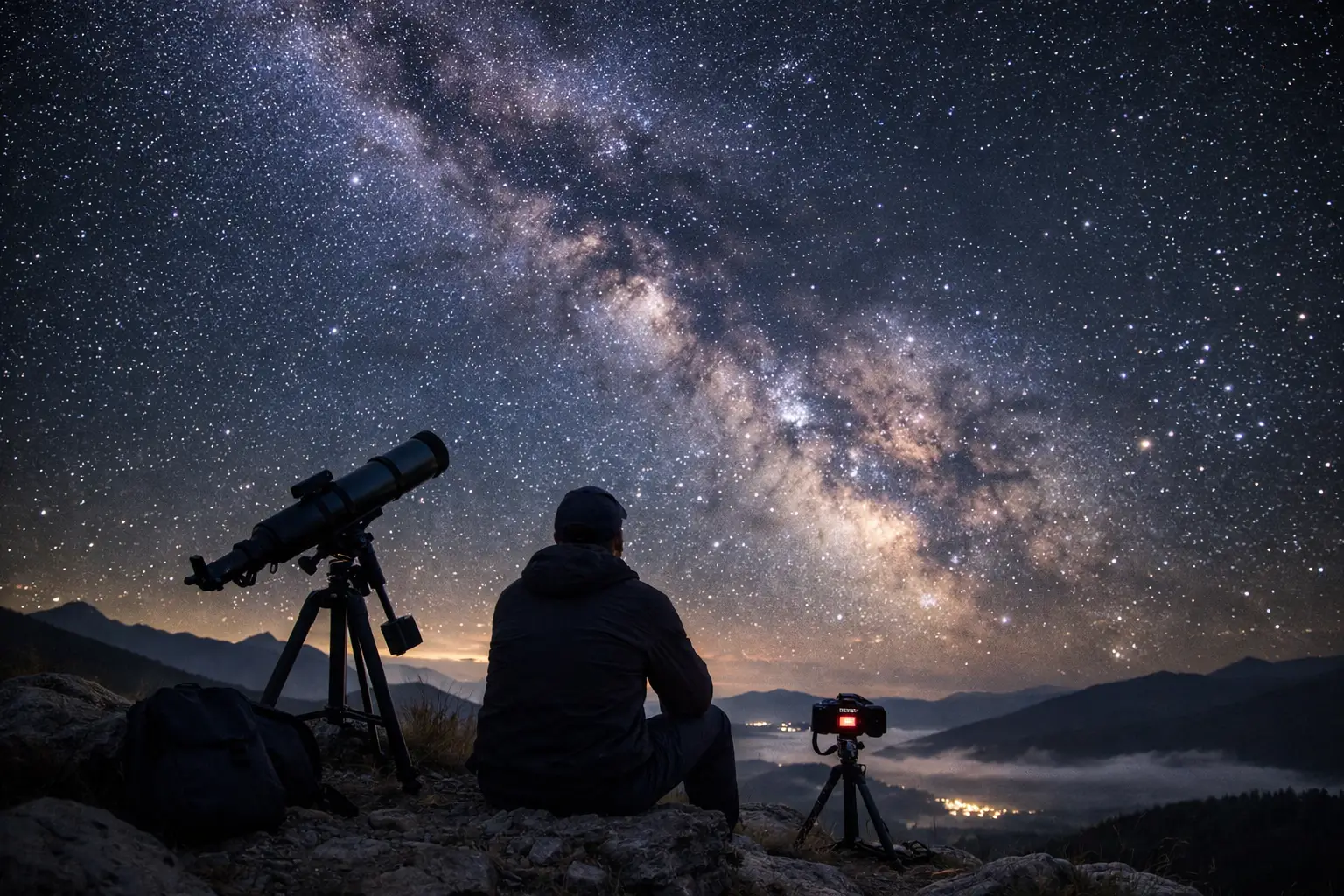
The Milky Way is always overhead, but its brightest and most photographed region does not appear on command. For U.S. observers, a successful night comes down to a live combination of season, latitude, moonlight, twilight, and sky brightness. Get those five variables right and the galaxy can become a structured river of stars, dark dust lanes, and glowing clouds stretching across the sky.
| Observer latitude (° N) | Galactic center peak altitude (°) | What that means from the U.S. |
|---|---|---|
| 25° N | 36° | High enough for a strong, long core-season view |
| 30° N | 31° | Excellent southern states viewing |
| 35° N | 26° | A clear south horizon becomes crucial |
| 40° N | 21° | Visible, but low and more affected by haze |
| 45° N | 16° | A narrow target for dark, transparent nights |
What You Are Seeing in the Milky Way
The pale band visible to the unaided eye is our inside view of a disk-shaped galaxy. Instead of looking at a distant object, you are looking through billions of stars distributed along the plane of the Milky Way. The broadest, brightest section is toward the galactic center, located roughly 26,000 light-years away in the direction of Sagittarius. The galaxy itself spans about 100,000 light-years in diameter.
That center is not a single bright dot. It is a crowded star field partly hidden by interstellar dust. Under a genuinely dark sky, the dust produces dramatic dark channels, especially the Great Rift running through Cygnus and Aquila. In long-exposure images, colorful nebulae dominate. To the naked eye, expect subtler gray-white structure. That distinction matters: a camera can reveal light your eyes cannot collect in a few seconds.
The galactic center sits near declination -29°. That one number explains why Texas, Florida, Arizona, southern California, and Hawaii have an advantage over northern states. At 40° N, the center only reaches about 21° above the southern horizon. At 30° N, it climbs to about 31°, placing more of the core above the thick, light-polluted air near the horizon.
When to Track the Milky Way Core
The full Milky Way band is available during every season, but the high-impact core season in the continental U.S. generally runs from late February through late October. The best balance of darkness, altitude, and comfortable overnight weather usually falls between May and August.
In late spring, the core rises before dawn. By early summer, it is available for much more of the night. Around June 21, 2026, the galactic center reaches its highest point at roughly 12:30 a.m. local daylight time for many locations near 35° N to 40° N. Around July 21, it peaks closer to 10:30 p.m. local daylight time. Exact clock times can shift by 30 to 60 minutes depending on longitude within a time zone and daylight saving time.
The key threshold is astronomical darkness, which begins when the Sun is 18° below the horizon. Civil twilight may feel dark enough to walk around, but it is not dark enough for a strong Milky Way view. In June at northern U.S. latitudes, astronomical darkness can be short. Near 47° N, it may last only a few hours around the solstice. Farther south, the usable window is longer.
Moonlight Is Your Primary Launch Constraint
A moonless sky beats almost every other planning variable. Aim for the five nights centered on a new moon, or schedule your session when the Moon has set before the core rises. A Moon illuminated beyond roughly 30% can noticeably reduce contrast, particularly at urban-fringe locations.
Moon position matters as much as illumination. A 15%-lit crescent low in the west may have little impact if your target is high in the south. A 15%-lit Moon near the Milky Way band can still flatten the view. Your observing plan should show moonset time, lunar illumination, astronomical twilight, and the galactic center altitude together. Treat it like a four-signal launch window rather than a single calendar date.
Where the View Changes From Faint to Fantastic
For visual observing, dark-sky quality is usually the deciding factor. The Bortle scale runs from Class 1, an exceptionally dark natural sky, to Class 9, a bright inner-city sky. The Milky Way can be obvious from Bortle 3 or 4 sites. At Bortle 5, it may still appear, but its dark lanes lose definition. At Bortle 6 and brighter, the core often becomes difficult or invisible to the naked eye even on clear nights.
A useful technical benchmark is sky brightness. A pristine night can measure near 21.5 magnitudes per square arcsecond. Many bright suburban skies sit near 19 to 20 magnitudes per square arcsecond. That numerical difference sounds small, but the magnitude scale is logarithmic, so the visual penalty is major.
Do not choose a site only by its Bortle rating. At mid-northern latitudes, you need an open southern horizon. A ridge, forest line, casino glow, or distant city sitting 10° to 15° above the horizon can erase the very part of the sky you traveled to see. Humidity and airborne haze also matter more when the core is low. Desert locations often perform well because their transparency is excellent, but high-elevation mountain sites can be cold and windy even in summer.
How to Find It Without Guesswork
Start facing south on a dark May through August night. Look for Sagittarius and Scorpius, low to moderately high above the horizon depending on your latitude. Sagittarius has a compact star pattern often called the Teapot. The galaxy’s brightest core rises above that pattern, while Scorpius curves along one side of the field.
Give your eyes 20 to 30 minutes to adapt. Keep phone screens dim and red if possible, and avoid looking at vehicle headlights or white flashlights. Your eyes will not reach their full dark sensitivity if you repeatedly reset them with bright light.
A sky simulator is especially useful because the apparent angle changes throughout the night. It can show whether the core will be 12° above a tree line at 10:00 p.m. or 25° above it at 1:00 a.m. That difference determines whether a quick outing is worthwhile. SpaceInformer-style live sky planning turns this into a location-specific decision instead of a hopeful drive into the dark.
Photographing the Galaxy: Start With a Reliable Baseline
Use a tripod, a wide lens, and manual focus. For a full-frame camera, a 14 mm to 24 mm lens with an aperture of f/1.4 to f/2.8 is a practical range. Begin with a 10- to 15-second exposure, ISO 3200, and the widest available aperture. On an APS-C camera, shorten the exposure to roughly 8 to 12 seconds to limit star trailing.
Focus manually on a bright star using magnified live view. Infinity marks on lenses are often slightly inaccurate, and a soft image cannot be rescued later. Take a test frame, zoom into the stars, and refine. If the sky is bright, lowering ISO may protect highlights, but it will not recreate contrast lost to city glow. The better fix is a darker site or a moonless window.
Foreground compositions are powerful, but they add trade-offs. A canyon, barn, or coastline gives scale, while a clear south-facing overlook gives the core room to rise. If you want both, arrive before sunset, set your composition in daylight, and remain after astronomical darkness begins.
The next clear, moonless core-season night is not just another weather forecast. It is a chance to stand inside the galaxy’s disk, watch its structure emerge overhead, and turn a precise set of sky data into a real-world view you will remember.