
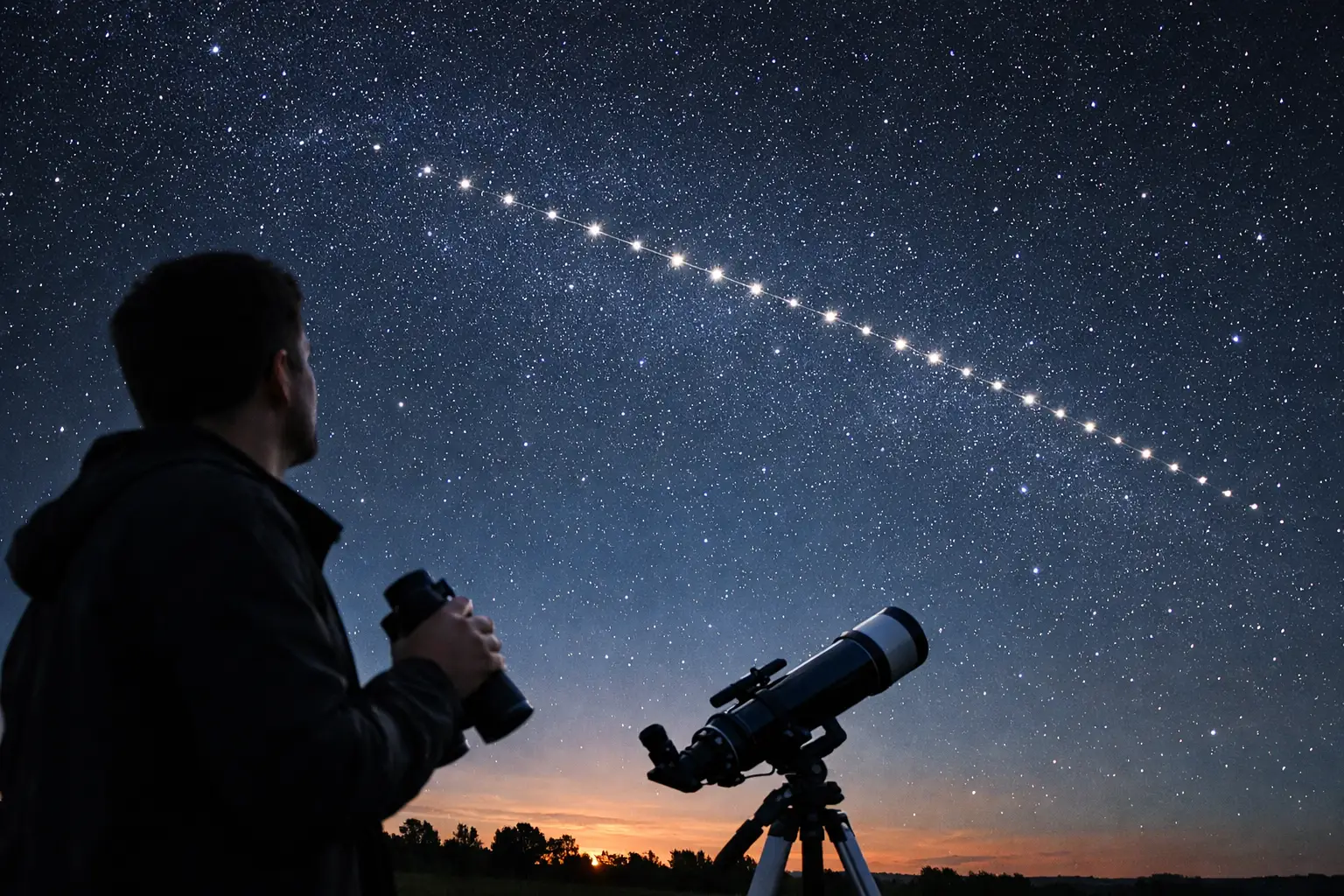
If you have ever stepped outside just after sunset and caught a string of bright points gliding silently across the sky, you already know why people search for how to see Starlink satellites. The trick is not luck. It is timing, sun angle, and knowing where in the sky a pass will peak. Starlink satellites orbit low enough to reflect sunlight when your ground location is already in darkness, which creates that brief, unmistakable moving-light effect.
| Observation factor | Typical value | Why it matters |
|---|---|---|
| Orbital altitude | About 530 to 570 km | Low Earth orbit keeps them bright enough to spot during favorable passes |
| Orbital speed | About 27,000 km/h | They cross the visible sky quickly, often in 2 to 6 minutes |
| Best viewing window | 30 to 90 minutes after sunset or before sunrise | The satellites remain sunlit while your sky is dark enough for contrast |
| Good pass elevation | 40 degrees to 90 degrees | Higher passes are brighter and easier to track above haze and buildings |
How to see Starlink satellites at the right time
The biggest mistake is going outside too late. Once the satellite drops into Earth’s shadow, it fades out fast, even if it is still above your horizon. For most US locations, your best shot comes within about 1 hour after local sunset or in the final hour before sunrise.
That timing works because of geometry. You are standing in twilight or darkness, but a satellite 550 km overhead can still be in direct sunlight. If the Sun is too high, the sky is too bright. If the Sun is too far below the horizon, the satellite goes dark. That narrow middle zone is where Starlink becomes visible.
A strong pass usually lasts 3 to 5 minutes. Lower passes can be closer to 1 or 2 minutes, especially if the object appears low in the west and disappears before reaching mid-sky. When a pass peaks above 60 degrees elevation, visibility improves sharply because you are looking through less atmosphere.
What Starlink satellites actually look like
Most of the time, a Starlink satellite does not look like a train. It looks like one steady white point moving at aircraft-like speed but without blinking lights, engine noise, or directional changes. Brightness can range from roughly magnitude 2 to magnitude 5 during a visible pass, depending on altitude, orientation, and your viewing conditions.
The famous “satellite train” is usually a post-launch effect. After launch, a group of newly deployed satellites can travel in a closely spaced line before they spread into operational positions. That train can be visible for several days, sometimes up to a few weeks, but it becomes less dramatic quickly as the satellites separate.
If you are watching months after a launch, expect isolated satellites or looser clusters rather than a perfect line. That is normal, not a failed sighting.
Where to look in the sky
For US observers, many visible Starlink passes begin low in the west or northwest after sunset and move toward the south, east, or northeast. Before sunrise, the pattern often reverses. But there is no fixed compass rule that works every night because orbital tracks shift with your latitude and the current satellite path.
This is where live pass data matters. A useful prediction will give you the start azimuth, maximum elevation, and end azimuth, along with local time down to the minute or even the second. If a pass starts at 21:14:30 local time in the northwest at 18 degrees elevation and peaks at 21:16:10 at 67 degrees, you want to be outside and adjusted by 21:12, not walking out the door at 21:15.
| Pass metric | What to look for | Best target |
|---|---|---|
| Maximum elevation | Highest point above the horizon | Above 40 degrees |
| Brightness | Predicted visual magnitude | Magnitude 3 or brighter |
| Start direction | Compass bearing at appearance | Open horizon, low obstructions |
| Peak time | Brightest and highest moment | Be ready 2 to 3 minutes early |
Weather, light pollution, and the visibility trade-off
Clear skies beat dark skies for this target. Unlike faint nebulae or galaxies, Starlink satellites can be seen from suburbs and even cities if the pass is bright and high enough. A magnitude 2 object on a 70-degree pass can cut through moderate urban light pollution without much trouble.
Thin clouds are the bigger issue. High haze can erase a marginal pass completely. Humidity near the horizon does the same thing, which is why a 15-degree pass that looks promising on paper may disappoint in summer conditions.
So if you have two viewing options, pick the site with the clearest western or northwestern horizon after sunset, even if it is not your darkest location. For this kind of event, openness often matters more than total darkness.
Do you need binoculars or a telescope?
No. The best way to start is with your eyes only. Starlink satellites move too quickly for most beginners to track comfortably in a telescope, and binoculars can narrow your field so much that you miss the pass while searching.
Binoculars become useful after you have the timing down. A 7×50 or 10×50 pair can help on dimmer passes around magnitude 4 or 5, especially in brighter suburban skies. Telescopes are more specialized and better for experienced observers who already know the exact path and want a close-up challenge.
For families and first-time watchers, naked-eye viewing is the win. You want fast setup, a wide field, and zero friction when the satellite appears.
How post-launch Starlink train sightings work
Right after a launch, Starlink satellites are often inserted into a lower parking orbit before climbing toward their operational altitude. During that early phase, they can remain grouped closely enough to create the train effect people share online.
Those early trains usually orbit at a few hundred kilometers altitude before orbital raising. As spacing increases, the line stretches out and brightness can change from pass to pass. The strongest train sightings often happen 1 to 5 days after launch, but there is no guarantee for every US city because visibility still depends on local twilight, cloud cover, and whether the train passes through sunlight while you are in darkness.
If you are specifically hoping for a train, look for a recent launch date first. Then focus on the next few evenings or mornings rather than waiting weeks.
A practical plan for tonight
If you want results, keep it simple. Check your location-based pass times this afternoon. Prioritize passes with at least 40 degrees maximum elevation and a predicted magnitude near 3 or brighter. Arrive outside 10 minutes early, face the starting direction, and let your eyes adjust for at least 3 minutes without staring at your phone.
A real-world example is useful. Suppose your tracker shows a pass at 8:47 PM local time, starting WNW at 22 degrees, peaking at 8:49 PM at 63 degrees, and ending ENE at 24 degrees. That is a very workable event. You should be in position by 8:40 PM, watching the WNW horizon by 8:46 PM, then tracking upward as the object climbs.
If the pass only peaks at 18 degrees and the magnitude is around 5, expectations should be lower. You may still catch it from a dark rural site, but a city backyard with trees and porch lights is a harder environment.
Common reasons people miss them
Most misses come down to one of four things: bad timing, looking in the wrong direction, expecting a dramatic train when the satellites are already dispersed, or confusing aircraft with satellites. Aircraft blink and often change brightness irregularly. Starlink satellites usually move on a straight, smooth path with steady light until they dim suddenly as they enter shadow.
Another issue is inaccurate local conversion. Pass predictions can be listed in local time or UTC. If a forecast says 02:13 UTC, that is not the same clock time for New York, Chicago, Denver, or Los Angeles. Always confirm the time zone before heading out.
For people who want a cleaner workflow, SpaceInformer-style live pass tools solve most of this by translating orbital data into local sky paths you can use immediately.
When your odds are best
Your odds are strongest on clear evenings in the 30 to 90 minutes after sunset, with a high pass and an unobstructed horizon. They also rise right after a fresh Starlink launch, when grouped satellites are more likely to create an attention-grabbing sequence. But even outside launch week, single-satellite sightings are common enough to make this an easy skywatching habit.
Give yourself one good pass, one clear horizon, and a few minutes of patience. The moment that bright point appears and crosses overhead, space stops feeling distant and starts feeling live.