
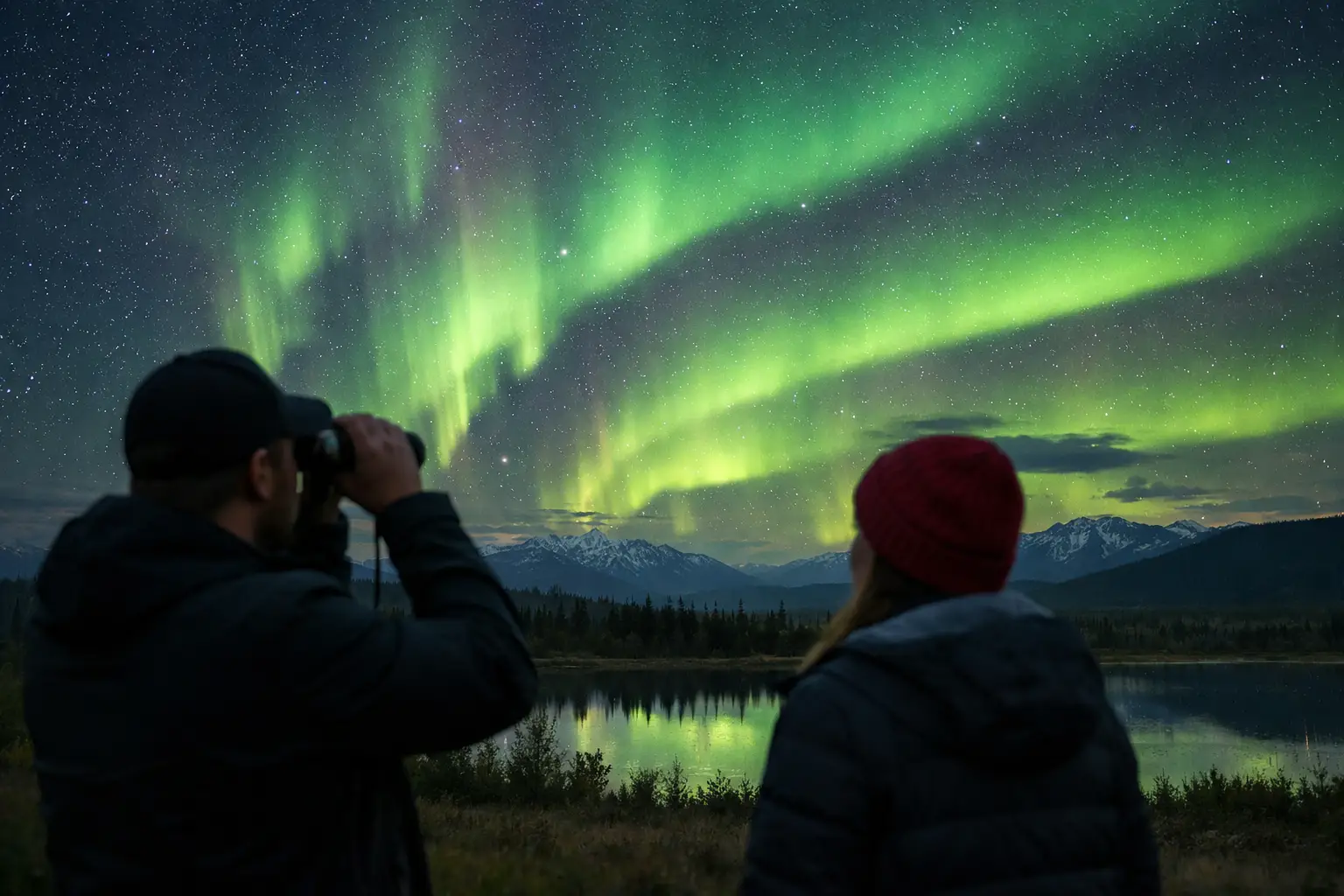
If you’re checking the aurora forecast tonight USA, the first question is not just whether geomagnetic activity is up. It is whether that activity lines up with darkness, clear skies, and your latitude at the same time. Aurora nights are won or lost on timing. A Kp 5 storm at 3:00 PM local time does nothing for most US observers. A Kp 5 spike between 10:00 PM and 2:00 AM can turn into a real chase night.
| Forecast factor | Useful range | Units | What it means for US viewing |
|---|---|---|---|
| Kp index | 3 to 7+ | index | Kp 3 favors northern Alaska, Kp 5 can reach the upper Midwest and northern New England, Kp 7 may push farther south |
| Best viewing window | 10:00 PM to 2:00 AM | local time | Usually the strongest dark-sky overlap for the continental US |
| Ideal cloud cover | 0 to 30 | percent | Even a strong aurora is blocked by overcast skies |
| Northern horizon clearance | 5 to 15 | degrees above horizon | Critical during weaker storms when aurora stays low in the sky |
For most readers in the lower 48, tonight’s aurora potential comes down to a simple threshold. If forecasts are clustering around Kp 4 or below, viewing is usually limited to far northern states and often low on the horizon. If models rise toward Kp 5, states along the Canadian border become much more competitive. At Kp 6 to 7, the viewing zone can expand well into the northern Plains, Great Lakes, and parts of the Northeast.
How to read the aurora forecast tonight USA
The fastest way to read an aurora forecast is to combine three numbers – Kp, local cloud cover, and the time of the expected peak. Kp measures geomagnetic activity on a scale that commonly runs from 0 to 9. For casual observers, Kp is not a guarantee. It is a map-shifter. Higher Kp means the auroral oval expands farther south.
A common mistake is treating the evening forecast as fixed. Aurora forecasts can shift within 30 to 60 minutes because solar wind conditions change fast. If the Bz magnetic component turns southward and stays there, the odds improve quickly. If it flips northward, a promising setup can fade just as fast. That is why a live tracker matters more than a single afternoon headline.
For US planning, use this practical rule. North of about 47 degrees latitude, Kp 4 can already be worth watching. Around 45 degrees latitude, Kp 5 is a more realistic trigger. Near 42 to 43 degrees latitude, you generally want Kp 6 or better for a meaningful shot, and even then the display may hug the northern horizon.
Best states for the aurora forecast tonight USA
If activity reaches moderate storm levels, the same states keep showing up for a reason. They sit far enough north, often have darker rural corridors, and can offer wide, flat northern sightlines over water or open land.
| State or region | Typical target latitude | Degrees north | Best-case aurora threshold |
|---|---|---|---|
| Alaska | Fairbanks area | 64 to 65 | Frequent at Kp 2 to 3 |
| North Dakota | Canadian border counties | 48 to 49 | Often viable at Kp 4 to 5 |
| Minnesota | Arrowhead and north shore | 47 to 48 | Good at Kp 4 to 5 |
| Montana | Northern tier | 48 to 49 | Often viable at Kp 4 to 5 |
| Michigan | Upper Peninsula | 46 to 47 | Better at Kp 5 to 6 |
| Maine | Aroostook County | 46 to 47 | Better at Kp 5 to 6 |
| Wisconsin | Northern counties | 45 to 46 | Usually Kp 5 to 6 |
| Washington and Idaho | Northern border areas | 48 to 49 | Possible at Kp 4 to 5 if skies are clear |
If you’re farther south – say Iowa, South Dakota, New York, Vermont, or New Hampshire – the forecast needs more punch. In those areas, Kp 6 is often the point where people start paying serious attention. Kp 7 can make it a statewide event rather than a border-only opportunity, especially in rural dark-sky locations.
Best times tonight to step outside
In much of the US, the sweet spot is 10:00 PM to 2:00 AM local time. That is not because aurora only happens then. It is because the overlap of full darkness, lower twilight interference, and typical geomagnetic storm timing often makes those hours the most productive.
The exact darkness window changes a lot by season. In northern states near the summer solstice, astronomical darkness may be very short or absent. For example, northern Minnesota and northern Maine can retain enough twilight in late June to wash out faint aurora. By late August through March, darkness improves dramatically, and weaker displays become easier to catch.
Moonlight matters too, but less than people think. A bright moon can reduce contrast, especially for faint green arcs low on the horizon. Yet strong aurora can still cut through moonlight. If the forecast is hot, do not stay home just because the moon is above 75 percent illumination.
What can ruin a strong aurora setup
Clouds are the obvious problem, but haze and smoke can be almost as bad. Thin high clouds may let bright aurora show through, yet they often flatten color and structure. Wildfire smoke can erase the lower horizon, which is exactly where weaker US aurora often sits.
Light pollution is the second major spoiler. City observers sometimes assume they have no chance, but that depends on storm strength. During major events, aurora can be visible from suburbs and even urban edges. Still, moving 15 to 30 miles away from major metro lighting can be the difference between a vague gray glow and visible green curtains.
Then there is the forecast lag problem. Some apps update in near real time, while others display stale snapshots. If your data source has not refreshed in 20 to 30 minutes during an active storm, treat it cautiously. This is where an event-focused toolset earns its keep. SpaceInformer-style live sky tracking works best when you are making decisions on a moving target, not reading static advice written six hours earlier.
What the colors and shapes usually mean
Most US observers first see aurora as a low green arc. Cameras often reveal more color than your eyes at first, especially magenta and red. That is normal. Smartphone night mode can pull detail from weak displays that looked nearly colorless in person.
Green usually dominates because oxygen emissions around 100 to 150 km altitude are common in visible aurora. Red can appear higher up, often above 200 km, and may be easier to capture in long exposures than to see clearly by eye. Purple and pink edges can show during active, fast-moving displays, especially when particle energy increases.
Shape matters for timing. A stable arc means conditions may be building. Vertical rays, bands, and moving curtains usually signal a more active interval. If the horizon starts brightening and you notice structure changing over a span of 5 to 10 minutes, stay put. That is often when the show improves.
How to plan a same-night aurora chase
Keep the plan simple. First, find your darkest reachable site with a clear northern horizon. Lakeshores, open farmland, ridgelines, and north-facing pullouts work well. Second, aim to arrive at least 20 minutes before the predicted peak window. Third, let your eyes adapt for 15 to 20 minutes and keep checking the horizon rather than staring at your phone.
For photos, use a tripod if you have one. Start with a 3 to 10 second exposure, wide lens, and the lowest f-number available. On newer phones, night mode exposures often run 3 to 10 seconds automatically. If the display brightens, shorten the exposure to preserve curtain detail.
Temperature and dew are the underrated issues on aurora nights. In fall and winter, batteries drain fast below 32 F. In humid conditions, lenses can fog in under 15 minutes. Pack a power bank, gloves, and a microfiber cloth. That tiny prep can save the whole session.
When the forecast looks borderline
Borderline forecasts are where most people either overreact or miss a chance. If tonight is sitting around Kp 4 to 5 and you are in the northern US with clear skies, it is usually worth at least a quick check. Especially if you have a northern water view or very dark local terrain. If you are several states south of the Canadian border, the same forecast is less convincing unless real-time solar wind data is strengthening.
This is the trade-off. Driving two hours on a maybe-night can be frustrating. Driving 20 minutes to a local dark spot is often the smart middle ground. Aurora chasing in the US is not just about the strongest storms. It is about matching effort to probability.
The best aurora nights reward people who watch the data and stay flexible. If tonight’s numbers are climbing, skies are clearing, and your northern horizon is open, get your gear ready and go give yourself a shot. The lights do not care about perfect plans, but they do reward people who are outside when the sky turns on.